Sunday, December 18, 2011

rocket

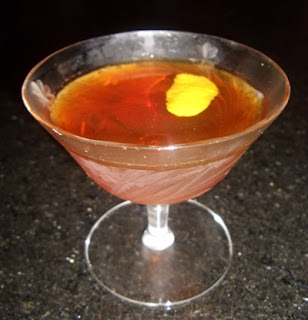
2/3 Brandy (1 1/2 oz Courvoisier VS)
2 dash Swedish Punsch (1/2 oz Homemade, Ellestad recipe)
2 dash Sweet Vermouth (1/2 oz Vya)
1 dash Picon Bitters (1/4 oz Amer Picon)

Stir with ice and strain into a cocktail glass. I added an orange twist.

Two Fridays ago, we started the evening with a drink from Pioneers of Mixing at Elite Bars: 1903-1933 called the Rocket. While rockets had existed since 13th century China, the rocketry in the news during the book's time period would revolve around Dr. Robert Goddard. While his tinkering with rocketry started when he was a student, Goddard acquired two patents in 1914 -- one for a rocket using liquid fuel and the other for a multi-stage rocket using solid fuel. Sadly, his 1920 report declaring the feasibility of landing a rocket on the moon was met with much derision from the press. The ridicule greatly effected him; however, it did not deter him from launching a liquid fuel rocket in 1926 amongst other later feats including launching scientific equipment to high altitude and working out guidance systems over 34 rocket launches and 214 patents.
I felt that the Rocket's recipe could use a citrus twist and I opted for an orange one to complement the Amer Picon, although a lemon one would work too to accent the Swedish Punsch instead. The twist thus started the drink off with an orange aroma that flowed into a darker orange flavor from the Picon coupled with the vermouth's grape in the sip. The Swedish Punsch's aged rum and funky Batavia Arrack notes paired well with the Cognac ones in the swallow, and the Punsch's spice and tea tannins rounded out the aftertaste.

libretto

1 1/2 oz Siete Leguas Añejo Tequila
3/4 oz Carpano Antica Sweet Vermouth
1/2 oz St. Germain
1/2 oz Cynar
2 dash Mole Bitters

Stir with ice and strain into a rocks glass.

For my second drink at Craigie on Main, bartender John Mayer proposed a drink that he had made for Christine of DudeKicker. Since she is a librarian, he called it the Libretto before he later realized that he had chosen the wrong Italian word. When I heard that the drink contained both St. Germain and Cynar, I instantly thought of the Scotch and dry vermouth-based Alto Cucina. Not only did John not know of that drink so as to be influenced by the recipe, the interplay of the two liqueurs ended up being rather different.
The Libretto met my senses with a tequila aroma over darker herbal notes from the Cynar. The sip showcased the vermouth's grape and the St. Germain's pear-like flavor; this was one of the few drinks where the floral aspect of St. Germain was less prevalent in the mix. The swallow mimicked the nose with tequila and Cynar notes, and this led into chocolate flavors at the end along with a lingering Cynar aspect. The sweetness from the liqueurs and vermouth rescued the balance from being harsh as things warmed up. In comparison to the Alto Cucina, the Libretto had less clear interplay between between the two liqueurs perhaps due to the Carpano Antica dampening the flavors.

Friday, December 16, 2011

magic wand malfunction

1 oz Citadel Reserve Gin
1 oz Becherovka
1/2 oz Lemon Juice
1/2 oz Maple Sugar Simple Syrup (1:1)
1-2 dash Jerry Thomas Decanter Bitters

Shake with ice and double strain into a coupe glass. Garnish with an orange twist.

Two Thursdays ago, Andrea and I ventured over to Craigie on Main after getting dinner at Veggie Galaxy in Central Square. For my first drink, bartender John Mayer suggested a curiously named cocktail called the "Magic Wand Malfunction." Of all things, yes, the name is a reference to a broken vibrator. I instantly recalled John's bio for the OnTheBar phone application that read, "If the drink is named after Texas, firearms, or sex toys, there's a good chance I created it." It turns out that John's wife is a sex ed teacher, so these topics come up as part of her work. Andrea asked John if there were other drinks named after sex toys, and John admitted that this was the only one. I told John that the name rivaled Bergamot's Beacon Fix which was not named for the drink style (it lacks the crushed ice and fruit garnish of a traditional Fix) but for a methadone clinic one of the bartenders walks by to get to work. The other curious part of the John's drink was one of the ingredients -- maple sugar syrup. Maple sugar is what is left after the tree sap is boiled down into solid form; while it retains maple syrup's warmth, it lacks its viscosity.
The Magic Wand Malfunction initially greeted me with orange and gin aromas that later gained spice notes from the Becherovka and perhaps the bitters. The lemony sip gave way to maple flavors on the beginning of the swallow. The later elements of the swallow contained the spice and herbal notes from the gin and Becherovka including a clove flavor that increased with successive swallows and soon began to linger. Overall, the Magic Wand Malfunction was rather smoothed out by the maple sugar at first; as it warmed up though, it turned into more of a gin drink.

in 2 deep

1 1/2 oz Reposado Tequila (Espolón)
3/4 oz Ginger Liqueur (King's Ginger)
1/2 oz Punt e Mes
1 barspoon Fernet Branca (1/8 oz)
2 dash Orange Bitters

Stir with ice and strain into a cocktail glass. Garnish with an orange twist.

The other drink we had two Wednesdays ago was the In 2 Deep from Left Coast Libations. The recipe was created by Kevin Diedrich who used to be the bar manager at the Burrit Room in San Francisco before moving on to Jasper's Corner Tap. We had not made this drink previously since our sample nips of Domaine de Canton were running low; however, I was quite impressed by the King's Ginger at the No. 3 Gin launch (perhaps even more so than the gin itself) -- impressed enough to buy a bottle. While that was the first time I tasted it neat, I was first introduced to the Scotch-based liqueur at Tales of the Cocktail this year via Jackson Cannon's Flip Royal. At a little over forty dollars a bottle, the King's Ginger is pricier than Domaine de Canton, but it packs more ginger punch and less syrupy sweetness.
The orange twist in the In 2 Deep dominated the nose at first until the oils dissipated and the tequila began to take over. The sip was a slightly sweet grape flavor that led into the Punt e Mes' bitter and the tequila's agave notes at the beginning of the swallow. Toward the end of the swallow, the tequila morphed into ginger, and lingering Fernet and orange flavors rounded out the drink on the aftertaste.

Thursday, December 15, 2011

corpse reviver #5

1 oz Blanco Tequila (Espolón)
1 oz Cocchi Americano
1 oz Pineapple Gomme Syrup (Homemade)
1 oz Lemon Juice

Shake with ice and strain into a cocktail glass. Garnish with a lemon twist and 2 dashes of absinthe (Obsello).

Two Wednesdays ago, I decided to make one of the late autumn recipes from San Francisco's Rickhouse that appeared in SeriousEats. The Corpse Reviver #5 is a tequila and pineapple take on the classic gin and orange liqueur Corpse Reviver #2. When I spotted that pineapples were on sale at the Harvest Co-op a few days before, I bought one and decided to whip up a large batch of pineapple gomme syrup so that I could make this drink.
The Corpse Reviver #5's aroma offered up the lemon oils from the twist, the herbal notes from the absinthe, and spicy vegetal notes from the tequila. The citrussy sip was a combination of the lemon juice and Cocchi Americano, and the swallow was the tequila melding with the pineapple syrup flavors. Finally, the drink's finish was a faint anise note from the absinthe garnish integrating into the drink.

buffalo

2/3 Rye Whiskey (2 oz Redemption)
1/6 Sweet Vermouth (1/2 oz Vya)
1/6 Maraschino (1/2 oz Luxardo)
1 dash Angostura Bitters

Stir with ice and strain into a cocktail glass. I added a Luxardo Maraschino cherry.

One of the recipes I had spotted in Pioneers of Mixing at Elite Bars: 1903-1933, the Buffalo, caught my eye because it reminded me a lot of a drink that was created 70-100 years later, namely the Red Hook. While the Red Hook generates grapey bitterness through Punt e Mes alone, the Buffalo has sweet vermouth and Angostura Bitters akin to a Manhattan. Although the drink could be named after the animal, it is probably a tribute to the city in New York State that had a large bar presence during the pre-Prohibition days and apparently stayed rather wet during the Ignoble Experiment.
The Buffalo began with a sweet maltiness that ensconced the funky Maraschino aroma. The malt continued into the sip where it paired with the vermouth's grape, and the swallow presented the Maraschino, rye notes, and Angostura's spice. Overall, the Buffalo was a little more sweet and spicy but less bitter and complex than the Red Hook. Furthermore, it came across perhaps a little closer to a rye Fancy Free than a Red Hook.

Wednesday, December 14, 2011

chaplin

3/4 oz Bourbon (Bulleit)
3/4 oz Dry Sherry (Lustau Dry Oloroso)
3/4 oz Ramazzotti Amaro
1/8 oz Cointreau
2 dash Orange Bitters (1 dash Angostura Orange, 1 dash Regan's)

Stir with ice and strain into a cocktail glass. Garnish with a lemon twist.

In the post about La Viña that I had at Hawthorne, I mentioned that it was Alex Day's riff on the Chaplin that appears in Robert Hess' The Essential Bartender's Guide. Since I had tried the variation, I was game to try the original that inspired Alex to create his recipe. Hess attributed the Chaplin to bartender Ben Dougherty at Seattle's Zig Zag Cafe, and he mentioned that at the time, it was "regularly one of their go-to drinks when a customer wants something just a bit different."
The lemon twist brightened the darker notes from the Ramazzotti and complemented the orange aromas in that amaro, the Cointreau, and the bitters. The sherry's grape and the Bourbon's malt mingled in the sip, and the barrel notes of the Bourbon began the swallow. The swallow then finished with bitter orange, cinnamon, and coffee-like flavors. Overall, the Chaplin was drier and more orange driven than the La Viña, and the La Viña came across as the more quintessential brown, bitter, and stirred drink.

schiphol

3/4 oz Bols Barrel Aged Genever
3/4 oz Amaro Montenegro
3/4 oz Aperol
3/4 oz Lemon Juice

Shake with ice and strain into a cocktail glass.

Two Mondays ago, Andrea and I had dinner at Estragon. While chatting with bartender Sahil Mehta, he mentioned that we had just missed him at Hawthorne the night before. There, he had the Paper (Air)Plane, a drink created a few years ago by Manhattan mixologist Sam Ross that was adopted as one of the first drinks on the Hawthorne menu. Sahil said that he was so taken by the drink that he came up with his own variation using barrel-aged Genever and Amaro Montenegro instead of Bourbon and Amaro Nonino, respectively. Given the aeronautical and Dutch themes, he dubbed this one the Schiphol after the airport in Amsterdam (which is where I was able to buy Bols Corenwyn during a layover on a business trip last autumn).
The Schiphol greeted my nose with an Aperol, lemon, and dark amaro aroma that coupled to make an almost grapefruit aroma like they did in the Paper Plane. The sip contained the fruit notes of the lemon and Aperol, and the swallow presented a malty and caramel flavor from the Genever and Amaro Montenegro. The swallow also contained a citrus pith-like note that I attributed as an interaction of the lemon with the Genever; moreover, as the drink warmed up, the Schiphol finished with herbal notes from the amaro and Genever on the aftertaste.

Tuesday, December 13, 2011

la viña

1 oz Rittenhouse 100 Rye
1 oz Lustau East India Solera Sherry
1 oz Amaro Nonino
1 dash Regan's Orange Bitters

Stir with ice and strain into a coupe glass.

For my second drink at Hawthorne, I decided to leave the small menu and delve into what else the bartenders had to offer. When I described a desire for a dark spirits drink, Scott Marshall conferred with fellow bartender Katie Emmerson, and Katie suggested a drink created by Alex Day called La Viña. From her time at Death & Co., Katie appears to have brought over a rich history and mental recipe book from the Manhattan cocktail scene. The drink she recommended was Alex's twist on the Chaplin as described in Robert Hess' The Essential Bartender's Guide:
Chaplin
• 3/4 oz Bourbon
• 3/4 oz Sherry
• 3/4 oz Ramazzotti Amaro
• 1/8 oz Cointreau
• 2 dash Orange Bitters
Stir with ice and strain into a cocktail glass. Garnish with a lemon twist.
I will have more to say later about the Chaplin for I made it shortly after. Alex described the La Viña in an article about seductive sherries as, "La Viña is boozy, but light to the Manhattan drinker. It's a rich combination of nut and raisin notes from the sherry, a slight orange-flavored bitterness from the amaro, and a peppery spiciness from the rye. It's a perfect drink for fall." Katie mentioned that Alex originally created the drink with Russell's Rye, but lacking that at Hawthorne, Scott opted for Rittenhouse.
La Viña offered up a rye aroma with a darker herbal note from the Amaro Nonino lurking behind it. The sherry's grape and the amaro's caramel provided a rich sip, and the whiskey notes and amaro's herbal aspect rounded out the swallow.