Showing posts with label *spiritsreview. Show all posts

Wednesday, December 7, 2022

:: rum tasting of raising glasses new releases ::

My friends John and Lorri have started a spirits importing company called Raising Glasses that has done some interesting single cask work in terms of Scotch and rum. On my last shift at Drink a few Saturdays ago, they arrived on the early side to bid me adieu and also gave me their recent rum bottlings to taste. These included a 15 year Barbados, an 8 year Trinidad, and a 9 year Guyana rum as well as a blend of the three to attempt a replica of British Navy-style rums.

The Barbados one entitled "Burning Cane" on the front and curiously "The Steel Donkey" on the back is a 15 year old specimen that they were careful to point out spent 11 years in Barbados before being aged another 4 years in the UK (which violates the proposed Barbados Rum designation that requires all aging and bottling to be on the island to be called Barbados Rum) in ex-Bourbon barrels. The rum was distilled from a molasses-based wash on both column and pot stills at the Four Square Distillery, and it was bottled at cask strength at 62.3% ABV. The Steel Donkey name was later explained as part of the island mythos in regards to cane burning. In a Glencairn glass, I got orange peel and balsa wood on the nose. Next, dried orange peel, caramel, dried fig, and ginger flavors came through elegantly on the palate.

The Trinidad one titled "The Guardians" is a 8 year old offering that spent 6 years on the island before spending 2 years maturing in the UK in used Bourbon barrels. The rum was distilled from a molasses-based washed on a column still at Trinidad Distillers Limited, and it was bottled at cask strength at 67.9% ABV. The name reflects the island legend of the River Mother and Forest Father who protect the environment. In a Glencairn glass, I got caramel, toffee, wood, and dried fruit akin to date on the nose, and after the addition of a few drops of water gained an apricot note. Next, caramel, wood spice, butterscotch, root beer, dried orange peel, and lemon came through on the palate.

The Guyana one entitled "Moongazer" is a 9 year old rum that spent most of that time in the UK instead of South America. The part that I was excited about is that this molasses-based wash was distilled in a wooden Versailles pot still. The rum has added caramel color as is traditional with many of the aged Demerara-style rums coming out of the Diamond Distillery (added at the distillery to the rum going into the barrel), and its proof was cut from cask strength of 62.7% ABV to 57.5% for bottling. The name reflects the local legend of a giant that roams the shoreline while gazing at the moon. In a Glencairn glass, I picked up cherry wood and cedar on the nose. Next, caramel, chocolate, and dried cherry fruit came through on the palate.

The final offering was the FTG Blend (with the 'F' for the Four Square Distillery instead of a 'B' for Barbados) that blended the three single casks above to replicate a British Navy blend. The final breakdown was 58% Barbados, 38% Trinidad for spice, and 4% Guyana for finish that was bottled at 62.5% ABV. Unfortunately, my bottle had two back labels, so I was not able to get a photo of the more attractive front label. In a Glencairn glass, I got pine wood, orange peel, and straw aromas. Next, caramel, chocolate, cola, dried fig, and clove flavors came through on the palate. 

For more about the Raising glasses project, read here. For more about these rums and where to buy them, look here.

Tuesday, November 24, 2020

second sip & :: virginia distillery courage & conviction whisky ::

2 oz Scotch (Virginia Distillery Co. Courage & Conviction Whisky)
1/2 oz Sweet Vermouth (Cocchi)
1/2 oz Cockburn Tawny Port (Sandeman)
1/4 oz Fernet Branca
2 dash Bittermens Mole Bitters

Stir with ice and strain into a cocktail coupe.
I was recently sent to review a bottle of Courage & Conviction, the new release from Virginia Distillery Co. I became familiar with the brand when I worked their booth at a Taste of Boston event in late 2017, and I was gifted a bottle of their Port Cask-Finished Virginia-Highland Whiskey (Batch 5) as a thank you present from their ambassador. While the port-finished whisky I received was a combination of Scotch single malt blended with their own single malt that they make in Lovingston, Virginia, the Courage & Conviction is a single malt of their own distillate and not a blend with imported ones. The blending was probably crucial back in 2017 for the distillery only started distilling in 2015, so their stock was only a little over two years old at most at that point. This new release was inspired by the guiding principles of their founder, Dr. George G. Moore, to "have the courage of your convictions," and the batch was dedicated to Dr. Jim Swan who consulted with the distillery and guided them with their distillation and cask maturation strategies before passing away in 2017. Here, Courage & Conviction is a Virginia single malt whisky aged in used Bourbon, sherry, and cuvee casks.
Virginia Distillery Co. Port Cask-Finished Virginia-Highland Whisky (Batch 5, 2017)
Nose: A dry peat without much smoke, cherry, chocolate, and toasted wood.
Taste: Plum, hint medicinal, caramel, chocolate.
Finish: Cherry, chocolate, cinnamon.

Virginia Distillery Co. Courage & Conviction (Batch: Dr. Jim Swan, 2020)
Nose: Apricot, nutty, toasty, freshly shaved oak.
Taste: Orange, nectarine, cedar.
Finish: Chocolate, medicinal, red fruit.

Overall, the Courage & Conviction was a much more refined spirit than the one that they produced three years prior. It came across as softer and more finished of a spirit showing that the distillery is indeed heading in the correct path as their own products are maturing on site.
For a drink to mix this whisky, I selected from my notes a recipe on the Bittermens website. A few years ago, Avery and Janet Glasser challenged Brian Miller at Death & Co. to make a Scotch, Fernet, and bitters cocktail, and the Second Sip was what he came up with. The combination reminded me of a Chancellor with the whisky, port, and vermouth elements, but here, there was the addition of Fernet Branca to made for a bit more aggressive of a tipple (which I also attempted to do in the Preceptor using other amari). In the glass, the Second Sip donated a grape, malt, and menthol aroma. Next, grape and caramel swirled on the sip, and the swallow showcased whisky, dried fruit, and briny flavors with a menthol finish.

Sunday, April 12, 2020

:: four roses small batch select ::

Last week, I received a package containing the new Four Roses product, Small Batch Select, as well as a sample of the regular Small Batch. Normally, I rather infrequently do spirits reviews on here, but I gave the go-ahead on this sample delivery since I figured that it would give us something to do during our time in quarantine. The Small Batch select is the first permanent addition to the Four Roses lineup since 2006, and it makes the fourth "rose" or permanent bottling option. The Select varies from the regular Small Batch by being at a higher proof (104° instead of 90°) and eschewing chill filtering. While both are mixes of 6 and 7 year old Bourbons and each contains the lower and higher rye mash bills (75/20/5 and 60/35/5), there was a difference in the yeast strains selected of the five: the Small Batch that I was sent opted for ones that produce robust fruitiness and slight spice character (yeast strains O and K, respectively), and the Select utilized delicate fruity flavor, light herbal essence, and the same slight spice character strains (yeast strains V, F, and K, respectively). I tasted these two samples against my bottle of Four Roses Yellow Label -- a circa 2019 80° bottling that is a mix of Bourbons that are around 5 years of age and generally consist of both mash bills and all five yeast strains (10 types in total although sometimes four yeast strains for 8 types in total). Not included in this tasting was their single barrel offering of a single mash bill-yeast strain combination generally aged longer and bottled at 100°. Here, I chose a Glencairn glass, did not add any water to the samples, and performed the tasting alongside Andrea, my wife and quarantine-mate.
Four Roses Yellow Label - circa 2019, 80 proof, chill filtered, around 5 years, 5 yeast strains-2 mash bills.
Nose: apple, pear, caramel, woody in a cedar way.
Taste: caramel, toffee, vanilla, clove, mint, allspice.
Four Roses Yellow Small Batch - 90 proof, chill filtered, a mix of 6 and 7 years, 2 yeast strains-2 mash bills.
Nose: maple, pear, softer wood notes akin to balsa.
Taste: Toffee, caramel, butterscotch, currant, mint, clove, cinnamon, vanilla on the finish.
Four Roses Yellow Small Batch Select - 104 proof, non-chill filtered, a mix of 6 and 7 years, 3 yeast strains-2 mash bills.
Nose: Caramel, raspberry, vanilla, wood in a pine and cedar way.
Taste: Caramel, toffee, melony soft fruits like pear and apricot, vanilla, mint, clove, allspice.

Overall, the Small Batch Select had more in common with the Yellow Label's flavor profile than the regular Small Batch did; however, it had an extra level of age (caramel richness and vanilla presence) and finesse over Four Roses' entry level product. While Andrea picked the Small Batch as her favorite, I leaned towards the Small Batch Select as the winner here.

Wednesday, October 16, 2019

peachy keen

1 1/2 oz Bruichladdich Port Charlotte 10 Year Scotch
3/4 oz Lemon Juice
3/4 oz Giffard Crème de Peche
1/4 oz Cinnamon Syrup
1/4 oz Honey Syrup

Dry shake, pour into a double old fashioned, fill with crushed ice, and garnish with dashes Angostura Bitters, mint sprigs, and a peach slice.

Two Wednesdays ago, I ventured down to the Hawthorne to hear Bruichladdich's head distiller Adam Hannett present a talk entitled "Experience Octomore." Adam spoke about how the site in Islay was a purpose-built distillery founded in 1881 opposed to a farm-based one, and this distillery produced single malts for blends until it was mothballed in 1994. A group of whisky industry professionals had a vision of exploring the local terroir and striving for quality over quantity, and they were able to acquire the site from Jim Beam. The goal for Bruichladdich was to feature both unpeated and peated whiskies as well as to make parallel whiskies from barley sourced from local Islay barley farms as well as bulk barley sourced from the whole of Scotland. The conditions in Islay are tougher to grow barley, but the end result is more flavorful despite the lower yield of fermentable sugars by weight and the higher cost to grow the crops. With their Octomore product, they asked their malt company for a large shipment of peated malt that would be used as the only barley source. The malt company was concerned that there would be no consistency since the result varies by season and by batch; normally the level of peat smoke phenols is modulated by diluting it with unpeated malt. With this approach, Octomore became the world's most smoky Scotch through keeping the proof near cask strength, skipping chill filtration, and leaving out unpeated malt. What we got to taste were three variations of this 10th season of Octomore with my favorites being tied between 10.3 using local farmer James Brown's barley and aging for 6 years in first filled American whiskey casks and 10.4 using Scottish barley and aging for only 3 years in virgin French limousine oak casks. Indeed, 10.3 highlighted the beauty of the barley grown in tougher conditions on a single estate, and 10.4 had loads of dried fruit such as date and fig notes from the new French barrel.
Before Adam spoke, Hawthorne bartender Rob Ficks was making drinks from a small menu utilizing some of Bruichladdich's other offerings. The one I selected was the Peachy Keen subtitled "and I won't forget." Here, the Port Charlotte whisky's peat mingled with the mint on the nose. Next, the sip was an elegant malt, peach, and lemon combination, and the swallow hit the palate with peat smoke and peach flavors with a cinnamon finish.

Monday, July 13, 2015

:: boston harbor distillery ::

About two weeks ago, I was invited by the IndustryPress to take a tour of the new Boston Harbor Distillery. Since I have known co-proprietor Corey Bunnewith since his days as a bartender from Drink onward, I was definitely interested in attending. The distillery itself is on the south shore of the Harbor and visible from the I-93 as you head south of the city. The building itself has had a lot of history since it opened in 1859. First, it was the S.S. Putnam Nail Factory that produced nails including for horse shoes to both sides of the Civil War. Later, it became George Lawley ship builders and then part of the Seymour's Ice Cream dynasty -- the company the created the Nutty Buddy. To reflect the building's time line of land, sea, and confection, all whiskey products will pay respects under the Putnam line, rum and anything coastal with the Lawley line, and liqueurs via Seymour's. For a still, the distillery has a 150 gallon Vendrome with 6 plates, with a second, larger 250 or 500 gallon still from the same company to be ordered shortly. The still itself is run by John Couchot who besides working for various breweries such as Dogfish Head has also worked at Rogue where he helped with their distilled products line.

The Putnam Whiskeys that they were aging were a classic rye with 95.5% of that grain in the mashbill and a single malt whiskey that utilizes, beside a 2 row barley, chocolate roasted malts to add deeper, richer flavors that are often seen in amber and darker beers. With these spirits, they are trying to capture the essence of New England whiskey by grain and brewing styles. The rye that I tried had been aging for a month and was around 118° instead of the future bottling proof of 86°. At such a high rye content, it had plenty of spice from the grain and caramel from the new #4 char barrel. Next, in honor of the maritime past, the Lawley line has sugar cane spirits. To make it more New England, Vermont maple syrup is added to the ferment; however, this prevents the distillate from ever being called rum. Instead, they have branded it a New England spirit. Unaged, this maple gives a roundedness to the sugar cane, and in the barrel-aged sample, it complemented the woody spice. The third line is the Seymour's with the liqueurs, and here the maple syrup really shines. Their coffee liqueur using a white rye whiskey base and cold brew of New Barrington coffees is sweetened by maple syrup. Moreover, the maple lends an elegance to the mid-palate. Also connecting to the ice cream magnate, the rickhouse is in the old ice cream warehouse, so perhaps they will be able to tap into the architecture and design for better control during aging.
One of the product lines that I found most interesting was a collaboration set up by another of Boston Harbor Distillery's proprietors, CEO Rhonda Kallman. Tapping into her long history with Boston Beer Company as one of the co-founders of Sam Adams back in the mid 1980s, they are distilling Sam Adam beers into hopped whiskeys. Taking Sam Adams New World Belgian-style Tripel, the distillery made a hopped eau de vie that expressed both the hops and grain. While I tasted it at 120° instead of the bottling 86° strength (essentially 6-fold more concentrated than the approximate 10% starting beer strength), the nose offered darker malts and resiny floral hops aromas. While other beer whiskeys exist such as Aventinus, it is great to see a local connection to this style.

Please visit their website to learn more, and perhaps visit the distillery itself!

Sunday, December 22, 2013

absinthe drip

The theme for this month's Mixology Monday (MxMo LXXX) was picked by Nick of The Straight Up blog. The theme he chose was "Anise," and he elaborated on the theme with his description of, "While I had a few ideas I've been kicking around for this months theme, ...I ultimately decided on one of my favorite flavors: anise. Although great any time of year, there is something about colder weather and the holidays that really sets my anise fetish into overdrive. While past MxMos have seen a few specific sources of anise, such as pastis and absinthe, I wanted to open things up to anything anise flavored, the more unique the better. Most folks have something with anise notes laying around, whether it's absinthe or pastis, ouzo, Genepe, even Green Chartreuse, Peychaud's, Raki, etc. Maybe get creative and make something tasty with some star anise, like a syrup, infusion or tincture. Show us that riff on a Sazerac or Improved Holland Gin Cocktail that you love, or create something entirely new."

I originally wanted to do a drink that used Peychaud's Bitters as a base spirit, but there were few save for the Gunshop Fizz that came to mind that I had not tried yet. And I did think of recreating a Sazerac in Tom & Jerry format, but I recalled that I had already written about the Sazerac Toddy. Next, my mind drifted over to the bottle of Butterfly Absinthe that had been sent to me and I considered doing an Absinthe Suissese, but I got bogged down over picking the right recipe as to whether it had crème de menthe, orgeat, cream, egg white, orange blossom water, or other. The earliest recipe I found was in Maloney's 1900 The Twentieth-Century Cocktail Guide for Mixing Fancy Drinks but it was just absinthe, orgeat, and egg white. With such a minimalist recipe, I decided to take a step further back and go with an Absinthe Drip.
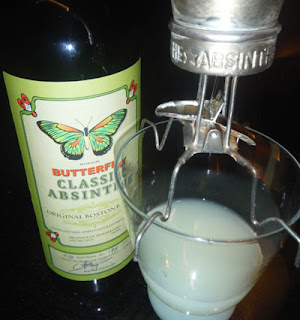
Over the course of a few events through the last 14 months or so that have included a pre-Boston Cocktail Summit Origin Spirits tasting event, Whiskey Live, and Boston Thirst, I have had the honor of meeting the people behind Butterfly Absinthe. The spirit is a recreation of 1902 Boston recipe that benefits today from the elegance of modern day Swiss absinthe producers. The ingredients list are historically the same with wormwood, hyssop, melissa, peppermint, anise, star anise, fennel, and citrus, but no sample of the original of the early 20th century product has turned up to confirm the flavor profile. I was quite pleased when they decided to send me a sample of the absinthe for review and delighted when they also included a pair of absinthe glasses as well (one pictured above). The glasses have a mark for an ounce and a half pour of absinthe and I was able to determine where the 4:1 and 5:1 dilution marks would lay. While we do not own a fancy absinthe fountain, Andrea did purchase a rather mesmerizing absinthe balancier years ago -- a similar one tick-tocking away can be seen here in action on Youtube. Since most modern quality absinthes do not require any sweetener, I skipped the sugar cube and instead filled the balancier with crushed ice. I added ice water until the desired 4:1 dilution was reached in the glass.
Absinthe Drip
• 1 1/2 oz Absinthe (Butterfly)
• 6 - 7 1/2 oz Ice-chilled Water (6 oz)
Slowly add ice water to the absinthe in a glass.
With the 4:1 dilution, the 130 proof spirit was decreased to 13% ABV, the approximate strength of many wines, and it gained a beautiful louche. Our tasting notes included anise, fennel, licorice, mint, lemon, and wormwood, and the low proof and clean spirit was definitely gentle enough to drink even without sugar added. With the sugar, the drip would be the simplest of classic cocktails for the spirit, bitters, and water are already in the mix.

Thanks to Nick for hosting this month's spiced event, and cheers to all the rest of the Mixology Mondayers for keeping the lifeblood flowing!

Monday, March 11, 2013

:: 86 company spirits ::

[Brava Daiquiri]
2 oz Eighty Six Co. Caña Brava Rum
2/3 oz Grapefruit Juice
1/3 oz Cinnamon Syrup
Few drops Herbsaint
1 dash Angostura Bitters

Shake with ice and strain into a rocks glass.

Two Wednesdays ago, Simon Ford was in town for the launch of The 86 Company's spirits line that he helped to found. For the launch, they had four products to showcase -- a gin, a rum, a tequila, and a vodka -- each produced in collaboration with a different well-respected distiller. The event was spread out over three destinations with each bar featuring one of the spirits (with the vodka one being left unaccounted for except at the tasting), and in between each leg was a 80s-themed party bus that took us from the Hawthorne to Drink and from Drink to Brick & Mortar. The event started at the Hawthorne with a tasting of the four spirits followed by classic gin cocktails. Here are my notes from the tasting:
Fords Gin - Simon's namesake gin was produced in collaboration with the distiller at Thames Distillers in London. In the botanical mix besides juniper are corriander, bitter orange peel, lemon peel, grapefruit peel, jasmine flowers, orris, angelica, and cassia, and their website in a brave degree of honesty actually lists the percentages of each botanical by weight in the infusion. On the nose, the gin reminded me a lot of Bombay Sapphire, No. 3, and Nolet's gin due to angelica or orris in conjunction with the juniper. At first the gin was rather earthy and low in citrus when tasted neat; however, after adding a splash of water to this 90 proof spirit, grapefruit peel and cinnamon suddenly became quite apparent.
Aylesbury Duck Vodka - This spirit is made from white winter wheat grown on small farms in western Canada and is distilled to 193 proof before being diluted for bottling at 80 proof. Yes, it was vodka, but it was not absolutely flavorless and I enjoyed the light grain notes when tasted neat similar to that in Russian Standard. A few did not enjoy that like I did, but the biggest complaint was a glycerol sweetness and body aspect to it. Compared to a pot stilled spirit, it was slight and I did not really have a problem with this.
Caña Brava Rum - The rum was made in conjunction with Panamanian distiller Francisco "Don Pancho" Fernandez who is also the maker of Ron de Jeremy. The 86 Co. sought him out for his experiences of making rum in Cuba before Castro and they wanted to make a Cuban-style white rum that would be perfect for Daiquiris. The end result is a rum made from wild sugar cane grown on volcanic soil in Panama, aged up to three years in wood, blended, and stripped clean of color through charcoal filtration. I was hoping for something grassy like I had heard old Cuban rums were, but instead the sugar cane notes were more subtle in this smooth and clean white rum. The vanilla notes from the barrel aging were there but not as robust as say El Dorado 3 Year. Bottled at 86 proof.
Tequila Cabeza - For all that I found the rum to be on the subtle end of things, the tequila was quite the opposite. The spirit was produced in the Los Altos region of Jalisco, and the Vivanco family opted for cooler, slower winter fermentation to bring forth this extra flavorful style. I enjoyed the spirit for it had more vegetal and fruity notes to it as opposed to many of the tequilas that are on the market. Also bottled at 86 proof.
Besides the tasting at the Hawthorne, bartenders Katie Emmerson and Nicole Lebedevitch were mixing up cocktails with the gin. Before the tasting, Jackson Cannon offered me a gin and tonic which was good but hid the gin a bit too much to make a decent call. For a cocktail later, I chose a Martinez and the gin worked well to add extra spice and citrus notes to the mix. I think the gin will appeal the No. 3 and Nolet's crowd more so than the Beefeater or Plymouth set.
After the Hawthorne, we loaded up onto the party bus and traveled to Fort Point to have punch and cocktails made by the Drink crew. The Don's Mix-laden Daiquiri of sorts that I tried was crafted by Josey Packard; perhaps it was closer to a Donga Punch. The cinnamon on the nose led into a sweet grapefruit sip. Next, the swallow offered rum, cinnamon, and spice.

Thursday, December 27, 2012

tangier nights

2/5 Caloric Punch (1 oz Kronan Swedish Punsch)
2/5 Courvoisier Brandy (1 oz Pierre Ferrand 1840 Cognac)
1/5 Cusenier White Crème de Menthe (1/2 oz Tempus Fugit)

Stir with ice and strain into a sherry glass (small cocktail glass).

Two weeks ago, I spotted Tempus Fugit's crème de menthe at Ball Square Fine Wines in Somerville. I had been waiting for a quality crème de menthe for a while as a savoir from the bottom shelf bottles, so I gladly snagged a bottle. For tasting notes, it was more subtle than expected; indeed, it was more herbal with natural peppermint and spearmint notes and less of an intense, almost synthetic extract flavor that is common in many of the other brands. For a cocktail to put it use, I looked through the Café Royal Cocktail Book and found the Tangier Nights. The recipe was an original created in the 1930s by UK Bartender Guild member Freddy Janowitz and looked like a Stinger that was enhanced by Swedish Punsch.
tempus fugit creme de menthe cocktail recipe
The Punsch's rum joined the liqueur's mint on the nose. A smooth sip led into brandy, mint, and the Punsch's tea on the swallow. As it warmed up, the Tangier Nights became a little sharper and more Batavia Arrack-driven on the finish; perhaps serving this drink on crushed ice like the Stinger might help to reduce this effect.

Wednesday, November 28, 2012

the cross & the switchblade

1 oz Puerto Rican White Rum (Caliche)
1 oz Dry Vermouth (Noilly Prat)
1/2 oz Lime Juice
1/2 oz Crème de Cacao (Marie Brizard)
2 dash Bittermens Burlesque Bitters

Shake with ice and strain into a coupe glass.

Two weeks ago, the Liquor Fairy gifted me a bottle of Caliche Rum, an aged white rum from Puerto Rico. The rum is made by the Serrallés Distillery that also makes Don Q and Blackbeard Spiced Rums; it was created in a partnership between nightlife entrepreneur Rande Gerber and Roberto Serralles, a sixth generation rum producer from Destilería Serrallés. For the aging, they use a solera system with the oldest rum in the mix being about 5 years old, and the color is then stripped away via charcoal filtration. For a price point, the rum seems to be selling for around $20.
Caliche Rum
• Nose: Vanilla, coconut.
• Taste: Coconut, lime, woodiness.
Overall, the rum had a lot more flavor than I first imagined since the PR materials stressed that it was a superpremium spirit (which often means distilled to a higher proof to rid the liquor of its natural flavor); perhaps a little less complex than some of the white rums in my collection but still more flavorful than the Don Q White Rum they also produce.

In searching for a recipe that calls for white rum without drowning out the rum with a dozen ingredients Tiki-style, I got a little frustrated. Therefore, I decided to craft a drink that works well with the rum's flavor profile. My idea was to cross a Scofflaw with a White Witch. Instead of the orange bitters in the Scofflaw, I opted for the spicier and floral ones in the Bittermens Burlesque Bitters. Keeping true to the Scofflaw theme, I thought about Puerto Rican street gangs such as the Mau Maus from New York during the 1950s; moreover, the film about them, The Cross and the Switchblade, seemed like a great name for this cocktail.
caliche rum puerto rico rican cocktail
The Cross and the Switchblade offered a lime, cacao, floral, and grassy aroma. The lime and coconut-tinged sip led into a chocolate and rum swallow. Finally, the bitters' spice and heat on the finish rounded out the drink.

Tuesday, October 30, 2012

a sainted devil

3/4 oz Blanco Tequila or Mezcal (Piedra Azul Blanco Tequila)
3/4 oz Cherry Heering
3/4 oz Fernet Branca
3/4 oz Orange Juice

Shake with ice and strain into a cocktail glass.
In thinking about how well Fernet Branca and Cherry Heering complement each other such as in Sahil Mehta's South End Sling, Misty Kalkofen's Darkness til Dawn, and the classic Pinto, I wondered how I could utilize this combination in other ways. My mind wandered to another Cherry Heering drink, the Blood and Sand, and I figured that a hybrid of these ideas might prove interesting. Keeping the cherry liqueur and orange juice constant, I swapped the original's sweet vermouth for Fernet Branca. For a spirit, I was thinking agave. While I might have reached for mezcal, the liquor fairy had delivered a bottle of Piedra Azul tequila that I was interested in trying out.
Piedra Azul Blanco Tequila
• Nose: citrus, a light pineapple note, mineral/briny aroma.
• Sip: Lots of body with light citrus flavors.
• Swallow: Agave with a hint of smoke.
• Price: around $19/750 mL.
• Overall Assessment: Not a showstopper, but definitely a solid blanco for the price point.
For a name, I searched for other Rudolph Valentino movies besides the Blood & Sand, and I picked his 1924 film A Sainted Devil. The drink began with tequila and Fernet Branca aromas with a hint of cherry. The cherry continued on into the sip where it paired with the orange. And the swallow rounded off the drink with agave and Fernet Branca flavors. Overall, the orange juice mellowed out the Fernet Branca and tequila and made for an easier drinking libation.

Wednesday, October 17, 2012

:: turkey shore distillery ::

The other distillery I visited in Ipswich after Privateer yesterday was Turkey Shore Distillery located right next to the Mercury Brewing Company, makers of Ipswich Ale, and soon they hope to take over the Mercury's space when Mercury finishes with their new brewery.

One of the undercurrents with GrandTen and Privateer was a connection to history to the current distillery space, familial links to old distillers, and/or the area as a once active spirits producer. Here, one of the two owners of Turkey Shore, Mathew Perry, took it a step further by going to college as a history major and making a career out of being a history teacher before deciding to become a distiller. Mat and the other owner, Evan Parker, are childhood friends and they grew up on the same street, Turkey Shore Road. Between their two houses on the shore of the Ipswich river are the remnants of a late 18th to early 19th century rum distillery run by John Heard including the wharf where ships docked and a low grade slope to transport barrels of molasses off ships and into the distillery. Once the idea to open a micro-distillery came about, they took an interest in their childhood neighborhood's history. The two took some time to research the layout of the old distillery and chose equipment to mimic what this old distillery had.
Evan gave me a tour of the still they had custom made to recreate what the Heard Distillery utilized. While the still has the appearance and most of the functionalities of a classic pot still, the rising part of the swan's neck contains 4 plates to add a modern column aspect to it. For further purification and historic recreation, they installed a thump barrel which acts to pull of oils and other impurities. While thump barrels are more associated with whiskey, the Heard distillery had one, and Mat and Evan surmise that the Heard distillery made whiskeys out of local grains in addition to their main product of rum. Both the thump keg and the barrel containing the condenser worm came from the Mercury Brewing through a circuitous route starting in Spain followed by a Scotch producer and then the Sam Adams brewery.

For the fermentation, Turkey Shore uses pure molasses to recreate the historic rums back when sugar would have been too expensive to use. As for a yeast strain, they opted for a rhum agricole one from the French isles based off of the flavor profiles they achieved. One down side of using a Caribbean yeast is that instead of the 60-70°F ferments with other yeasts, they need to heat and maintain the molasses wash at 90°F to keep the yeast happy. For aging, the rum is stored in new 15 gallon barrels for 6-12 months. Since the barrels are all new and sourced from the same cooperage, blending in easier since there is less barrel-to-barrel variation. Blends are a combination of 8-9 barrels with some newer ones for spice notes and some older ones for more mellow flavors.
One thing that I found interesting when I tasted their white rum was that it had overlapping butterscotch-toffee notes as their aged Tavern Style Rum (reviewed previously) did. Evan broke their rum's flavor profile into three parts: the yeast which creates floral and vanilla notes out of the molasses, the molasses which donates sugary and caramel notes, and the barrel which contributes butterscotch and tobacco notes. Their Ipswich White Cap Rum is filtered in charcoal, but I did not inquire if it is barrel aged as well. Their two other rums that I tried are seasonal spiced ones. Their Greenhead Spiced Rum is unusual with green tea, lemongrass, and spearmint and was designed for spring and summer mixing. Their fall and winter one, Golden Marsh Spiced Rum, is more traditional with a few unique spices like peppercorn.

Mat summed up their operation by comparing it to Nantucket Nectar's Tom and Tom; they are two friends producing a product. And here, they are trying to recreate something that was lost to the region.

:: privateer rum distillery ::

While at the Boston Cocktail Summit, I met a handful of distillers with several of them being from local distilleries. Two of them, namely Privateer and Turkey Shore, were not only enthusiastic about me visiting but were pretty close to each other in Ipswich, MA, and suggested that we coordinate a double visit.  So yesterday, I hopped on the commuter rail and headed north.

The last distillery I visited was GrandTen in South Boston. It was interesting in comparing and contrasting each distillery's angle on their product. For example, one of the two people behind GrandTen is a classically trained chemist, and the way that they perfected each round of prototype gins definitely had a focused, scientific way about it.

The distiller for Privateer is Maggie Campbell, and her initial classical training was getting a philosophy degree. She traced her interests in distilling to prior to graduation; when she was 20, she visited the Oban distillery in Scotland and became fascinated by the tour. After college, her life path took her to wine school in Denver to become a sommelier, which definitely paid off later in training her nose for shaping her spirits. She found a job at a boutique beer and store, and when she suggested that they also sell spirits, it became her job to research what they should carry. As she got into home brewing, she began writing people for advice about books about beer and spirits. Her email correspondence with the Germain-Robin distillery paid off for there was soon an opening for an assistant distiller, and she worked there for nearly a year. The owner of Privateer Rum, Andrew Cabot, was in need of a distiller who could take their product to the next level, and when he contacted Germain-Robin for a recommendation, they suggested Maggie.

From a historical side, Andrew traced his lineage back to another Andrew Cabot who was a rum distiller and was also involved in privateering activities during the Revolutionary War period.  His ancestor's distillery was in nearby Beverly, MA.  While I did get to meet Andrew at the Boston Cocktail Summit, he was away on business during my visit.
Although there are other products in the works, Privateer has two main offerings, their silver and amber rums. The silver is made from evaporated cane juice and brown sugar with the former having apple and fruitier notes and the latter having some molasses-like ones; skipping molasses proper for the unoaked rum provides for a smoother spirit since molasses takes quite some time in the barrel to tame. The silver rum is treated like an eau de vie on the still to bring out more aromatics and delicate notes. The amber, on the other hand, is made from molasses and brown sugar; the molasses is an early pull than black strap so it has figgy and softer flavors instead of a darker, raisiny one. For the amber, the still is treated as if it were a whiskey run. Maggie's approach has changed the rum from where it was with the previous distiller, and from my tasting, it seems to be for the better. Months ago, I remember tasting the old silver rum, and I recall more tropical fruit notes; the current silver rum reflects that eau de vie technique and the rum contains more orchard fruit notes including apple and quince. While I did taste the amber back then, my mental notes were not strong enough to describe how the new amber rum has changed, but indeed, both were quite well done.

For ferments, the methodology is long, cool, and slow to create deeper and richer flavors and to minimize as much of the aromatics from being carried off with the carbon dioxide. While 24 hour to 3 day ferments are common in rum, Privateer's product takes a full 7 days. For a yeast, they use a European yeast strain that the original distiller selected from Scotland. The still, pictured above has the capability of being run as either a pot or a column still; the first or stripping run is done solely as a pot and the second or spirit run uses the hybrid pot-column.
One thing that Maggie spoke about was the art of élevage or the art of aging wine. Privateer uses a wide variety of barrels including second fill Bourbon and third fill brandy barrels, and the end product is an artful blend to reach the desired flavor profile. I found it interesting how Andrew, the owner, requires Maggie to devote 20% of her time to experimentation whether it be ways of improving the current products or creating new ones. One of the interesting ones that she spoke of was a single barrel experimental series using various wild and cultured yeast, with the wild yeast being collected from interesting geographical and agricultural regions.

Friday, October 12, 2012

:: single malt & scotch whisky extravaganza ::

Last night, I had the privilege of attending the Scotch Malt Whisky Society's Single Malt & Scotch Whisky Extravaganza held at the Taj Mahal here in Boston. Right after arriving and receiving a booklet of the whiskies that would be tasted later, a tasting glass, and a token for cigars, I headed downstairs for a question and answer forum. At the door, I was asked the rhetorical question of whether I would like a dram of Aberfeldy 21 to sip while at the forum.

Besides the booklet and other goodies, they handed out cards to submit questions so that the audience could ask the panel of six brand ambassadors and one whisky guru. The questions they received were on everything from the basics to advanced questions about the future pricing market for rare whiskies. Here are the questions that I found of general interest:

What differences are there in peat?
There is peat growing through out the world. In Massachusetts, there are large fields in North Adams, and the largest fields in the United States are in Minnesota. The Irish have peat that they will sometimes use for their whiskeys. Basically, peat is the flora that lives, dies, and decomposes. When visiting a distillery, see what is growing around it. In the Highlands, this is coniferous trees, on Islay this is seaweed, and in Orkney this is heather. Indeed, geography has a big influence on the peat and thus in the whiskey, for the germinated wet barley will soak up these notes like a sponge from the peat smoke.

How to develop a nose?
• Taste/smell whisky frequently.
• Taste in a flight. Comparison and contrast will help to bring out extra flavors. Also, go back and taste the first whisky again at the end to shed new light on it.
• Start with simple notes like smokey and fruity before trying to break it down to what type of smoke or whether it is green apple or lemon. Learn to develop a vocabulary.
• Trust your instincts, and have confidence even when your notes betray what is written.
• Like people have a dominant eye, there may be a dominant nostril. Do not be afraid to plug one up and then the other. For example, some pick up sweeter notes from one and spicier notes from the other.
• Sometimes a little water will help bring out extra aromas.

What exactly is the grain whisky in a blend contributing?
In a blend, the grain whisky is contributing to the mouthfeel and the single malt to the spicier flavors. Often it is 40% single malt and 60% grain whisky. Grain whisky is made more efficiently, but it has its own character and complexity. 93% of all Scotch is a blend with Dewars and Famous Grouse being the top sellers in the United States and Scotland, respectively.

For tasting, I tried 24 different Scotches. One of the most interesting experiments was tasting the whole Glenmorangie series. I stayed at the table since the brand ambassador seemed excited to showcase the original 10 year as well as the same Scotch then aged for additional 2 years in other barrels.
Glenmorangie 10 Year - Floral aroma of honeysuckle. Soft with citrus notes, especially lemon, on the taste.
Glenmorangie Lasanta Sherry Cask 12 Year - Raisin notes on aroma. Walnut and toffee flavors.
Glenmorangie Quinta Ruban Port Cask 12 Year - Manadarine orange and sandlewood spice aroma. Chocolate and walnut flavors.
Glenmorangie Nectar d'Or Sauternes Cask 12 Year - Coconut and vanilla aromas. Creamy and lemon flavors with a ginger spice finish.
I was surprised at how much I enjoyed the port one, and I was pleased to have tried a Sauternes one for it was a novel cask finish for me.

Some of the most intriguing Scotches of the night were at the Scotch Malt Whisky Society's table. Alan Shayne, president of the society, traced back the group's history 30 years when Pip Hill founded it in Edinborough. Pip gained an intense interest in single cask, single malt whiskies as opposed to batched, chilled-filtered, and diluted ones. Some of these nonfiltered single casks had some unique character to them that needed to be celebrated. Throughout the night, I tried all five of their offerings that ranged from light Lowlands to intense coastal ones. Each of the cask bottlings had unique names like Laundry in the bakery, Burnt granary toast with bramble jelly, and Seaweed, sushi, and Arbroath smokies. Of all the whiskies I tasted that night, these five examples had the most discernible aromatic and tasting notes per spirit. Indeed, the complexity in these single cask nonfiltered offerings was truly stunning.

Thursday, October 4, 2012

:: origin tasting event ::

Good morning and welcome to the Boston Cocktail Summit!  Yesterday were a pair of greeter events, the Origin Beverage Company fall portfolio tasting during the afternoon and the SpeedRack competition at night.  I am going to give my highlights to the tasting events before I run off to catch my bus to hear David Wondrich's "Greasing the Hub" talk.  These are new to me spirits that stood out.

Delirio Reposado Mezcal - While their joven was good, their reposado had fruit, vanilla, and smoke notes in harmony on the smell and swallow.
Clandestine Absinthe - Perhaps not new to me since I had a taste back in 2009 at Tales of the Cocktail, but my first formal Boston taste.  Peppermint and anise notes; like St. George's Absinthe, the other botanicals diminish the anise-fennel dominance in a pleasant way.
St. George's Single Malt - Speaking of their distillery, I had not tried their whiskeys.  They approached their single malt like a beer by selecting roasted barley for richer flavors and aromas.  Smoke was present from alder and beech but was not dominant.  Apparently aged in used Bourbon, port, and sherry casks and French oak casks, but such nuances were lost in my small tasting dram in a big plastic cup.
Uprising Whiskey - Also a beer-driven brew process to proceed the distillation, the Sons of Liberty Distillery in Rhode Island made the mash like an unhopped stout so the roast notes came through. Unique.
Imbue Vermouths - There were two that I tasted and both were as good as I had heard. The Bitter Sweet was Lillet Blanc-like but with a well-balanced chamomile and tangerine notes on a Pinot Gris-base.  The Petal & Thorn took it up a notch with bitter notes though; chamomile and orange on the front with a bitter wormwood-cinnamon like finish.


Tuesday, August 28, 2012

superior

1/2 Rum (1 1/2 oz Old Ipswich Tavern Style)
1/6 Apricot Liqueur (1/2 oz Rothman & Winter)
1/6 Sweet Vermouth (1/2 oz Cocchi)
1/6 Lemon Juice (1/2 oz)

Shake with ice and strain into a cocktail glass.
After the Barefoot in the Dark, I decided to make the Superior from William Boothby's 1934 The World's Drinks and How To Mix Them. The drink reminded me of a less citrussy and more grape Periodista so I was definitely intrigued. For a rum, I reached for my new purchase of a local rum made up on the North Shore of Massachusetts, namely Turkey Shore Distilleries' Old Ipswich Tavern Style Rum (they also make a white rum as well). The rum had garnered a lot of praise from reviewers as well as local picky spirits mavens like Deep Ellum's Max Toste, so I gave the rum a chance without having tasted it. Here are my tasting notes:
Old Ipswich Tavern Style Rum
• Aroma: caramel, toffee, butterscotch
• Sip: sweet and rich
• Swallow: some heat, butterscotch, and spice notes that included something almost clove-like
Once mixed, the Superior presented the rum's butterscotch aroma along with the apricot and a hint of citrus. The rum's caramel came through on the sip where it played well with the lemon and the vermouth's grape. Finally, the rum showcased its toffee flavors beside the liqueur's apricot. Overall, I really like this rum, but it was a bit too rich and overwhelming for this recipe; I can definitely see why Max uses this rum in an Old Fashioned along with dashes of Pierre Ferrand Curaçao and bitters at Deep Ellum.

Thursday, August 9, 2012

:: grandten's wire works gin ::

I was recently given a bottle of GrandTen's Wire Works Gin made here in Boston. Unlike the St. George's gins in the last review, these were less of a straight gift and more of a thank you present for helping guide the distillers with their gin development process. In the late fall, I was contacted by Matt and Spence from GrandTen to attend a private tasting at the Boston Shaker store of some of their gin prototypes. Out of the bunch, I gave my suggestions of which paths were worth following and what I liked and disliked about each. A few months later, I was contacted again for a second tasting at the distillery to try out the later stage prototypes.
Once at the distillery, I, of course, was distracted by their beautiful still as well as the historic space which used to be a 19th century iron foundry where they made weaponry and munitions before transitioning over to wire cable. Once we got down to business, I could tell that the gin had been progressing, and I picked out my favorite two directions. It still was not there; however, they seemed to understand my abstract comments and put it into action on the still for their finished product a short time later turned out to be solid and devoid of the flaws that I had pointed out in that second tasting.
Andrea and I sat down to taste the final version of this gin (along with the St. George gins). On the nose, it was citrussy even though from what I recall there is no citrus peel in the botanicals. The bouquet also presented bay leaf and juniper notes. On the tongue, Wire Works was juniper forward but it was well-balanced with the complex spice flavors; finally, at the end was a lingering mint tingle. Wire Works was surprisingly easy and enjoyable to drink straight which is not something one usually thinks about with gin. Unfortunately, we have not tinkered enough with this gin to determine its full range, but it did work rather well in the Margaret Rose, a gin-Calvados Sidecar of sorts.

:: st. george's gins ::

I was gifted the new gins from St. George Spirits for review. Many people are  familiar their delightfully potent absinthe, and they recently came out with three gins: Botanivore, Terroir, and Dry Rye. A week or two ago, Andrea and I sat down to try out these spirits.

The first one we tasted was the Botanivore. With 20 different botanicals in the mix, the gin was rather complex but no single note was out of balance here. The nose was rather citrussy and juniper; the citrus can be attributed to the lemon, lime, bergamot, and Seville orange peel in addition to Citra hops. On the tongue, we tasted pine, juniper, and coriander flavors with a slightly mint-like finish. Overall, the gin that popped into my head for comparison was Bluecoat due to the citrus elements and balance; likewise, the Botanivore would probably work in most standard gin recipes.
The next one we tried was Terroir. The name reflects the regional sourcing of some of the botanicals in the area around the distillery in Alameda, CA. The botanicals that stand out as most likely locally harvested are the Douglas fir, California bay laurel, and coastal sage. On the nose, the pine tree and sage notes combined to make me think of Christmas; Andrea commented that it was very sprucy. On the tongue, it was more vegetal and sweeter than the Botanivore; sage, juniper, and a sharper bay note were easily discernible. Interestingly, the gin was not as Christmassy on the mouth as it was on the nose; instead of pine flavors, it was more balanced with green herbal notes. While the information we received declared that Terroir would pair well with berries and citrus, the ingredients that popped into our heads to complement the Terroir's flavors would be the sharper Green Chartreuse and the more savory Yellow one such as in a Bijou or an Alaska, respectively.

The last of the trio was the Dry Rye. Given the name, it is not surprising that the alcohol base was derived from pot-stilled rye. Likewise, on the nose, we got a whiskey grain note that was distinct akin to the malt aromas hovering over Genevers. In addition to the rye, there was an earthy-black pepper aroma as well. On the tongue, the gin was light in body with juniper and black pepper on the front. On the finish, the caraway pleasantly gave the gin a sweetness to balance the black pepper spice. The distillery suggests swapping out rye for this gin or using it drinks that have gin and whiskey variations such as the Negroni/1794.

Finally, Josh Childs, bartender at Silvertone and Trina's Starlite Lounge, recently wrote about the spirits for Boston.com. In his article, he includes two recipes to show how bartenders are using these gins around town. One is a Manhattan Martini created by Backbar's Joe Cammarata using the Dry Rye, and the other is the Necromancer by Citizen's Chad Arnholt using the Terroir.

Wednesday, November 9, 2011

mind the gap

1 1/2 oz No. 3 Gin
3/4 oz Grapefruit Juice
3/4 oz Martini & Rossi Sweet Vermouth
1/2 oz Cardamom Syrup
1/4 oz Simple Syrup
2 dash Angostura Bitters

Shake with ice and strain into a cocktail coupe glass.

Last Thursday, I attended the No. 3 Gin release party at Eastern Standard. After having one of the three cocktails, the Mind the Gap which I will discuss in a moment, I had a chance to speak with Dennis Carr, the VP of Sales from Anchor Distilling, and Gregory Fitch, the local rep from Preiss Imports. While discussing the gin which they represent and distribute, they acquired me a tasting sample in addition to describing the gin's genesis.

The botanicals in the gin are described as three fruits, three spices. The fruits are juniper, orange peel, and grapefruit peel, and the spices are coriander, angelica root, and cardamom. While there is a lot of implication that the recipe is stripped down and simplified, it is nowhere as minimalistic as Death's Door Gin which in juniper, coriander, and fennel seeds, but less than say Beefeater which has 9. From the first whiff of No. 3, there is no mistaking that this is a gin. In crafting the spirit, the distillers did not shy away from juniper like many of the newer gins on the market like New Amsterdam. One of the other notes that came across rather robustly was a delightful grapefruit peel that was stronger than the orange peel one; indeed, the grapefruit here was much more intense than in Beefeater 24. The coriander notes helped to supplement the citrus flavors and also donated peppery notes that worked well with the cardamom. Angelica root is the 6th ingredient, and this earthy note has always been difficult for me to pick out; it has been described as a botanical which functions to tie the others together. I am not sure which of the six ingredients reminded me a lot of Bombay Sapphire, but it was the lingering herbal clean note; it is a note that I associate more with Gin & Tonics than cocktails for some reason.

The name No. 3 has a lot of symbolism for the brand. The easy answers are the 3 fruits and the 3 spices, the event was held on the 3rd of the month, and the 3 drink cocktail list. The gin was created for Berry Bros. and Rudd who are London's oldest wine and spirits merchant with 3 centuries of experience (actually 313 years). The real No. 3 relates to their address on St. James's Street in London. The gin itself is not made in the UK, but in Schiedam, Holland, where they make it to Berry Bros. and Rudd's specifications on pot stills. So far I have seen the gin in a few liquor stores around town including Ball Square Liquors in Somerville and Marty's in Newtonville for $40 per 750mL.
The first cocktail I tried was the Mind the Gap that bartender Kevin Martin made for me. The drink's name pays tribute to the merchant's London address through a reference to their subway system's warning. The recipe was crafted to accent the gin's grapefruit and cardamom notes. With no twist garnish, the Mind the Gap's aroma was strikingly juniper forward. The sip offered the grapefruit and the sweet vermouth's grape flavors, and the swallow presented the gin's juniper, the syrup's cardamom, and the Angostura's spices. Of all the combinations, I was most impressed at how well the grapefruit and cardamom flavors interacted here.

Friday, October 28, 2011

port au prince

3/4 oz Barbancourt 5 Star Rum (Atlantico Reserva)
3/4 oz Amber Virgin Island Rum (Atlantico Platino)
1/2 oz Lime Juice
1/2 oz Pineapple Juice
1/2 oz Falernum (Velvet)
1/4 oz Simple Syrup (Jaggery)
6 drop (1/8 tsp) Grenadine

Shake with ice and strain into a rocks glass filled with crushed ice. I garnished with a lime shell and a Maraschino cherry. Note that the original recipe was a blender drink with 4 oz of crushed ice.

We were recently sent small samples of the Atlantico rum line -- just enough to do a tasting and make a cocktail. Atlantico rums are produced in the Dominican Republic using a combination of molasses and fresh cane juice, and they just added a white (Platino) and amber (Reserva) rum to their older Private Cask offering. When Andrea and I tasted the spirits straight, here were our thoughts:
Atlantico Platino - aromas of coconut and melon; flavors of vanilla with a sharper clove-like note at the end.
Atlantico Reserva - aromas of pineapple, caramel, slight fusel oil note, and vanilla; flavors of vanilla, tropical fruits, and coconut.
Atlantico Private Cask - aromas of coconut and lime; thinner on the sip than the Reserva with a lot of barrel-aged notes on the swallow.
Of the three, Andrea picked the Platino as her favorite and I leaned towards the Reserva as mine. While the Private Cask has some elegant wood notes, the 15+ years in wood has diminished some of the more intriguing fruit elements seen in the other two expressions. As for price, the Private Cask sells for around $35 a bottle, and I believe that the Reserve and Platino will be $25 and 20, respectively.
Since we are more cocktail people than straight spirits ones, it was time to mix with these rums. In Jeff Berry's Sippin' Safari, I discovered the Port Au Prince that felt like a good complement to the Atlantico Platino and Reserva's tropical fruit and spice notes. Berry attributed the recipe to Don the Beachcomber in the late 1930s; the drink appeared on some of his early menus but disappeared by 1941. While the city of Port au Prince is in Haiti, it is not all that far from the Dominican Republic. The drink itself possessed a lime aroma from the juice and garnish and prepared the taste buds for the sweet lime sip. The swallow showcased the grand combination of the pineapple, rum, and clove-driven spice notes.

Thursday, June 16, 2011

naked lady

1/2 Light Rum (1 oz Ron de Jeremy)
1/2 Sweet Vermouth (1 oz Vya)
4 dash Apricot Brandy (3/8 oz Rothman & Winter)
2 dash Grenadine (1/8 oz homemade)
4 dash Lemon Juice (1/2 oz)

Shake with ice and strain into a cocktail glass. I added a lemon twist. For a more rum-driven drink, 1 1/4 oz each for the rum and vermouth, 1/4 oz for the juice, and a barspoon each for the grenadine and liqueur would work.

A few weeks ago, I received a small sample of the new Ron de Jeremy Rum -- yes, the rum that features the likeness and name of adult film star Ron Jeremy. The idea for the rum apparently started as a clever joke using "ron," the Spanish word for rum, and when Ron Jeremy was finally contacted, he approved of the marketing brainstorm. I know from watching the documentary Porn Star: The Legend of Ron Jeremy, Ron is a shrewd businessman with a good sense of humor, so it did not surprise me that he would support this venture. Soon, 72-year old Cuban Master Distiller Francisco "Don Pancho" Fernandez got aboard, and they crafted a 7 year old rum made in Panama.

So does the joke end with the name? On the nose, the rum possesses notes of caramel and leather. The sip has a bit of body to it and contains vanilla, clove, and tannin notes; the latter aspect comes across as a wood note that was a little rough. My assessment was that this rum is no joke and would make a good mixing rum but perhaps not a sipping one. Mixing could tame some of the sharper edges and perhaps offer some spice and intrigue to a cocktail. The rum is perhaps priced a little higher than I would like at $30-35 per 750mL bottle; that puts it in the same price league as Smith & Cross, Scarlet Ibis, and El Dorado 12 which is some stiff competition. Moreover, if you forget that I said leather, wood, rough, and stiff in this paragraph, you might even forget the marketing behind this spirit.
My hesitation in using or reviewing this rum was that I needed find the right recipe especially since I was only sent a 4 ounce sample. When I was confirming my remembrance that Up in Mabel's Room was in Crosby Gaige's Cocktail Guide and Ladies' Companion, I spotted the Naked Lady which happens to be a rum drink! Perfect. I adjusted the dashes in the recipe to meet my preferred sweetness to tartness balance point, and my interpretation was pretty close to the recipe I later found on CocktailDB for the drink. The Naked Lady as I mixed it began with a fresh lemon oil aroma from the twist. A sweet lemon sip was supplemented by the richness of Vya's grape flavor, and this was followed by the apricot from the liqueur and the spice from the rum and vermouth with the rum's clove note being the strongest. Overall, the drink was very reminiscent of a less citrussy Periodista, and with the Vya sweet vermouth, it even had the appearance of the Boston version of it (despite the original Cuban Periodista being a white rum drink, the dark rum variation has won out on menus across town here in Boston). In order to tone down the apricot and bring forward the rum, I proposed an alternative recipe in the drink instructions above, but I have yet to try the drink this way; the John Gertsen-approved 2:1/2:1/2 (here, fractionated) did make for a good starting point though.