Showing posts with label creme de noyaux. Show all posts

Saturday, February 8, 2025

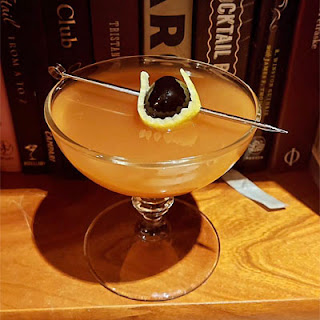
broadway junction

1 1/2 oz The Sexton Single Malt Irish Whiskey (Knappogue Castle Single Malt)
1/2 oz Campari
1/2 oz Tempus Fugit Crème de Noyaux
1 dash Bitter Truth Creole Bitters (Peychaud's)

Stir with ice, strain into an old fashioned glass with a large ice cube, and garnish with grapefruit oil from a twist.
Two Saturdays ago, I reached for my copy of Paddy Drinks: The World of Modern Irish Whiskey Cocktails and stopped flipping the pages when I reached the Broadway Junction. Jillian Vose's creation at The Dead Rabbit in Manhattan was described as "a Boulevardier meets a Japanese Cocktail with a twist." Overall on paper, the whiskey and Campari modified by liqueur reminded me of her Psycho Killer in structure. Here, the Broadway Junction expressed a grapefruit, nutty cherry, and orange aroma. Next, a semi-sweet citrussy sip led into whiskey, almond, and bitter orange flavors on the swallow.

Sunday, September 15, 2024

cutlass

1 oz Clear Creek 8 Year Apple Brandy (Morin Calvados Selection)
1/2 oz Laird's Applejack (Laird's Bonded)
1/2 oz Del Maguey Mezcal Vida (Banhez)
1/2 oz Crème de Noyaux (Tempus Fugit)
1/4 oz Honey Syrup
3 dash Peach Bitters (Fee Brothers)

Stir with ice, strain into a coupe, and garnish with a grapefruit twist.
Two Sundays ago, I pulled up the online recipe flashcards for Palomar in Portland, Oregon, and the Cutlass called out to me. I soon found it in the bar's menu archives for a December 2022 launch, and it seemed like an interesting use of my bottle of crème de noyaux (that had been gathering dust) to support an apple brandy and mezcal combination. Furthermore, the drink name made me think of the unrelated Cutlass that I found in the 2018 Lustau Sherry competition collection which took a split-based concept in a banana-coffee direction. In the glass, this Cutlass slashed at the nose with grapefruit, apple, and nutty peach aromas. Next, honey, apple, and orchard fruit notes on the sip parried apple, nutty cherry-peach, vegetal, and smoke flavors on the swallow.

Wednesday, November 1, 2023

mikado

2/3 jigger Brandy (2 oz Du Peyrat Selection Cognac)
2 dash Orgeat (1 tsp)
2 dash Curaçao (1 tsp Pierre Ferrand)
2 dash Noyau (1 tsp Tempus Fugit)
2 drop Bitters (2 dash Angostura)

Stir with ice, strain into a cocktail glass, and garnish with a cherry and a lemon twist.
Two Wednesdays ago, I reached for my reprint of Cocktail Bill Boothby's 1934 edition of World Drinks and How to Mix Them and landed on the Mikado. Mikado is the term for the emperor of Japan, and the word gained popularity in the United States due to Gilbert and Sullivan's 1885 comic opera The Mikado (the movie version came out in 1939 after the book's printing though). The cocktail name makes sense since the drink appears to be an expansion of the Japanese Cocktail with the addition of curaçao and crème de noyaux. In the glass, the Mikado awoke with lemom, nutty, and orchard fruit aromas. Next, a creamy orange sip was ruled over by Cognac, nutty, and orange flavors on the swallow with a cinnamon and clove finish.

Thursday, February 16, 2023

king kong

3/4 Booth's Dry Gin (1 1/2 oz Beefeater)
1/8 Benedictine (1/2 oz)
1/8 Noyaux (1/2 oz Tempus Fugit)
1 dash Lemon Juice (1/2 oz)

Shake with ice, strain into a cocktail glass, and garnish with a cherry (omit) and orange twist.
In early December, Al Sotack, bartender and co-owner of Jupiter Disco, wrote me to see if I could track down the King Kong recipe that was not the Sam Ross one from Attaboy but the gin Sour one with crème de noyaux. Since the movie came out in 1933, that limited things down to a handful of books that came out in the few years after that. I soon found it in the 1934 1700 Drinks for the Man Behind the Bar and sent him that page. Curiousity got the hold of me one night when I spotted the dusty bottle of noyaux on my top shelf and I made the drink, but I soon agreed not to write it up until Al's article on it got published. When I made the drink, it donated an orange and fruity-nutty bouquet to the nose. Next, lemon with caramel notes on the sip climbed to gin and marzipan-herbal flavors on the swallow.

Saturday, February 1, 2020

old etonian

1/2 London Gin (1 1/2 oz Beefeater)
1/2 Kina Lillet (1 1/2 oz Cocchi Americano)
2 dash Crème de Noyau (1/4 oz Tempus Fugit)
2 dash Orange Bitters (Angostura Orange)

Stir with ice, strain into a cocktail glass, and garnish with an orange twist.

In 2010, I became obsessed with the lost ingredient of crème de noyau and went as far as making my own (along with the cyanide risk of doing so). There were a few artificially-flavored bottom shelf examples out there, but nothing worth spending the money on. Drinks from Louis Fouquet's 1896 Bariana such as Louis' Saratoga Cocktail led me on a quest that year to ask around at Tales of the Cocktail. That search guided me to a Cognac blending seminar where I spoke to the producer of Noyau de Poissy. While I did get to attend a great talk for free, I was disappointed when I learned that their crème de noyau was not exported to our area. It was not until 2015 that I was able to get my hands on a bottle of Tempus Fugit's craft take on the liqueur.
Two weeks ago, I was flipping through the 1930 Savoy Cocktail Book where I spotted the Old Etonian Cocktail. It had been easier to skip over recipes in the Savoy for there were so many that I could make that it was not such a let down by the ones I could not make given their lost or difficult to source ingredients like Caperitif and Hercules; however, Bariana called for a few ingredients in many of their drinks, and that book served as a greater motivator. Therefore, I felt it was time to give this Martini abstraction a go (although the lesser known Fairbank with its dry vermouth would fall closer to a Martini). In the glass, the Old Etonian proffered orange and nutty aromas to the nose. Next, a peach-like orchard fruit sip led into gin, nutty, and herbal flavors on the swallow.

Tuesday, February 12, 2019

morton house

2/3 Black & White Scotch (1 1/2 oz Famous Grouse)
1/3 French Vermouth (3/4 oz Noilly Prat Dry)
1 dash Crème de Noyaux (1/4 oz Tempus Fugit)
1 dash Bokers or Picon Bitters (1/4 oz Torani Amer)

Stir with ice and strain into a cocktail glass.

Two Tuesdays ago, I returned home from a bonus shift at work in need of a nightcap. For a solution, I searched my way through Pioneers of Mixing at Elite Bars: 1903-1933 until I found the Morton House that came across like a Scotch Brooklyn with noyaux in place of the similarly nutty Maraschino. That book also had the Parisian which was a Cognac Brooklyn with noyaux subbing in place of the Picon. As for the name, I was a bit flummoxed for there are many famous Morton Houses. The most famous is probably the 1872 book of that title published by Christian Reid, and the most interesting is an 1890s farmhouse that has been declared one of the most haunted places in America (albeit, the hauntings began after the recipe was created).
In the glass, there was less uncertainty for the mix provided a nutty aroma in a fruity-vanilla sort of way. Next, a dry malt-laden sip shifted into Scotch flavors and dark orange melding into nutty stonefruit pits on the swallow.

Tuesday, November 6, 2018

tammany

3/4 Rye (2 1/4 oz Michter's Straight Rye)
1/4 Italian Vermouth (3/4 oz Cocchi Vermouth di Torino)
1 dash Crème Yvette (1/4 oz)
1 dash Crème de Noyaux (1/4 oz Tempus Fugit)

Stir with ice and strain into a cocktail glass; I added an orange twist.

Two Tuesdays ago, I was perusing the American whiskey section of Pioneers of Mixing at Elite Bars: 1903-1933 when I spotted an interesting Manhattan variation called the Tammany. Here, the Manhattan lacked bitters but contained a dash of Crème Yvette's like that book's Caboose and a dash of crème de noyaux akin to the book's Borgers. Tammany is most likely a reference to Tammany Hall that was a New York City political group founded in the late 18th century that lasted until the mid-20th century; it controlled both New York City and State politics especially during the mid-19th to early 20th centuries where it was heavily implicated in a slew of graft and corruption issues. I first became aware of the political machine during college where my dorm's coffee shop was named Tammany (Risley Hall at Cornell University) -- while it had its cliques, it seemed pretty non-corrupt save for the menu that contained puns like the Pizza Hegel (for the pizza bagel).
The Tammany as a drink led off with an orange, nutty, and berry-floral aroma. Next, grape and berry danced on the sip, and the swallow proffered rye whiskey, violet, and nutty flavors.

Saturday, May 5, 2018

fairbank

2/3 Gin (2 oz Tanqueray Malacca)
1/3 Dry Vermouth (1 oz Noilly Prat)
2 dash Crème de Noyaux (1/8 oz Tempus Fugit)
2 dash Orange Bitters (Regan's)

Stir with ice and strain into a cocktail glass; I added an orange twist.
After work two Saturday nights ago, I ventured into Harry McElhone's 1927 Barflies & Cocktails and landed on the Fairbank. It is unclear if the drink is a tribute to Douglas Fairbanks of that era like this one was, but a Martini with a dash of crème de noyaux seemed delightful akin to the Silver with its dash of Maraschino. Once stirred and strained, the Fairbank's garnish gave orange oil aromas over a nutty pine note. Next, a crisp white grape sip led into gin and nutty cherry flavors on the swallow with a strawberry-orange finish.

Sunday, April 29, 2018

chinese cocktail

2 dash Angostura Bitters
4 dash Crème de Noyaux (1/4 oz Tempus Fugit)
4 dash Curaçao (1/4 oz Pierre Ferrand)
1 spoon Sugar (omit)
Curlier Cognac (1 oz Courvoisier VS)
Rum (1 oz Rhum Barbancourt 8 Year)

Stir with ice, strain, and garnish with a lemon twist.

After the Moreaa Fizz, I decided to make the Chinese Cocktail in Louis Fouquet's 1896 Bariana which I was recently reminded of in my reading. The book pointed out that the better known Chinese Cocktail was published by Franck Newman in his 1904 American-Bar book, and Newman's recipe was adopted by Robert Vermeire and Harry McElhone; I made the latter drink as it appeared in the 1935 Old Waldorf-Astoria Bar Book. Whereas the better known Chinese Cocktail has rum, Maraschino, curaçao, grenadine, and Angostura Bitters, this one split the spirit base with Cognac, swapped the Maraschino for the also nutty crème de noyaux, and opted for sugar instead of grenadine, but overall, the general feel of the two is similar.
In the glass, the Chinese Cocktail came across almost tea like with fruit and tannin notes, so opting for a Chinese tea cup was surprising apt. On the nose, the lemon twist's oils joined Cognac and nutty noyaux aromas. Next, a dry cherry-like sip gave way to rum, brandy, and nutty apricot flavors on the swallow with a bitter clove and allspice finish.

Sunday, April 15, 2018

coats house

2/3 Rye Whiskey (2 oz Old Overholt)
1/6 Sherry (1/2 oz Lustau Amontillado)
1/6 French Vermouth (1/2 oz Dolin Blanc)
1 dash Crème de Noyaux (1 bsp Tempus Fugit)
1 dash Angostura Bitters

Stir with ice and strain into a cocktail glass.

Two Sundays ago, I ventured into Pioneers of Mixing at Elite Bars: 1903-1933 for an intriguing gem that I have somehow passed over through the years. There, I stumbled upon the Coats House that seemed like it would be an interesting Manhattan riff with perhaps a nutty sherry pairing the with the crème de noyaux. I probably skipped over this recipe when I interpreted French vermouth as dry vermouth, but with blanc vermouth as an option, I could use a drier sherry instead of opting for Pedro Ximenez as the sweetener. My search for what the drink could be named after yielded a historic English-style cottage in North Carolina that was built around 1860; while the house was important enough for a Wikipedia entry, was it important enough to have a drink named after it?
In the glass, the Coats House proffered a nutty apricot bouquet to the nose. Next, malt and grape on the sip slid into rye, nutty, and floral flavors on the swallow with an orchard fruit and clove spice finish.

Thursday, April 5, 2018

borgers

2/3 Rye Whiskey (2 oz Old Overholt)
1/6 Sweet Vermouth (3/4 oz Maurin)
1/6 Crème de Noyaux (1/4 oz Tempus Fugit)
1 dash Angostura Bitters

Stir with ice and strain into a cocktail glass; I added a cherry garnish to the recipe.
Two Thursdays ago, I began perusing Pioneers of Mixing at Elite Bars: 1903-1933 when I uncovered the Borgers that seemed like an interesting Manhattan riff with a touch of crème de noyaux in the mix. Once prepared, the Borgers' displayed the noyaux on the nose with a nutty note along with the more traditional Manhattan-esque rye spice and fruity aromas. Next, grape and malt paired on the sip, and the swallow gave forth whiskey, nutty, and cherry fruit flavors with a cinnamon and clove-spiced finish.

Wednesday, June 22, 2016

martician vermouth cocktail

1 part Rum (1 1/4 oz Depaz Rhum Agricle)
1 part Turin Vermouth (1 1/4 oz Dolin Sweet)
1 spoon Pineapple Syrup (1/4 oz)
2 dash Noyaux (1/8 oz Tempus Fugit)
2 dash Curaçao (1/8 oz Pierre Ferrand Dry)
2 dash Angostura Bitters

Stir with ice, strain into a cocktail glass, and garnish with lemon oil.

After returning home from Green Street, I was in the mood for a nightcap so I reached for Louis Fouquet's 1896 Bariana. The recipe appeared like a gussied up Pirate's Cocktail with added tropical complexity from pineapple syrup, crème de noyaux, and curaçao. For a rum, I opted for a rhum agricole given the Martinique reference in the name as well as the French author (ignoring of course, the Martinique from Pioneers of Mixing at Elite Bars that was a rye-based number).
The Martician Vermouth Cocktail presented lemon oil over a vanilla and apricot nose. The sip was mostly grape from the vermouth with the swallow giving forth grassy rum, nutty, orange, apricot, and spice notes.

Monday, February 15, 2016

parisian

2/3 Cognac (1 1/2 oz Camus VS)
1 dash Dry Vermouth (1 oz Noilly Prat)
2 dash Crème de Noyaux (1/4 oz Tempus Fugit)
1 dash Maraquin (1/4 oz Luxardo Maraschino)

Stir with ice and strain into a cocktail glass.

Two Tuesdays ago, I was browsing Pioneers of Mixing in Elite Bars: 1903-1933 when I spotted the Parisian, a brandy drink that reminded me of a Brooklyn in structure. Instead of Amer Picon, the Parisian utilized the nutty crème de noyaux. That ingredient is something that is very French to me for it is featured heavily in the French cocktail book Bariana -- a drink book that sent me on a journey to find artisanal noyaux after buying the book and attending a talk at Tales of the Cocktail in 2010 on the past and present Paris cocktail scene. Five years later, I was finally able to purchase Tempus Fugit's rather authentic version.
The Parisian began with a brandy aroma with nutty undertones. Next, the sip was rather light with some barrel age, white wine, and cherry notes in the mix, and the swallow offered the Cognac with a nutty-fruity combination of noyaux and Maraschino.

Sunday, February 7, 2016

john street

3/4 Scotch (2 oz Buchanan's 12 Year)
2 dash Dry Vermouth (2/3 oz Noilly Prat)
1 dash Crème de Noyaux (1/3 oz Tempus Fugit)
1 dash Orange Bitters (Angostura Orange)

Stir with ice and strain into a cocktail glass.

For Bobby Burns Night on January 25th, I began to scan Pioneers of Mixing at Elite Bars: 1903-1933 for Scotch options. There, I spotted the John Street which was one of three recipes in that section containing whisky, vermouth, and crème de noyaux. Since Bobby Burns recipes range from Benedictine, Drambuie, and absinthe in the Rob Roy format, having another liqueur in the formula did not seem that big of an aberration.
The John Street began with an almondy aroma with a whisp of smoke. Malt and white wine on the sip transitioned into smoky whisky, nutty, and orange flavors on the swallow.

Wednesday, November 4, 2015

kiki

3/4 jigger Gin (1 1/2 oz Bluecoat)
1 dash Cointreau (1/2 oz)
1 dash Noyaux (1/2 oz Tempus Fugit)
2 spoon Sweet Sour (3/4 oz Lemon Juice)
2 drop Bitters (1 dash Jerry Thomas Decanter Bitters)

Shake with ice and strain into a cocktail glass.

Sunday two weekends ago, I began the cocktail hour by flipping through Boothby's 1934 World Drinks and How to Mix Them. In the pages was the curiously named Kiki which seemed like a good use of my new bottle of crème de noyaux in what appeared to be a gin Mai Tai of sorts. Perhaps it was named after Kiki de Montparnasse who was served by many an expatriate bartender during Prohibition including Jimmy Charters as described in his This Must Be the Place biography. Moreover, the name also triggered the Scissor Sister's song "Let's Have a Kiki" that got referenced here and there at Camp Runamok this past September.
So when we had a Kiki, it proffered a lemon and almondy bouquet. The lemon continued on into the sip where it was complemented by the Cointreau's orange, and the swallow donated gin, clove, apricot, and almond flavors. Instead of the anticipated gin Mai Tai similar to the Blande Dubois, it felt a bit closer to an Amaretto Sour.

Friday, October 9, 2015

louis' saratoga cocktail

20 mL Scotch (1 oz Buchanan's 12 Year)
20 mL Curlier Cognac (1 oz Moyet)
20 mL Vermouth (1 oz Dolin Sweet)
2 dash Curaçao (1/4 oz Pierre Ferrand Dry)
2 dash Noyaux (1/4 oz Tempus Fugit)
2 dash Angostura Bitters

Stir with ice and strain into a cocktail glass. Garnish with a lemon slice (lemon twist).

Tuesday last week I wanted to utilize my new purchase of Tempus Fugit's Crème de Noyaux; therefore, I reached for my reprint of Louis Fouquet's 1896 Bariana -- the book that started my noyaux quest back in 2010. One drink that called out to me was a Saratoga Cocktail. There are two competing Saratoga Cocktail camps in the literature supporting that this health spa resort and horse racing town was quite the tippling Mecca back in the day. The lesser known Saratoga is a brandy Old Fashioned of sorts sweetened by pineapple syrup and Maraschino liqueur; while the better known Saratoga is a Jerry Thomas-published split spirits Manhattan that is more frequently had as a gussied up version with Benedictine and Peychaud's Bitters -- namely, the Vieux Carré. The Bariana Saratoga varies from Thomas' by adding smoke to the whiskey element as well as orange and nutty liqueurs; since many of the drinks in the book are named "Louis' (cocktail)," I decided to tack that on to differentiate it from the better known version.
Louis' Saratoga offered a lemon, almondy, and grape bouquet. The grape continued on into the sweet sip, and the swallow shared brandy and smoky whisky flavors with an orange and almond finish.

Sunday, November 20, 2011

pink squirrel

This month's Mixology Monday theme, "Retro Redemption!" (MxMo LXIII), was picked by Jacob Grier of the Liquidy Preference blog. Jacob's challenge was "to revive a drink from mixology's lost decades. Perhaps you feel one of these drinks has a bad rap; tell us why it deserves another shot. Or maybe the original concoction just needs a little help from contemporary ingredients and techniques to make it in the big leagues. If so, tell us how to update it."

When I read this theme, I immediately thought of a post I had wanted to do for a while. At Tales of the Cocktail 2010 at one of the informal tasting events, I had a chance to try Matt Rowley's Ratafia aux Noyau that was simply glorious. Like old fashioned crème de noyau, his was crafted from the aromatic and flavorful kernels of peach pits. Despite the glorious almond flavor from the stones, the FDA frowns upon the small amount of cyanide-creating compounds in them, and all crème de noyau is either distilled after infusion, such as Noyau de Poissy, or artificially flavored and colored, such as the bottom shelf bottles that these days only find their way into Alabama Slammers. Moreover, one of the talks I attended at Tales that year was "Bariana: the Golden Age of French Cocktails." In the classic French drink book Bariana, they called for dashes of noyau like Maloney called for apricot brandy bell-ringer rinses. My efforts for locating a bottle or scoring a sample of Noyau de Poissy were for naught, and in wanting to make some drinks from Bariana, I started harvesting peach pits to make Rowley's ratafia.

After a decent effort during peach season that year, I gathered up enough kernels to make a scaled down version of the recipe Rowley used from the Picayune's Creole Cook Book from 1910:
Peach Kernel Ratafia
• 1/3 oz Peach Kernels
• 5 1/3 oz Brandy
• 3 1/3 oz Sugar
• 2 2/3 oz Water
Pound the kernels along with some of the stones and steep them for a month in brandy. Add syrup made from sugar and water, mix, filter, and bottle.
Unfortunately, the bottle of ratafia sat on the shelf for over a year until this event. The other thing that has sat around gathering dust is a box of powdered drink packets from my parents' house that Andrea and I rescued. While there is no date stamped, my guess is that they are from the late 1960s to mid 1970s. One of these glorious packets is for a Pink Squirrel. Pink Squirrels when mixed without a powdered packet require crème de noyau, so everything seemed to fall into place here.

Gary Regan in The Joy of Mixology traced the Pink Squirrel back to the 1966 edition of Old Mr. Boston and he claimed that the drink was still going strong when he bartended at New York's Drake's Drum in the mid 1970s. Gary provided the recipe as:
Pink Squirrel
• 1 oz Crème de Noyau
• 1 oz White Crème de Cacao
• 1 oz Cream
Shake with ice and strain into a cocktail glass.
Made like this, the drink was not pink for our liqueur was not artificially colored, but it had a wonderful almondy and vanilla nose from the infusion. The sip was sweet and creamy, and the swallow was almondy and chocolate. Overall, it had the format of an Alexander and made for a decent dessert cocktail.
The scarier prospect was the Holland House mix that was possibly as old as I am. Here are the instructions and please note the packet's ingredients.
Pink Squirrel
• 1 1/2 oz Milk or Half & Half
• 1 tsp Sugar
• 1 Packet
• 1 1/2 oz Vodka
Shake or blend with ice. Strain into a cocktail glass. I stirred sugar, packet, and cream until dissolved. Added rest of ingredients and ice, shook, and strained into a cocktail glass.
Ingredients of Packet: sugar, natural flavors, artificial flavors, silicon dioxide, xanthan gum, artificial color.
The strangest part about this Pink Squirrel was that it smelled like Strawberry Quik. It was not almondy or chocolaty in the least. It was similarly creamy; however, it was not as sweet as expected despite additional sugar being added to a packet that listed sugar as its first ingredient. Just like it smelled, the swallow presented a very chemical Strawberry Quik taste. After a few sips shared between Andrea and me, this drink got sinked. Perhaps a better way to demonstrate the Pink Squirrel of that era would be to purchase bottom shelf liqueurs, but then I would have been stuck with them unless I somehow located nips of noyau or bombed the bottles later as a "gift" at a party.
Definitely, made with decent liqueurs in Alexander format, the Pink Squirrel is passable. It lacks the complexity of the Golden Cadillac, but the aroma of the ratafia made the experience worth while. Thank you to Jacob for reviving a dusty relic, and to Paul Clarke for helping me raid my parents' liquor cabinet again this month.

Monday, August 9, 2010

[amor fati]

3/4 oz. J. Wray and Nephew rum
3/4 oz. Rothman and Winter Orchard Apricot
3/4 oz. lime juice
3/4 oz. ratafia des noyaux (housemade)

Shake with ice in a Parisian shaker, strain into a cocktail glass, letting the finer ice shards out so they form a slush on top of the drink.

My notes state that I tasted the cherry and apricot flavors at the same time, followed by the tartness of the lime, then finished with the distinctive J. Wray funkiness (aww, yeah). I quite enjoyed this extempore creation by Scott, which paired well with my dessert of cherry-rhubarb crostada.

I had barely been back for 48 hours from Tales of the Cocktail, and the rums were still calling out to me. Fred had emailed me earlier in the day, saying he was off to a cognac seminar in Westborough that evening to chase down some creme de noyau - noyau being one of the recurrent themes during our trip to Tales this year. This gave me a rare evening to myself to indulge in my favorite culinary (etc.) vices.

My boss, Adam, had headed over to Green Street to enjoy some dinner with his wife, and he'd invited me to catch up with him there after I closed up the Shaker. By the time I arrived, I'd managed to miss him, but I sat happily at the bar and ordered some tacos (one yucca, one duck) and the lobster gnocchi. On the opposite side of the taco menu was a selection of tequila cocktails, so I deferred my rum craving in favor of a Taxco (one of my favorite drinks). Though the bar was rather full, I felt comfortably anonymous. One straight week of being "on" is pretty rough for an introvert like me. That's why I like being surrounded by New Englanders, who know how to respect one's mental space. I tried to catch up on facebook and LJ on my iPhone as I ate, and soon my glass and plates were empty. Time for my other vices, rum being one of them. Funky rums were a sub-theme for my trip to Tales this year. French spirits and cocktails were the the other sub-theme. I wanted a cocktail to honor my extraordinary experiences at Tales (more on that below). So, where to indulge my fancy? As if there were any question.

Rendezvous' bar wasn't as full as Green Street's, but the few remaining seats were taken shortly after I arrived. Scott welcomed me back and poured me a glass of water. As usual, he waited for me to settle in a bit before asking me what I wanted to drink, though in this case I knew the instant I spotted the J. Wray. I had forgotten he had it, though of course it was the base spirit for the ratafia des noyaux. I patiently waited my turn and then gave my order. "You've got this?" I asked. As if there were any question.

The first day of Tales, I had still been bright-eyed and outgoing. A couple of tastings in, I spotted Wayne Curtis and Jeff Berry talking with another gentleman on the mezzanine at the conference hotel. I walked right over and introduced myself, saying to Wayne and Jeff that their books continued to sell very well at the Boston Shaker. I also told them about my dream that someday we would once again have authentic Old Medford rum on the market. Their eyes collectively widened - the third gentleman turned out to be famed rum collector Steve Remsberg. He asked me if I'd ever tasted a New England rum, and I sadly shook my head. And then he oh so casually mentioned that he might be having a tasting at his house at the end of Tales, and maybe an old New England rum would be on the docket. I walked away from that conversation with Steve's phone number and a small amount of amazement that I had the nerve to introduce myself in the first place. Over the next few days, we ran into Wayne several times, and he was careful to impress upon me the honor I had been accorded in being invited to Steve's tasting. But still I hesitated to call as my ingrained shyness took over. By the last day of Tales, my ability to socialize had dwindled to almost nothing, and I had gotten maybe 7 hours of sleep total over the past 2 nights. I wanted nothing more than to relax by the pool. Still, I knew it would be the height of foolishness to let this opportunity pass. So after settling into the hotel on our last night, I begged Fred to make the fateful phonecall for me. Steve was perfectly gracious and gave us his address and directions. I took a shower, put on my new favorite skirt, and headed down to the lobby to fetch a taxi. We were the first Tales stragglers to arrive, and Steve and his wife Cheryl made us feel right at home with a serving of the house rum punch. Soon Jeff, Wayne and his wife Louise, and a couple of others arrived. The relaxed atmosphere was the perfect way to unwind after a hectic week. Delicious food, good company. I noted the little plaque on the family room wall, about 3 or so feet from the floor, which indicated the water-line in the house from Katrina.

We all gathered around the bar as Steve brought out a bottle of Austin, Nichols & Co. Old New England Rum, distilled in Everett, MA and then aged 17 years in wood. I blushed crimson as Steve announced to the room that this would be the first rum we would be tasting, in honor of my presence, and in hopes that the style would someday soon be revived. I raised my glass to those assembled and sipped. I gave my first few impressions to Steve - almost like a combination of rum and whiskey. The first sip smelled and tasted very like bourbon. This rum had been bottled in bond and its heat left a waxy feeling on my lips. It was much drier than I had anticipated, with almost a sour cherry flavor. Wayne said it had probably been aged in whiskey barrels. As the rest of the crowd compared notes, I backed off to the side to savor and record. Dry, almost metallic, little to no caramel, stone fruit, ferric, like overcooked molasses. I frantically tried to capture in writing what I was tasting. I hadn't tasted anything quite like it, and Steve told me that this particular rum was characteristic of all the New England rums he's ever tasted. Other rums (pre-revolution Cuban, old London dock-aged Jamaican) were offered up for tasting, and out of politeness (and a sense of awe) I sampled a couple. But I hoarded the flavor of the old New England on my tongue, on the remote possibility that I might one day taste a modern version. I didn't want any other flavor memories to overwrite this experience before I had a chance to completely internalize it. As the evening wore down and folks began to gather to leave. Steve pulled me aside in the kitchen. He pulled out a little nip bottle, still sealed, and handed it to me with a twinkle in his eye: "For the cause." The label said Caldwell's Old Newburyport rum.

When I walked up to Wayne, Jeff, and Steve that first day, I had no idea how the idea of reviving the style would become reality. The evening of the tasting, Wayne said he had gotten an email that some Matt guy was working on it - already had a lead on a space for lease in Boston, currently wading through the permits. A web search the day after I got home revealed nothing about who this person might be. As I began to relax back into normal post-Tales life, I thought it was all some crazy dream. Then a couple of days ago, two guys walked into the Boston Shaker and asked to speak to Adam about making bitters. One of the guys mentioned wanting to know about some drink slut guy in Boston who was making bitters, and Adam pointed me out. He stuck out his hand and introduced himself as Matt. Old New England rum had once again found me.

Wednesday, July 7, 2010

[sang et sable]

1 1/2 oz La Favorite Rhum Agricole Blanc
1/4 oz Batavia Arrack
1/2 oz Ratafia des Noyaux (housemade)
1/4 oz Orange Juice

Stir with ice and strain into a rocks glass. Garnish with an orange twist.

For my after dinner drink at Rendezvous, Scott Holliday wanted to make me a drink that highlighted his work-in-progress. Scott had been steeping crushed cherry pits in Wray and Nephew rum for a few weeks along with allspice and nutmeg in order to make a Ratafia des Noyeaux. Authentic crème de noyaux is nearly impossible to find in this country, and the first person I read who made their own was Matthew Rowley. While Matt made his ratafia out of peach pits, Scott made his out of cherry pits that he procured from Rendezvous' dessert chef. Scott had not sweetened his ratafia yet, but the infusion had a very cherry aroma with a funky rum taste and was delightful in its unfinished state.
The drink Scott made for me was loosely based off of the Blood and Sand with the smokey Batavia Arrack and ratafia representing the Scotch and Cherry Heering. Its nose was kind of sweet and floral from the cherry and orange elements and spicy from the rhum agricole and Batavia Arrack. At the beginning of the sip, the sharpness of the rhum and Batavia Arrack coupled with the citrus notes, and the swallow was full of cherry flavors. It was noteworthy how well the La Favorite and Batavia Arrack paired as they had a very similar character.