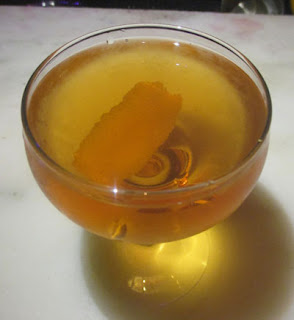
Showing posts with label kümmel. Show all posts

Sunday, October 4, 2020

juan madera

1 1/4 oz Mezcal (Fidencio)
1 oz Sweet Vermouth
1/2 oz Lime Juice
1/4 oz Kümmel (Helbing)
1 dash Angostura Bitters

Shake with ice, strain into a cocktail coupe, and garnish with a cherry.

Two Sundays ago, I was flipping through William Boothby's 1934 World Drinks and How to Mix Them and I spotted the John Wood. I was intrigued but it seemed familiar; alas, I had made it over five years before, but the combination still caught my attention. Instead of continuing on in my literature search, I decided to riff on this obscure classic. The original was whisky and lemon; I opted for Scotch but Boothby grouped all Bourbons, ryes, and Scotches under the ingredient header "whisky," and the Savoy Cocktail Book had the John Wood as an Irish whiskey drink. Here, the kümmel made me think of mezcal for the liqueur pairs well with agave in drinks like the Island of Misfit Toys, Silver Surfer, and Mission Bell. I also changed the citrus to lime and dubbed this one the Juan Madera.
The Juan Madera met the nose with a smoke, agave, cumin, and cherry aroma. Next, grape and lime mingled on the sip akin to the Fig Leaf, and the swallow showcased the mezcal spiced by cumin, caraway, and clove rather well.

Saturday, December 14, 2019

rusty soul

2 oz Apple Brandy (Laird's Bonded)
3/4 oz Cardamaro
1/4 oz Kümmel (Helbing)

Stir with ice, strain into a cocktail glass, and garnish with a lemon twist.
While I was perusing the Kindred Cocktails database, I spotted the Rusty Soul that paired apple brandy with Cardamaro as was recommended by Haus Alpenz; I discussed this combination recently in the Wooden Shoe post. Here, Owen Thomson's recipe that he created at Washington DC's Bar Pilar and Café Saint-Ex was published in a 2014 Eric Felton article in the Wall Street Journal, and Owen rounded the duo off with spice from kümmel liqueur. In the glass, the Rusty Soul donated lemon and apple aromas. Next, the apple worked well with Cardamaro's grape on the sip, and the swallow showcased the apple flavors being complemented by caraway and herbal notes.

Thursday, April 18, 2019

loensky cocktail

2 oz Chivas Regal 12 Year Blended Scotch (Cutty Sark Prohibition)
3/4 oz Noilly Prat Dry Vermouth
1/4 oz Combier Kummel (Helbing)
1 dash Regan's Orange Bitters

Stir with ice, strain into a cocktail glass, and garnish with a lemon twist.

After dinner two Thursdays ago, I reached for Frank Caiafa's The Waldorf Astoria Bar Book that was their house adaptation of the Loensky from the 1930s Waldorf Astoria book. Frank described the Loensky as a Poussé-cafe of one part Scotch floated on top of two parts kümmel liqueur although the original book lacks specific directions. Here, things were made into a Bobby Burns riff by pairing dry vermouth with a touch of kümmel akin to what I did with my tequila-based El Mariachi Club.
The Loensky Cocktail proffered a lemon and apricot nose that preceded a malt and white wine sip. Next, the Scotch's orchard fruit and hint of smoke flavors joined the liqueur's caraway and cumin notes on the swallow.

Friday, February 22, 2019

the weeper's joy

3 dash Gum (1/4 oz Simple Syrup)
1/2 pony Absinthe (3/4 oz Kübler Absinthe)
1/2 pony Vino Vermouth (3/4 oz Cocchi Sweet)
1/2 pony Kümmel (3/4 oz Helbing)
1 dash Curaçao (1/4 oz Pierre Ferrand Dry)

Stir with ice and strain into a cocktail glass.

When I got home two Fridays ago, I thought that it might be time to revisit a drink never made it on to the blog. The recipe was the Weeper's Joy -- an oddball combination that appeared in William Schmidt's 1891 The Flowing Bowl. I made that drink before I got a reprint of that tome for I was able to source it from David Wondrich's Imbibe! Many of the cocktails in Schmidt's book were weird ones, and it was not surprising that the 2010 Beta Cocktails zine (the photocopied one that came out between the book printing of 2009 Rogue Cocktails and 2011 Beta Cocktail books) hosted what appeared to be a riff on it called the Spice Trade with overlapping absinthe, kümmel, and curaçao ingredients.
For an absinthe, I selected Kübler for its softer balance seems to work the best in my collection with absinthe-forward recipes. Once prepared, the Weeper's Joy offered an anise and caraway aroma that preceded a sweet grape sip. Next, caraway, cumin, orange, anise, and other spice notes filled the swallow. Overall, it was the orange flavors that donated an elegance to the combination.

Monday, December 31, 2018

ask & embla

1 oz Michter's Rye
1 oz Brennivin Aquavit
1/2 oz Green Chartreuse
1/2 oz Dolin Dry Vermouth
1 dash Angostura Bitters

Stir with ice, strain into a cocktail coupe pre-rinsed with Combier Kümmel, and garnish with a lemon twist.
Two Mondays ago, Andrea and I stopped in for a late bite to eat at Estragon. For a drink, I perused bartender Sahil Mehta's drink notebook and selected a drink of the day from September that was full of herbal and spice notes. For a name, I took inspiration from the Brennivin and proposed Ask & Embla, the Norse Adam & Eve, and Sahil approved. Once prepared, the cocktail proffered lemon, caraway, and floral aromas at first, and later, the Green Chartreuse's notes began to dominate the nose. Next, a semi-sweet sip led into rye, Green Chartreuse herbal, and caraway and cumin spice on the swallow. Indeed, the rye paired elegantly with the aquavit as it had in the Immigrant Song and Carra-ryed Away.

Monday, August 27, 2018

el mariachi club

2 oz Blanco Tequila (Casa Noble)
3/4 oz Dry Vermouth (Noilly Prat)
1/4 oz Kümmel (Helbing)
2 dash Mole Bitters (Bittermens)

Stir with ice, strain into a cocktail coupe, and garnish with a lemon twist.
In thinking about the tequila-kümmel pairing from the Silver Surfer two nights prior, I wondered what it would do in a Georgetown Club Cocktail that Charles H. Baker, Jr. had in Guyana. Instead of white rum and falernum, the tequila-kümmel combination seemed like it would slide in well to that drink skeleton especially if complemented by some chocolate molé bitters. For a name, Andrea suggested the El Mariachi Club for mariachi music centers around the heart of tequila in Guadalajara, Jalisco. Once prepared, El Mariachi Club proffered lemon oil notes that brightened an agave and cumin nose. Next, a semi-dry white wine sip led into vegetal tequila and caraway spice flavors on the swallow with a chocolate finish. Overall, Andrea commented that this would make a great aperitif for it promoted salivation with its dry and savory elements.

Saturday, August 25, 2018

silver surfer

2 oz Blanco Tequila (Cimarron)
1/2 oz Orgeat
1/2 oz Kümmel (Helbing) (*)
3/4 oz Lime Juice

Shake with ice, strain into a double old fashioned glass, fill with crushed ice, and garnish with mint sprigs.
(*) For a potent kümmel like Combier, cut this to 1/4 oz (can add a 1/4 oz simple if desired as well).

On the walk home from my bar shift Saturday night, I began scheming my evening's nightcap. I honed in on the agave-kümmel pairing that I first appreciated in late 2012/early 2013 by way of Tommy Klus' Mission Bell and Misty Kalkofen's Island of Misfit Toys shortly after Combier's kümmel liqueur came out. Perhaps the concept started with a Mai Tai riff subbing in kümmel for the curaçao akin to the cinnamon syrup substitution in the Cuban Anole, and then it drifted to subbing it into Trader Vic's tequila Mai Tai, the Pinky Gonzalez. As prepared above, I was quite pleased at how the drink balanced out with Helbing Kümmel; however, when I made it for a guest 18 hours later at River Bar using Combier's kümmel, the kümmel was a bit more overpowering (I ended up increasing the lime and orgeat each by a 1/4 oz to compensate). The guest who received it commented that it was the best drink she had tried this year, so perhaps this combination is a winner.
Since part of my thinking was that this was a Silver Bullet crossed with a Pinky Gonzalez, I dubbed this one the Silver Surfer. I know that there are other Silver Surfers drink recipes out there, but none that are at home at a Tiki or craft cocktail bar. Once prepared, it shared mint notes over vegetal, caraway, and cumin aromas. Next, a creamy lime sip transitioned into vegetal agave, earthy nuttiness, and caraway-cumin spice. Overall, the match of the flavors were supported mentally by how tequila, almond, and cumin all factor into Mexican culture and cuisine.

Friday, June 22, 2018

prize winner

2/3 Brandy (2 oz Courvoisier VS)
1 dash Cointreau (1/4 oz)
1 dash Orange Bitters (2 dash Regan's)
1 dash Kümmel (1/4 oz Helbing)

Stir with ice and strain into a cocktail glass; I added an orange twist.
Two Fridays ago, I set out in search of a nightcap in Pioneers of Mixing at Elite Bars: 1903-1933. There, I spotted the Prize Winner that came across like an orange spiced Cognac Old Fashioned that seemed like it might live up to its name. Once prepared, it shared a Cognac, orange oil, and caraway-cumin spiced nose that preceded a lightly orange sip. Next, the swallow gave forth brandy, orange, and caraway flavors. Over all, it was a solid tipple, but perhaps not dynamic enough to get a trophy or a ribbon.

Wednesday, May 30, 2018

who dares win

2 oz Beefeater Gin
3/4 oz Lemon Juice
1/2 oz Orgeat
1/4 oz Kümmel (Helbing)

Shake with ice, strain into a cocktail glass, and garnish with a star anise pod.
Two Wednesdays ago, I reached for Clair McLafferty's The Classic & Craft Cocktail Recipe Book for the night's libation. There, I was drawn to the Who Dares Win by Scottish bartender Mike Aikman for it reminded me of an Army & Navy crossed with a Silver Bullet. Once prepared, it gave forth a spiced nose mostly from the caraway with perhaps lighter notes from cumin, star anise, and juniper. Next, the creamy lemon sip transitioned into gin, nutty, and caraway flavors on the swallow; moreover, towards the end, the star anise from the garnish seemed to infuse into the drink itself.

Friday, May 25, 2018

my old piano

1 1/2 oz Rittenhouse Rye
3/4 oz Carpano Antica Sweet Vermouth (Maurin)
1/2 oz Mezcal (Fidencio)
1/4 oz Kümmel (Helbing)
2 dash Apple Bitters (Bittermens Burlesque)

Stir with ice and strain into a cocktail coupe.

For my Friday's nightcap, I turned to Amanda Schuster's New York Cocktails and I paused on the My Old Piano presented by Sother Teague at Amor y Amargo. I had passed over this drink since I lacked BarKeep's Apple Bitters (or homemade ones), but I decided that I could probably get by with another fruit and spice bitters. With a little research, I discovered that the drink was created by bartender Ari Form, and I was lured in by the combination of rye over mezcal that worked well in drinks like the Last Caress, Red Ant, and other recipes. I was also curious about the kümmel ingredient; I recalled how well it paired with whiskey in William Schmidt's 1891 Gladstone. Moreover, modern mixology has demonstrated how well kümmel works with agave spirits such as in the Island of Misfit Toys and Mission Bell.
My Old Piano greeted the nose with grape, smoke, and cumin notes. Next, grape and malt mingled on the sip, and the swallow proffered rye along with smoky vegetal flavors with a caraway and cumin finish.

Wednesday, May 16, 2018

minsky

2/3 Bacardi (2 oz Barbancourt 8 Year + 1/4 oz Smith & Cross)
2 dash Cointreau (1/4 oz)
2 dash Kümmel (1/4 oz Helbing)
2 dash Maraschino (1/4 oz Luxardo)

Stir with ice and strain.
After my bar shift two Wednesdays ago, I dove into Pioneers of Mixing at Elite Bars: 1903-1933 for a nightcap. There, the Minsky with its spirit, Maraschino, and kümmel reminded me of William Schmidt's 1891 Gladstone from a few weeks ago, so I was curious to see what a rum-forward cousin would be like. In the glass, the Minsky proffered Jamaican rum funk and hints of caraway to the nose. Next, caramel from the aged rum on the sip gave way to rum, nutty, and orange flavors on the swallow with a cumin followed by caraway finish.

Thursday, April 26, 2018

the gladstone

1 drink Whiskey (2 oz Old Overholt Rye)
1 dash Jamaican Rum (1/4 oz Smith & Cross)
a little Maraschino (1/4 oz Luxardo)
2 dash Gum (1/4 oz Simple Syrup
1 dash Absinthe (1 scant bsp Kübler)
1 dash Russian Kümmel (1 bsp Helbing)
2 dash Bitters (Jerry Thomas Decanter)

Stir with ice and strain into a cocktail glass.
For a drink two Thursday nights ago, I reached for William Schmidt's 1891 The Flowing Bowl and spotted the Gladstone. The recipe came across like a more complex Improved Whiskey Cocktail with additional flavors from Jamaican rum and kümmel. Once prepared, the Gladstone shared a whiskey, anise, and caraway bouquet to the nose. Next, malt and a light cherry flavor on the sip slid into rye, rum funk, nutty cherry, caraway, and other spice elements on the swallow. I was definitely pleased at how well the kümmel notes merged in with the bitters and absinthe of the Improved Whiskey Cocktail, and a touch of Jamaican rum funk rarely seems to hurt a flavor profile.

Sunday, January 21, 2018

silver lady

2 oz Dry Gin (Beefeater)
1/2 oz Kümmel (Helbing)
1/4 oz Simple Syrup
1/2 oz Lemon Juice
1 Egg White

Shake once without ice and once with ice, strain into a cocktail coupe, and garnish with lemon oil (if using a lemon peel coin, feel free to float the twist).

While reading Gin Glorious Gin, I was reminded of the Silver Bullet from the Savoy Cocktail Book which is two parts gin, one part kümmel, and one part lemon juice. The drink came up in a discussion of British royalty shaping the perspective on gin and its uses, and how Prince Philip was rather fond of the Silver Bullet besides the royal family favorite of Gin & Tonic. Since kümmel can be rather forward, I wondered how to better balance the drink, and I decided to merge it with another Savoy Cocktail Book classic, the White Lady. Actually, the 1930 recipe lacks egg white, but the 1940s recipes starting with Crosby Gaige soon included it. Using the 4:1:1 structure in the White Lady recipe I linked to (plus a touch of simple to also smooth things out), I crafted my mashup: the Silver Lady.
The Silver Lady greeted me with a lemon oil bouquet. Next, a creamy lemon sip transitioned into a juniper, caraway, and cumin swallow with lemon tartness on the finish.

Saturday, December 16, 2017

rook racked

1 1/2 oz Bonal Gentiane-Quina
1 oz Pierre Ferrand Ambre Cognac (Couvoisier VS)
1/2 oz Tanqueray Gin
1 tsp Gilka Kümmel (Helbing)
3 dash Orange Bitters (Regan's)
4 dash Absinthe (1/2 bsp Kübler)

Stir with ice, strain into a Nick & Nora glass (coupe), and garnish with a lemon twist.
Two Saturdays ago, I was perusing the BarNotes app when I spotted a curious drink by Nicholas Jarrett called the Rook Racked that he crafted at Brooklyn's Dram in 2011. With Bonal, Cognac, and absinthe, it reminded me of the Quinquina Cocktail, but with the additional herbal elements from gin and kümmel instead of fruit ones, it reminded me of some of the drinks in Beta Cocktails. Once prepared, the Rook Racked offered up a lemon oil aroma over anise and caraway notes. Next, a grape sip gave way to brandy, juniper, caraway, and cumin flavors on the swallow with an anise finish.

Tuesday, December 6, 2016

before night falls

1 oz Mezcal
1 oz Manzanilla Sherry
3/4 oz Green Chartreuse
1/4 oz Combier Kümmel
1/2 oz Lime Juice

Shake with ice and strain into a cocktail glass.
For my first drink at Estragon, I asked bartender Sahil Mehta for the Before Night Falls. The drink's aroma was dominated by the kümmel spice especially the cumin, and the sip was rather crisp and clean from the sherry and lime components. Finally, the swallow was the combination of smoky agave and savory herbal from the pairing of the kümmel with the Chartreuse.

Tuesday, December 22, 2015

south pole swizzle

1 1/4 oz Letherbee Gin (Darnley's View)
3/4 oz Gilka Kümmel (Helbing)
3/4 oz Passion Fruit Syrup
1/2 oz Honey Syrup
3/4 oz Lemon Juice
1 dash Angostura Bitters

Build in a Hurricane glass, fill with crushed ice, and swizzle to mix and chill. Garnish with an orange twist.

Two Wednesdays ago, I decided to make a drink that I had spotted in Punch Magazine called the South Pole Swizzle. The recipe was created by Billy Helmkamp of the Whistler in Chicago. Indeed, the combination of gin, passion fruit, honey, and lemon reminded me of my Surfer Rosa that was a mashup of Don's Special Daiquiri and a Bee's Knees. Here, additional spice notes were added via kümmel and Angostura Bitters.
The South Pole Swizzle shared orange oil and caraway aromas from the garnish and kümmel, respectively. Next, honey balancing lemon on the sip gave way to juniper, caraway, passion fruit, and spice on the swallow. Moreover, there was a pleasant lingering rye bread note on the finish.

Wednesday, September 23, 2015

[tropicalia]

1 1/2 oz Leblon Cachaça
3/4 oz Lime Juice
1/2 oz Passion Fruit Syrup
1/4 oz Velvet Falernum
1/4 oz Combier Kümmel

Shake with ice and strain into a cocktail coupe.
The other drink that I had at Estragon was also from bartender Sahil Mehta's recipe notebook. This spiced Special Daiquiri-like cachaça number lacked a name, and I dubbed it the Tropicália after the Brazilian musical style that is a fusion of traditional Brazilian rhythms with foreign rock and roll influences. I became acquainted with the style through bands like Os Mutantes that people at the radio station I worked at were excited about. Moreover, this is not unlike the cachaça Sahil was using which made its way from Brazil over to France to be finished in used Cognac barrels. Once mixed, the drink offered grassy funk aromas spiced with cumin notes. Next, lime and passion fruit on the sip transitioned into a grassy and passion fruit swallow accented with cumin and clove.

Saturday, September 19, 2015

cubano cocktail

3/4 oz Gin (1 1/4 oz Bluecoat)
3/4 oz Dry Vermouth (1 1/4 oz Noilly Prat)
2 dash Pineapple Syrup (1/2 oz)
2 dash Kümmel (1/4 oz Helbing)

Stir with ice and strain into a cocktail glass.
Last Saturday after my shift, I was looking through a few old cocktail books for a nightcap. The one I ended up selecting was the Cubano from Trader Vic's 1947 Bartender's Guide which seemed like an interesting tropical and spiced Martini variation. I had also spotted it in Boothby's 1934 World Drinks and How to Mix Them, but I had passed over the recipe for it just said "pineapple" which gave the impression of a shaken juice-driven drink. I later discovered that the Cubano Cocktail first appeared in the Savoy Cocktail Book with a few dashes of "Charbreux" also in the mix. My curiosity about this ingredient led to this Cocktaildb explanation that links references to this ingredient to solely this recipe:
Charbreux: Defunct term cited in bar books which is theorized to have been a corruption/typo for Les Peres Chartreux, the name given to Chartreuse during the period 1903-1940 when it was produced solely in Tarragona, Spain. The only reference to this product with this spelling was in a drink named the Cubano. Its first appearance was in the Savoy Cocktail Book (London 1930). In 1934, "Cocktail Bill" Boothby listed the recipe in his guide with the ingredient entirely eliminated, as did Trader Vic in 1947. Ever since, (as here,) "Charbreux" only shows up in recipe lists which draw from the Savoy book - or from the books which drew from those books!
A little Green Chartreuse in the mix would not have hurt, but that was not the recipe that I had spotted that night. In the glass, the Cubano shared juniper and caraway aromas with a hint of pineapple. On the sip, sweet tropical fruit transitioned into gin and kümmel spice on the swallow with a pineapple finish.

Tuesday, April 21, 2015

john wood

1/3 jigger Whisky (1 oz Buchanan's 12 Year Blended Scotch)
1/3 jigger Sweet Vermouth (1 oz Dolin)
1 spoon Lemon Juice (1/2 oz)
1 spoon Kümmel (1/4 oz Helbing)
2 drop Bitters (1 dash Angostura)

Shake with ice and strain into a cocktail glass.
Two Tuesdays ago, I reached for my 1934 reprint of Boothby's World Drinks and How to Mix Them. There, I spotted a Rob Roy variation that reminded me a lot of the hint of citrus and sweetener structure that appeared frequently in James Maloney 1900-vintage The Twentieth-Century Cocktail Guide for Mixing Fancy Drinks such as in the Manhattan Bell Ringer (his Manhattan sans apricot rinse "bell ringer" also has lemon and simple in it). Interestingly, this "whisky" drink that I interpreted as Scotch appeared in the Savoy Cocktail Book a few years prior as an Irish whiskey one. Given the commonness of the name John Wood, I was unable to even make an educated guess as to whom the drink was named after. Once mixed, it offered a smokey and grape aroma. A crisp lemon, malt, and grape sip gracefully transitioned to a Scotch swallow with a bit of savory spice on the finish.

Monday, July 29, 2013

[mansion in the sky]

1 1/2 oz Diabolique Bourbon
3/4 oz Lemon Juice
1/2 oz Rothman & Winter Orchard Apricot Liqueur
1/4 oz Velvet Falernum
1/4 oz Kümmel
1 dash Angostura Bitters

Shake with ice and strain into a snifter glass.
Two Mondays ago, I was planning on staying in, but eventually I needed to get out of the house. Therefore, I opened up the OnTheBar app and spotted that Sahil Mehta was working at Estragon. Of course, Sahil works most Mondays, but I had lost focus on what night it was and the app surely helped out. For a drink, Sahil mentioned that he had created something for a customer who wanted a riff on the house cocktail the Delta Dawn. The Delta Dawn combines Bourbon, a peach-ginger shrub, orgeat, lemon juice, and Angostura Bitters. Changing the shrub for apricot liqueur and the orgeat for falernum and kümmel, the next generation of drink was created, but it still lacked a name by the time it reached my glass. Delta Dawn is the name of a song written by child rockabilly star Larry Collins and songwriter Alex Harvey around 1971. I dubbed the drink the Mansion in the Sky after a line from the first verse:
Delta Dawn, what's that flower you have on
Could it be a faded rose from days gone by?
And did I hear you say he was a-meeting you here today
To take you to his mansion in the sky?
Once presented to me, the cocktail offered an apricot and kümmel spice that came across as perfume-like with cherry-peach notes. Lemon on the sip joined a fruity note from the apricot, and as things warmed up over time, the cherry-like flavors began to appear on the sip as well. In retrospect, the cherry notes might be due to the Black Mission figs in the Diabolique Bourbon infusion (Estragon has a cordial license and cannot carry Bourbon proper). Next, the swallow showcased the whiskey followed by spiced apricot flavors.