Showing posts with label *book review. Show all posts

Monday, September 19, 2016

:: eight flavors - the untold story of american cuisine ::

I just finished reading Eight Flavors: The Untold Story of American Cuisine, and it got me thinking of a drink of the day at Loyal Nine that was rather successful but had not been published here. The author of the book is Sarah Lohman whom I followed on her historical food and drink blog, Four Pounds of Flour for a bit before meeting her in person on her 19th Century Pub Crawl adventure back in 2011. That led to a blog post exchange where Sarah wrote about the return of Damson plum liqueur which I believe disappeared from cocktail books around the 1930s.

Sarah's book discusses how certain outside flavors have entered into American cuisine and been adopted by the masses. She skipped over chocolate and coffee for those flavors have filled up books on their own, but chose to include black pepper, vanilla, chili powder, curry powder, soy sauce, garlic, MSG, and Sriracha. In each chapter are colorful histories of important but lesser known characters who pushed the flavors along such as the infamous Chili Queens or the 12 year old who figured out how to get vanilla orchids to fertilize and produce vanilla pods with great efficiency. The chapter that got me thinking about drinks I have created was the one on curry powder; I have included my chef's Piccalilli spice blend into two drinks with the first one being our house hot buttered rum batter over the winter.

Lohman's interest in this group of spice blends began on a foodie "curry crawl" through New York City, and she surmises that the Asian Indian ethnicity being the third largest immigrant group after Mexican and Chinese has not hurt curry's acceptance into American cuisine. The book goes into the tales of celebrity chef Ranji Smile who really helped popularize it in the late 19th century; however, curry has been used in America for over 200 years well before Smile's time. The term curry has grown to include spice mixes from other parts of Asian including Thailand and China as well. Curry perhaps got a solid start in early America for several of the spices have antimicrobial properties and are thus good for food preservation.

Curry traveled back from India to England through the British East India Company, and the desire to eat such foods traveled back with the soldiers, merchants, and officials who spent time over there. The British fascination with curry made its way to America in the mid 18th century, with Hannah Glasse's 1747 The Art of Cookery Made Plain and Easy book becoming popular with the Colonists. Curries then made their way into American-penned books starting with Mary Randolph's The Virginia Housewife in 1824.
At Loyal Nine, chef Marc Sheehan latched onto the Piccalilli curry spice blend that became popular in America. The term stems from Hannah Glasse's 1747 book with the section on how "to make Paco-Lilla, or Indian Pickle" perhaps as a take on the 1694 recipe to make "Pickle Lila." The spelling settled on Piccalilli around 1799. Recipes vary widely with a subset of mustard seed, turmeric root, and hot pepper being included in most recipes. The first reference to Piccalilli in America was 1856 in a list of imported English goods and later in an 1878 recipe and in 1880s jokes. Our house piccalilli includes mustard, turmeric, hot pepper (I leave this one out of our drink mixes though), and four other spices. After having great success with the spice blend in our Hot Buttered Rum batter (that worked not only with rum but with Malort!), I decided to make a spiced syrup with the mix that later found its way into a drink of the day.
Gulliver's Grog
• 1 1/2 oz Old Monk Rum
• 1/2 oz Batavia Arrack
• 1 oz Piccalilli Syrup (*)
• 1/2 oz Lime Juice
• 1/2 oz Lemon Juice
• 1 dash Angostura Bitters
• 12 drop St. George Absinthe
Shake with ice, strain into a rocks glass, add ice, and garnish with a lime wheel and freshly grated nutmeg.
(*) Sub a turmeric-forward curry powder here at around 1 Tbsp per 1 cup sugar and 1 cup boiling water. Let steep overnight and either carefully decant or strain through a coffee filter.
The idea came to me on my flight back from Tales of the Cocktail this past July with a note to myself to make a Grog with the syrup that I had made a month or so before. However, the drink came into fruition when a regular requested an Indian-inspired drink, and luckily I had the syrup and the spirits handy. For spirits, I opted for Indian rum accented with Indonesian Batavia Arrack. Given the guest's pleasure with the mix, I put the recipe into action as one of our drinks of the day with a similar level of success. For a name, I opted for the 1726 reference to Gulliver's Travels in how the ingredients were quite mobile across the world.

My copy of Eight Flavors was sent to me as an advance copy, but it is available on pre-order on Amazon.com for a December 6th release.

Tuesday, August 4, 2015

:: interview with paul clarke, author of the cocktail chronicles ::

During Tales of the Cocktail this year, I had the pleasure of sitting down with Paul Clarke to discuss his new book, The Cocktail Chronicles: Navigating the Cocktail Renaissance with Jigger, Shaker & Glass. Paul was one of the writers that I was reading as I started on my own cocktail quest. Back then, I was journaling my exploits that inspired my friend Jessica to start this blog that she later invited me to be an author of six months later. Two years ago, I paid tribute to Paul and 13 other bloggers who were active when I started writing for this blog, and part of the description for Paul is in the infographic below. Strangely, I did not pick up at first that Paul's decrease in blogging or his asking me for advice on essential cocktails had anything to do with this book project instead of writing for Imbibe Magazine or other, but I am overjoyed that his writing has solidified into hardcopy gem. A few years after I started blogging, I finally got to meet Paul at Tales of the Cocktail and have a drink of his, the Dunniette. But the vast majority of this book is not about his recipes, but his adventures chronicling the cocktail renaissance and featuring classics and neoclassics with an eye for simplicity, elegance, and longevity.
What were you doing before you started blogging?
Before I started blogging, I had already been spending about two years roughly digging into cocktails, collecting the books -- which at this time in 2003-2004, it was ridiculously easy to get an original copy of David Embury for $3 or the Gentleman's Companion for $10. I had already been spending a couple of years digging through the cocktail literature and exploring recipes and playing around with everything related to cocktail in my own time. I also kind of dabbled online a little bit on the DrinkBoy forum and eGullet which were getting pretty active at the time on the cocktail front. It wasn't until 2005 that I realized that I needed some sort of central repository to stick all the recipes that I had been playing with, and to put all the little bits and pieces of writing that I had been dabbling with... I had been doing the cocktail thing for a couple years before I started blogging, but blogging was where it started to solidify.

What, where, when was your first memorable craft cocktail?
Probably in my own kitchen. At the time that I first started getting into this in 2003, there simply weren't that many craft cocktail bars around the country. It was only a little bit later that I learned about the Zig Zag Café in Seattle, but my first craft cocktail experience was after reading through the excellent book by William Grime and from picking up a copy of Esquire Drinks and then heading out and finding a bottle of rye whiskey and coming back and saying maybe I've got a bottle of Pernod at home so let’s try a Sazerac or let's try a Manhattan. So my first experience was on my own, and I think in some ways that may have helped me because it left me to my own devices and my own judgment as I decided what tasted good and what worked well and what was fascinating.

What is your writing background?
Writing has always been one of those career directions that's not really a career direction. Like the thing you think about when you're in high school or in college and you think that there's no way you can make a living doing that... So when I did start dabbling in writing and writing professionally even when it wasn't touching on cocktails at all -- when I was working as a freelancer on anything they'd pay me to write on, I always saw the real desire... to be on good writing, on making it genuinely interesting... So when I actually started working with material that I found fascinating (in cocktails) I had a jewel box of information here and of stories at my disposal. If I write about these and manage to make them boring, then I have done an incredible disservice. So I feel an incredible obligation not only to the drinks themselves, but to the bartenders who created them, and also to the heritage of cocktail writing to try to elevate it. This is a topic that can be gorgeous and beautiful. This is a topic that is not essential to any of our lives: this is about a flight of fancy, an amusement, a luxury to many people, and so it deserves to be looked at in such a way that reflects that. If you manage to write about cocktails and make them boring, then I'm not really sure why you're doing it.
What old trends or drinks do you see or foresee coming back?
I think we've plumbed the past pretty well by now. And on occasion I will go through some of the older drink guides looking for things overlooked, but there are so many bartenders who have been turning over those stones for so long that I think we've really fleshed out most of the rediscoveries that are there to be dug out. So in terms of drinks for the future, that's tough. One thing that I would like to see and I think that we are starting to see in some parts of the bar world is a fresh embrace of simplicity which I think is wonderful. One of the hallmarks of the cocktail renaissance has been a renewed level of creativity and innovation on the part of bartenders regarding ingredients for example the spread of a thousand styles of bitters, infusions, gastriques, shrubs, and things of that nature -- those are fantastic to see, that's wonderful to see that level of creativity but simplicity is going to be the glue that continues to hold interest in the cocktail together. The moment that we make cocktails too difficult or too inaccessible to the average guest, the average consumer, then we start losing people. And we've lost people in the past. I am sure that the guys at Bartles and Jaymes wine coolers thought that their product was going to stick around forever, but tastes change. And we need to recognize that if we want this enthusiasm for the cocktail to last; we need to prioritize simplicity and approachability.

Which cocktails in the book are the babies you want to promote to the world?
I intentionally put [only] one of my own original cocktails in this book; I did not want this book to be about my experimentations with recipes. I wanted to highlight some of the classic drinks that are both on every menu like a Tom Collins and Last Word as well as things that bartenders and bloggers have dabbled with or dug up like the Self Starter or the Appetizer a l'Italienne and put back out there. But I also wanted to focus on some of the riffs on classics -- for example the entirety of Chapter 3 in the book is taking the five mainstays of cocktails: the Old Fashioned, the Martini, the Manhattan, the Negroni, and the Daiquiri, and looking at ways that those continue to resonate with bartenders today and have for decades in many cases. Showing variations on those such as the Boukman Daiquiri from Alex Day or the Chocolate Negroni from Naren Young -- fantastic variations on these classics. And of course the totally original drinks that have come out over the last 10 or 15 years that I think may actually stand a chance of being a classic that are enjoyed decades from now like the Chartreuse Swizzle by Marco Dionysos or the Penicillin by Sam Ross. Those are two of the more obvious examples because they are on a number of menus around the world now.

When you were writing your book, did you ponder the world of cocktail books? David Wondrich wrote an article last year about how the world does not need more cocktail books.
Yes, that was a dispiriting thing to read when working on the book. No I did. Part of writing any book is looking at the bookshelf and saying "Is there a gap?" and if so, how can I best fill that. The gap that I saw was that there had been a number of cocktail books that have come out and there are many many more on the way that specialize in techniques or in particular recipe approaches of individual bars. That's great, but it's been 10 or 12 years since [a book like] the Joy of Mixology -- or actually Esquire Drinks would be a way better example -- came out that was more of a comprehensive guide to classic cocktails and some new classic cocktails that are both of interest to the professional in the industry but also very approachable to the first timer, to the newcomer. I wanted to make sure that I did not write something that was only applicable to the industry. I wanted to bring in the first timer. We need to be conscious as this proceeds; we need to continue to bring more people in and this is going to include a younger generation, the people who may currently be in their early 20's but in a few years, their palates are going to be maturing, their tastes are going to be maturing, and they are going to be looking to get into things. So I wanted to have that sort of introductory aspect to it. So was there a need for this? I think so. There is nothing that really functions as a snapshot of where we've come thus far.
You can find Paul's book The Cocktail Chronicles on Amazon, Cocktail Kingdom, Boston Shaker, and other fine booksellers.

Friday, May 1, 2015

ginger-lime rum daiquiri

A few weeks ago, author Warren Bobrow asked if I would accept an advance copy of his new book, Bitters and Shrub Syrup Cocktails, and try out a recipe for the blog. As I read through all the recipes, one of the shrubs that grabbed me the most was the ginger-lime shrub. Besides the flavor profile sounding delightful, I had everything needed to start the project in my refrigerator. While some of the recipes in the book are rather quick shrubs, Warren recommended that this one and several others take its time to develop. So my post about the drink from the advance copy of the book is ready today, May 1st, when the book actually launches (see Amazon link above).
Ginger-Lime Shrub
• Peeled zest of 1 lime (discard pith)
• 1 lime (same one as above), quartered
• 2 oz sugar
• 1 1/2 tablespoons (3/4 oz) grated ginger
• 2 oz apple cider vinegar
Combine lime zest, lime flesh, sugar, and ginger; stir and leave 1-2 days. Muddle the lime and ginger; strain into a jar and add the vinegar. Store in a bottle for 3-4 weeks before using; mix every day or so until sugar is fully dissolved. Note: this recipe was scaled back 4x from the book.
I ended up scaling back the recipe a bit from the book's batch as well as reducing the 4 week incubation to 2 weeks. Resources and deadlines, you know. With this one shrub recipe, Warren provided 5 different drink recipes that can act on their own or serve as catalysts for future experimentation. From that handful, I was tempted by the egg white and Green Chartreuse-laden Twisted Cachaça Sour, but I ended up feeling the need for a Daiquiri.
The recipe for the Daiquiri pictured above is:
Ginger-Lime Rum Daiquiri
• 2 oz Rhum Agricole
• 1 oz Ginger-Lime Shrub
• 3/4 oz Lime Juice
• 1/2 oz Simple Syrup
Shake with ice and strain into a cocktail glass. Garnish with a lime wheel.
Once prepared, the Daiquiri offered grassy and funky rum aromas with a hint of fresh lime and savory vinegar. The sip was rather delightful with lime notes and a fruitiness very similar to peach. Finally, the swallow came through as expected with grassy rum and ginger flavors with a vinegar zing. Overall, Bitters & Shrub Syrup Cocktails is less history-driven compared to Michael Dietsch's Shrubs book but is loaded with culinary ideas and flavor combinations.

Monday, April 13, 2015

:: notes on madeira ::

I just finished reading Alex Liddell's Madeira: The Mid-Atlantic Wine and wanted to make a list of the salient ideas in the book as a reference for myself and others. Besides having a love of madeira in cocktails, the restaurant I work in, Loyal Nine, has an interest in madeira due to the wine's Colonial history and thus we offer flights of the four noble varieties. While there are a lot of common table wines grown on the island, most of the interest is focused on the aged and fortified variety. At first, the wines produced a high enough acidity and alcohol content on their own to make it over on the hot, spoil-inducing voyage to the American colonies, but later fortification with distilled spirits became the norm starting around the 1750s. British restriction on the American colonies made madeira rather popular; the British banned all European products unless they were brought over on British ships leaving British ports. Madeira, however, despite being under Portuguese control, is an island closer to the shores of Africa than Europe and was exempt from these restrictions. More modern madeira production mimics the long, expensive process of being kept in hot ships' holds through heating the wine via a process called estufagem. Whether modern steam-jacketed heated tanks or more classical casks left in hot parts of buildings, this cooking process converts the wine into something almost unspoilable and capable of long aging. Like centuries long. In fact, the author includes his tasting notes on late 18th century madeiras that were often spectacular (although some had crashed over the years due to poor storage or other issues).

Notes on the four noble varieties of madeira from driest to sweetest:

Sercial
• Grape variety known on the Portuguese mainland as Esgano Cão or the "dog strangler" due to its "mouth-puckering, astringent acidity."
• Grows at high altitude, difficult to grow, only limited sites.
• Palest and driest of noble madeiras.
• Younger versions have orange and dried fruit notes. Nuttiness develops with maturity. With longer aging, flavors can fade but develop balsamic qualities.
• Great palate cleanser due to its high acidity.

Verdelho
• Different from Verdelho in Portugal but the same as the one from the Azores.
• Capable of growing in harsher environments and moderately high altitudes. Prefers to grow close to the sea.
• Slightly darker and sweeter than Sercial. Less brusque as well.
• Younger versions have honeyed, slightly chocolate, and candied citrus notes. Aging intensifies flavors.
• Great to be drank all through the day as acidity is balanced by a hint of sweetness. As an aperitif and with food as well.

Boal
• Grows at low altitudes on the south half of the island.
• Low yields but the grapes are compact bunches of small, sugar-laden grapes.
• Darkest grape of the four.
• Younger versions have a barley sugar aroma and caramel and dried fruit flavors such as apricot. With age, the wine seems less sweet.
• Mostly a dessert wine that works well with fruit and nuts or alone.

Malvasia a/k/a Malmsey
• Grape of Greek origin.
• Very sensitive to climate and only thrives at low altitudes in certain micro-climates that protect the vines from dampness and mildew.
• Grapes are often picked when the begin to shrivel which increases the sugar content.
• Lighter than Boal but of a similar dark tawny tone. Sweetest and richest variety of the bunch.
• Younger versions have a vanilla cream toffee aroma with a hint of meatiness along with caramel, marmalade, and barley sugar flavors. With age, the sweetness also becomes less apparent.
• A dessert wine best drank on its own (instead of paired with food).


Some notes on madeira were taken from this Denver Post article in addition to Liddell's book.

Sunday, October 13, 2013

lindsey's whimsy

1 oz Oloroso Sherry (Lustau Dry)
1 oz Dry Vermouth (Dolin)
1/2 oz Amaro Montenegro
1/2 oz Benedictine
3 dash Allspice Dram (1/4 oz St. Elizabeth)
1 dash Angostura Bitters

Stir with ice and strain into a cocktail glass. Garnish with a lemon twist.

Two Thursdays ago, I began to flip through my new purchase of The Art of the Shim: Low-Alcohol Cocktails to Keep You Level. The book was written by Dinah Sanders, a long time writer for the Bibulo.us blog and an old school participant in Mixology Monday (she hosted a great 19th century-themed one back in 2008). The idea for the book was to split the difference between boozy libations and alcohol-free ones like the ones found in Natalie Bovis' Pregatinis in order to provide recipes that allow for more socialization balanced with more control of one's senses. The book in defense of the style has a variety of good quotes from famous bartenders including Pouring Ribbons' Joaquín Simó who said, "There's a lot that goes into having a good night out and being grown up about it." And Neyah White's comment, "The more that a drink is seen as a culinary experience, the less it needs to be an exercise in self-medication to be recognized as good." Overall, the book contains a good techniques section and 53 recipes that span from classics to modern drinks. Sherry, vermouth, aromatized wine, beer, sparkling wine, and liqueurs take center stage here with a good number of the drinks containing a half ounce or less of standard base spirits for backbone.
The drink I made that night was Lindsey's Whimsy created by Lindsey Baird at San Francisco's Comstock Saloon. With the dry vermouth and Benedictine, it reminded me a bit of the Chrysanthemum Cocktail, and the addition of sherry and Amaro Montenegro did not hurt either. Once mixed, it offered a lemon oil aroma over a nutty grape and sweet herbal nose. A grape-driven sip gave way to a nutty swallow with a chocolate and spice swallow.

Wednesday, March 6, 2013

:: this must be the place ::

While preparing for my first bartending gig last month, I read various treatises on the vocation in order to mentally prepare myself for the night. In reading Gary Regan's Annual Manual for Bartenders: 2011 about the mindful bartender, I was struck by a quote taken from This Must Be the Place. That book was a biographical number penned by Morrill Cody about bartender Jimmie Charters' time in the Montparnasse area of Paris when it was a vibrant artist and literary enclave after World War I that fizzled out shortly after the onset of the Great Depression. During Jimmie's time behind a few of the bars there, he served literary giants like Ernest Hemingway, artists like Marcel Duchamp, and models like Kiki. The following quote moved me enough to find the book and read it:
Almost anyone can learn to mix drinks accurately and fast. That is the least of it. I have always believed success behind the bar comes from an ability to understand the man or woman I am serving, to enter into his joys or woes, make him feel the need of me as a person rather than a servant.
Regan expounded on that quote by trying to figure out why a person is there at the bar and what they are trying to get out of the experience. From that, a mindful bartender can determine how much or how little interaction is desired and of what type. Likewise, Jimmie spoke of trying to size up a customer to determine if they want to be alone or are really looking for companionship. Jimmie also made observations on the effects of alcohol on people:
Liquor always has one of three effects on people. Upon a few it brings a deep depression, because, I suppose, there is some sorrow there already. On the normal person, though, the effect is either to make him amorous or belligerent, and he or she can jump from one state to the other without difficulty.
This is an added dimension to the earlier point -- it is not just why a person is there at the bar, but how the experience can shape the side that comes out that night. Jimmie offered tales and tactics of how to diffuse fights, introduce people, and offer free drinks and other distractions to make the evening go smoothly. "Diplomacy," he explained, "is a first requisite, without which a man can never be a success in anything but a very formal bar." Moreover, keeping the customer satisfied is part of the game both with the bartender experience as well as with the fellow clientele. In dealing with drinkers, Jimmie learned to handle drunks from being drunk himself. His tactic was, "I have sympathy for them, and they respond to that treatment like no other. Criticism always makes them worse." Regan took it a step further by explaining certain phrasings that avoids the criticism aspect, such as "I wonder if you could think about lowering your voice just a little, please" instead of telling them bluntly to quiet down and stop annoying everyone.

Throughout the book are glimpses of life in Paris during that time -- everything from the art students and their gala events that were captured well in William Morrow's Bohemian Paris of To-Day to the surrealists including André Breton and Man Ray. While the book does delve into quite a bit of gossip of the day, the text returns to the art of the bar with some amusing anecdotes. One cute one was where a customer ordered a Port Flip, and after Jimmie had made that, he proudly presented it to the waiter in his best French "Porto Flip." A bit later, the person who ordered it got a bit peeved and wanted to know where his drink order was. Upon Jimmie asking the waiter, the waiter explained, "Porto flip? I thought you said porte au flic (take it to the cop)!" at which point Jimmie peered through the window at a police officer on the street corner enjoying his gift.

In my night behind the stick, I certainly did not see the wide spectrum of people and experiences, but it did help going into it somewhat prepared. Part of that experience got described in a BostonChef's Drink Like a Pro article, but many of the details and moments never made it in there.

Friday, December 28, 2012

:: let's bring back - the cocktail edition :: & the veritas cocktail

lesley blume let's bring back cocktail edition3/4 oz Gin (Martin Miller Westbourne)
3/4 oz Cointreau
3/4 oz Lime Juice

Shake with ice, strain into a small cocktail glass, and float 1/4 oz crème de cassis (it will probably sink on you though; I later stirred it in).

Following the After Dark two Fridays ago, I began to peruse my new copy of Lesley Blume's Let's Bring Back: The Cocktail Edition. A Compendium of Impish, Romantic, Amusing, and Occasionally Appalling Potations from Bygone Eras. The book is a recently published collection of classic recipes, many of which have been forgotten over time and are rarely called upon despite appearing in more common books like Duffy and Trader Vic's. Blume explains, "Plenty of splendid cocktails have been rudely shunted aside after falling out of vogue -- and their successors often do not hold a candle to the drinks they replace." Sourcing recipes from the late 19th century up until the 1960s, the collection takes a humorous look at a literal gross of these drinks with special attention given to potations with noteworthy names. Each recipe is accompanied by a short history including entertaining facts or quotes about people involved, and the page is decorated rather elegantly in period fashion. For critique, if you have a decent collection, you will probably have most of these drinks; however, having them displayed in a new and favorable light will probably make you more willing to try them. In addition, some of the recipes are not my preferred ones such as the Fluffy Ruffles not including a piece of lime peel in the shake to make it more than just a Rum Manhattan (something that I discussed with BoulderLibation who repeated the drink with the peel after I urged him to try). Also, the Symphony of Moist Joy has a newer recipe that avoids the expensive and difficult to source crème de rose and sadly replaces it with grenadine of all things (but at least you can make it). Regardless, this book is stylish and there is much value in the text and illustrations that puts a positive perspective on these semi-neglected gems.
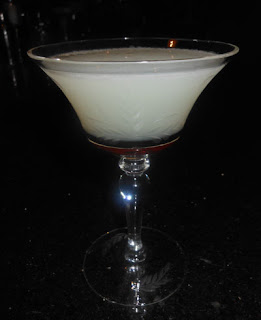
lesley blume let's bring back cocktail veritas
While I was tempted to do the Symphony of Moist Joy since it has one of the best cocktail names ever, I am still holding out for now until Crispin's Crème de Rose made at the Germain-Robin distillery in California makes its way out to Massachusetts. Instead, I opted for the Veritas Cocktail which seemed like a Pegu Club of sorts that swapped the Angostura Bitters for crème de cassis. The cassis was added as a float, but knowing that cassis is one of the most densely sugared liqueurs out there, it as expected still sunk no matter how carefully I layered it. While it is pictured above with a cassis layer on the bottom, I ended up stirring it in. The liqueur's currant joined the Cointreau's orange on the nose. An orange and lime sip contained berry flavors, and the swallow showcased the gin along with more cassis and the lime's tartness. Overall, the crème de cassis added a lot of complexity here without dominating the drink like cassis can often do.

Sunday, December 2, 2012

:: cocktails: a global history ::

joseph m. carlin cocktails a global history reviewDuring the Boston Cocktail Summit in October, I met Joseph Carlin, a nutrition and food history professor at UMASS Boston who wrote Cocktails: A Global History. As we got to talking, we had an interest in each other's books and swapped copies. Joseph's book is part of a recent series of books that covers general cocktails as well as a half dozen or so base spirits. The best known author of that bunch to me is 12 Bottle Bar's Lesley Solmonson who wrote the Gin: A Global History volume.

Cocktails: A Global History does not try to take the history of cocktails and spirits to the same depth of say David Wondrich's Imbibe! or William Grime's Straight Up or On the Rocks. However, it would make a great first overview from the scientific breakthroughs in distillation to the globalization of the cocktail. Moreover, the social aspects of the cocktail covered here reminded me of the RISD museums's 2011 "Cocktail Culture" exhibition with a focus on the tools, cocktail dresses, traditions, and symbolism involved in drinking culture. Despite some simplification of details or taking some hypothesis as fact, the book does a good job of covering a wide swath of history in a short format.

Even with my description of it being an overview, I was still gleaning bits of trivia and learning aspects of cocktails that I was unaware of or had forgotten. In the chapter on punch, for example, Carlin describes how it was common in making a bowl of punch to finish with draping a long curlicue of citrus peel over the edge of a punch bowl to signify that it was freshly made; many Dutch still-life painters captured this in their art. Carlin suggests that this tradition may explain why citrus twists, slices, and wedges are still popular garnishes today. Furthermore, in the tavern chapter, the etymology of bar was proposed. Back in the colonial tavern, the area where the spirits and punch bowls were stored and the drinks were made was locked up in the off hours with bars and slats which extended from counter top to ceiling and were raised when the drink making time began.

The book is not too much of a cocktail recipe collection but is instead an overview of the various classes of drinks and their ingredients. This also includes the wide assortment of food and drink that acquired the name cocktail such as fruit and shrimp. The most curious cocktail contained within is the 19th century libation, the Brompton Cocktail. Created at a London hospital, it contained gin, honey, and morphine for the very sick; in fact, it often got dubbed by the staff as the Terminal Cocktail.  Even some of today's medications, such as AIDS anti-retroviral drug combinations, are still called cocktails.

Overall, Cocktails: A Global History and perhaps the whole spiritous series would make a great primer for someone trying to learn the basics before they delve into the more advanced studies of David Wondrich, Jared Brown and Anistatia Miller, and the like.  In addition, its rapid pace and great illustrations put it in the realm of a great gift idea.

Monday, November 12, 2012

:: boston's best dive bars ::

boston's best dive bars luke o'neil weeklydigAfter reviewing Stephanie Schorow's Drinking Boston book, I decided it was time to tackle another Boston book I had in my pile, namely Luke O'Neil's Boston's Best Dive Bars: Drinking and Diving in Beantown. The book came out in 2011, but I was a little slow to purchase it for I felt that it did not represent my Boston. However, after flipping through it and seeing Somerville's Fasika in the list, I was sold. Fasika is an Ethiopian restaurant that was in Jamaica Plain and was forced to move; instead of staying in the neighborhood, they bought out the East Somerville dive, Coleman's Cafe, and opened in 2006 as a split Ethiopian restaurant and dive bar. The food on the restaurant side is rather good, and I have always been impressed at how the African clientele on the bar side mixes rather well with the old Coleman crew who laid stake to the spot regardless of who owns it. As I scan the bar index, I count a little over a dozen establishments I have been in during my 19 years here in Boston, a few more places that made the didn't-make-the-cut list, and many that I had walked or driven by. Of course there were probably more than that, but many have closed. Even during Luke's researching and writing of the book, places met their demise; that concept reminds me of how difficult it was to write the description of cocktail bars in my book as bar staff changed jobs during the few months that I wrote it.

That is definitely one recurrent theme in Luke's book -- a story of change and resistance to change. The dive bar with its cheap beer and food (if any) scrapes by, and as gentrification, rising property values, neighborhood antagonism, and other changes of neighborhood character occur, many of these places close or perhaps transform into upscale establishments. With liquor licenses fetching 6 figures these days, the temptation to sell it off is probably great.  But as the book describes, many of these places stand as time capsules of eras gone by with their furniture, demeanor, and loyal bar stool squatters.

Parts of Boston's Best Dive Bars reads like a Bukowski book, although Luke is less the drinker-brawler of Hank Chinaski and more the drinking-field researcher trying to fit in and not be at the wrong end of a pool stick beatdown. The book beautifully captures the decor, mood, clientele, and conversations he has with patrons and barstaff. Sometimes there are quotes from his friends and acquaintances that know the places well, and other times, Luke finds it best not to talk and only capture what is being yelled at the television or at others across the bar. Keno, cheap drinks, old men, XXL-sized Patriots jerseys, stale bags of potato chips, and jukebox tunes all make an appearances through out the write-ups.

Luke rates the places on a 1-5 scale in increasing dive-ability and danger. While there are a few 2s in the mix, I do not recall seeing a 1. With the places I knew, I would agree with the assessments although the Rosebud scoring a 5 kind of shocked me; the last time I was in there was when it was an Italian restaurant which was not all that seedy despite having no windows at all. Overall, I was impressed at how much field research and how many lost afternoons were spent compiling this book.

I was also impressed with the author's insight into dive bar truisms. Like how the youthful drinkers at Allston's Silhouette Lounge will drink in harmony with the "wobbly old-timers" that are future versions of themselves.  Or how sometimes at places like Shea's Tavern in South Boston "it's a pretty good idea to keep your head down and not look anyone in the eye. Dive bar drunks are like crocodiles or rhinos or whatever. Best not to show any outward signs of aggression..." Moreover, I was amused at his description of a character at Magoun Square's On the Hill Tavern not too far from where I live in Somerville. Luke's friend described him has "the sheriff. He just stands on the corner by the door and smokes cigarettes." However, my name for him is the Fire Marshall from when I used to walk by him years ago on the way to my East Somerville Muay Thai gym; he would hang out with two other locals at the bench outside the Dunkin' Donuts on Broadway and Rt. 28, and I have spotted him more recently standing guard on occasion in front of said Tavern.

Thinking back to Stephanie Schorow's book, she fetched a bit of her Colonial lore from Samuel Adams Drake's Old Boston Taverns and Tavern Clubs. The book was frequently quoted or re-written by others through the years (with or without attribution) as it was the best resource on Boston bars from that lost time period. In a way, what Luke O'Neil accomplished is capturing a snapshot of a parallel collection of Boston drinking establishments in a way that has not really been acquired in such a survey format before.

Luke's book is available on Amazon.com here: Boston's Best Dive Bars: Drinking and Diving in Beantown as well as at the Boston Shaker store in Somerville, MA (up the square from Sligo's and the Rosebud bar that the book covers -- feel free to stop by before or after).

Wednesday, October 31, 2012

:: book review - drinking boston ::

At the Boston Cocktail Summit book store, they had advance copies of Stephanie Schorow's Drinking Boston: A History of the City and Its Spirits for sale. The copy I bought sat around for a few days before I decided that I would read it on the plane trip over to Portland Cocktail Week. When I spoke with Stephanie, she mentioned that DrinkBoston's Lauren Clark was a possible author for it before Lauren departed to California. While Lauren would have made for an excellent story teller for this book, Stephanie's other books put her in a good position to make this her next step. Her last book, The Boston Mob Guide: Hit Men, Hoodlums, & Hideouts, has an overlapping cast of characters from the Prohibition days when liquor smuggling and speakeasies were rampant in the city. And her work on The Cocoanut Grove Fire book covers the post-Prohibition era when nightclubs began to take over from the speakeasy's and the saloon's reign.

One of the focal points of Drinking Boston is the Ward Eight cocktail in regards to tracing back the legend and lore of its creation at Locke-Ober and possible original ingredients. This aspect hit home because a few weeks before during the Boston Cocktail Summit, I had attended a charity gala there called TheThing and had the honor of drinking a Ward Eight there. It also was poignant because the weekend I was reading the book, Locke-Ober announced that it was shutting its doors forever (later, I learned that a buyer might re-open it with the history intact instead of the gutting we all feared).

After the Ward Eight introduction, the beginning of the book focuses on the early days of drinking in Boston. I touched on some of this information during David Wondrich's Greasing the Hub talk during the Boston Cocktail Summit and during Christine Sismondo and James Waller's The Bad, Bad Boys of Saloons talk at Tales of the Cocktail (in support of Sismondos America Walks into a Bar: A Spirited History of Taverns and Saloons, Speakeasies and Grog Shops book). Even with those primers, Schorow's research uncovers stories and locations that were new to me, and her focus was rather sharpened to the Boston area.

The novel material to me appears with the later years that included the Jacob Wirth restaurant and how it survived Prohibition serving near-beer and about the sports bar run by Michael "Nuf Ced" McGreevy. The speakeasy chapter covers interesting tales about the Marliave, Club Garden, Faneuil Hall Club, and other establishments that figured out ways to keep the drinks flowing despite the great problem sourcing spirits and the risks associated with operating an illegal bar during Prohibition. The book also traces the term "scofflaw" to a newspaper contest here in Boston, and how the name was usurped across the Atlantic for a cocktail to honor those who went against the Dry Tide.

The crime tie-ins are great during this period with one of the more colorful stories being about the life of Charlie Solomon who switched from narcotics trafficking to opening the Cocoanut Grove nightclub and hanging out at the Cotton Club during Prohibition. For the section on Prohibition repeal, Schorow ties in the modern speakeasy movement by discussing the aesthetics of modern day Boston establishments like Saloon, Brick & Mortar, and Backbar.

Moreover, Drinking Boston covers the city's beer brewing history as well including the Haffenreffer brewery that later became populated by the Boston Beer Company, and the other breweries that used to dot the Stony Brook corridor of Jamaica Plain and Mission Hill. Also, the modern rebirth of breweries and distilleries in Boston is discussed.

The more modern day chapters focus on famous Boston bars like J.J Foley's, the Rathskellar, Doyle's Café, and the Merry-Go-Round bar at the Copley (yes, there used to be more carousel bars than the one at the Hotel Monteleone in New Orleans). In addition, gay bar history, such as the Eagle, Playland, and Jacques, as well as jazz clubs like Wally's showcase the wide variety of drinking establishments in the city. And the end features some of the modern cocktail resurgence by providing coverage of Jackson Cannon, John Gertsen, Misty Kalkofen, Jamie Walsh, Todd Maul, and Brother Cleve.

Overall, the book does a good job discussing over three hundred years of imbibing in Boston. The power of the stories builds as the time frame becomes more and more recent, and the photo and illustration selections help to root these stories with images of bars and bootleggers alike.