Showing posts with label chinato. Show all posts

Thursday, November 24, 2022

no glory in the west

1 oz Del Maguey Mezcal Vida (1 1/2 oz)
3/4 oz Barolo Chinato (Cocchi)
3/4 oz Aperol
2 dash Angostura Bitters

Stir with ice, strain into a cocktail coupe, and garnish with orange oil from a twist.
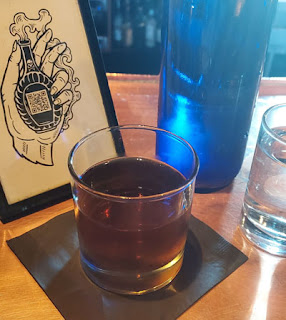
Continuing on in the "Drinks of Drink" notebook, I spied the No Glory in the West that reminded me a little of the Caesar Cardini that had also been created at Drink. The recipe was probably named after the Orville Peck song which makes its invention sometime after the song was released in 2020. Once stirred and strained, it proffered an orange, vegetal, and smoke bouquet to the nose. Next, grape and orange notes mingled on the sip, and the swallow wrapped things up with smoky, vegetal, grape, and quinine flavors on the swallow with a smoke and clove finish.

Monday, October 17, 2022

caesar cardini

2 oz Del Maguey Mezcal Vida
3/4 oz Barolo Chinato
1/4 oz White Crème de Cacao

Stir with ice, strain into a Nick & Nora glass, and garnish with freshly grated coffee bean.
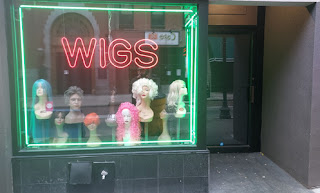
Two Mondays ago, I had finished up hosting two seminars for USBG Boston's Education Week 2022 at Drink, and I decided to treat myself to a cocktail on the way home. Therefore, I walked from Fort Point to Downtown Crossing to check out the recently opened Wig Shop -- a speakeasy-style cocktail lounge by the folks at JM Curley. The location used to be called the Wig Store, and they kept the wig display in front of the old shop but put black curtains to cut off the view to the interior of the repurposed space. I arrived around open so I got around the seeming need for a reservation. With the set up being tables with seating for up to 4 or perhaps 5 and no bar seating, it would make a great venue for meeting up with friends.
For a drink, I selected the Caesar Cardini attributed to Drink founder John Gertsen. I was able to source the recipe and some back history in a 2012 Boston Chefs article that described how John was influenced by the classic North Italian pairing of the quinine-laden Barolo Chinato with chocolate. To that John went with a base of mezcal and accented things with grated coffee beans to complement the crème de cacao and Chinato. The combination reminded me of the Bonal version that I had in Drink in 2010 that was attributed to John Gertsen and Misty Kalkofen. For a name, Gertsen went with a tribute to Caesar Cardini, an Italian immigrant chef who ended up in Mexico during Prohibition when it was too hard to run a restaurant in America; Cardini is best know for creating the Caesar salad at his Tijuana restaurant in 1924. This liquid tribute began with smoke and roasted coffee aromas on the nose. Next, grape and light cherry notes on the sip turned over into smoky mezcal, bitter-sweet herbal flavors, and light chocolate accents on the swallow.

Tuesday, July 5, 2022

big in japan

2 oz St. George Baller Single Malt
3/4 oz Del Professore Chinato
1/4 oz Amaro Nonino

Stir with ice, strain into a rocks glass, and garnish with lemon oil from a twist.

I had recently learned that Brick & Mortar had expanded their schedule to include Tuesdays, and I was excited to go. Previously, it had been impossible for my work schedule at Drink is the same Wednesday through Saturday that theirs was; I had been recommending the bar to my guests with the caveat that I assumed that it was as good as it had always been. When I walked up the stairs and approached the horseshoe copper bar two Tuesdays ago, I was surprised to see a familiar face who greeted me by name. Bartender Nic Mansur had worked at Brick & Mortar from 2013 until mid-2015 when he left to become the bar manager at Shepard, and when he was recently looking for opportunities, he contacted Brick & Mortar's owner about returning. For a first drink, I opted for the Big in Japan; the drink name alone reminded me of the "I'm an ass" (this was the description that bar manager Sam Gabrielli had in the new drinks notes) menu item at Russell House Tavern that partnered Yamazaki 12 Year, sweet vermouth, and orange bitters with Fireball in early 2014. Instead, this tribute to a Tom Waits song (at least Sam's was that) was much more elegant utilizing a chinato instead of a vermouth and Amaro Nonino instead of Fireball. While the whisky was not Japanese, St. George makes great products, so I was willing to let that slide especially since the price point and availability for the foreign stuff is very different than eight years ago. As an additional side note, the Fireball appeared on the bar after we all went out after a brunch shift at Russell House Tavern to Charlie's Kitchen, and the round of Fireball shots had my bar manager smitten for a bit. The product did not remain on our shelves long, but long enough for me to generate an OnTheBar menu item of a Fireball Fizz in a Ramos style that eventually found its way into Matt Rowley's book Lost Recipes of Prohibition: Notes from a Bootlegger's Manual. (I found it funny that I could sell it to friends for $7 as a $4 pour with $3 cocktail up-charge). Indeed, the years that Nic and I working at Brick & Mortar and Russell House Tavern, respectively, were a zany time.
The scene was a bit more sedate than some of the wild years nights on this Tuesday shortly after open with a handful of guests already having staked a claim to seats around the hairpin turn of the bar. The Big in Japan that Nic made me began with a lemon and grape aroma. Next, grape and caramel notes on the sip flowed into whisky and orange herbal flavors with a hint of smoke on the swallow. Overall, it was definitely great to be back in the space after a three year absence and to have an amazing drink there again.

Monday, April 3, 2017

harkness table

1 oz Christian Drouin Selection Calvados
1 oz Christian Drouin Pommeau di Normandie
1 oz Alessio Chinato Vermouth

Stir with ice, strain into a double Old Fashioned glass, and add ice cubes.
Two Mondays ago, I ventured down to No. 9 Park for an afternoon of education with the producer of Christian Drouin Calvados. After the talk, we were treated to Ted Gallagher of Steel & Rye making drinks. One of his recipes was the Harkness Table named after a teaching method where students sit in a large oval and discuss topics in an open-minded atmosphere with little teacher intervention. In the glass, the Harkness Table was like a Marconi Wireless with more fresh apple notes and a touch of quinine instead of the normal orange bitters.

Wednesday, June 19, 2013

[bezzera]

3/4 oz Campari
3/4 oz Cocchi Barolo Chinato
3/4 oz Ransom Old Tom (usually Wireworks Gin)
1/2 oz Coffee Rustico Syrup (1:1)

Stir with ice and strain into a cocktail glass. Garnish with an orange twist.

The better demonstration of how well coffee and Campari required a short wait as Tyler fetched some freshly brewed coffee, added sugar, and made a syrup. For a coffee, he selected Counter Culture's Rustico which is an espresso roast-level bean. He originally crafted this drink with Wireworks Gin with which he also made the Purple Princess, but in its temporary absence at the bar, he opted for Ransom's Old Tom. Tyler did not have a name for the drink yet, so in the meantime, I am dubbing it the Bezzera after the man who in 1901 filed the first patent for an espresso machine.
coffee cocktail
The drink greeted my nose with a grape and orange oil aroma. The grape continued on into the sip where it mingled with the coffee's roast notes; the roast notes then flowed into the swallow where it paired with the gin and Campari herbal elements.

Wednesday, July 25, 2012

bobby burns (variation)

2 oz Compass Box King Street Blended Scotch
1 oz Vergano Americano
1 barspoon Chestnut Flower Honey

Stir with ice and strain into a rocks glass.

The other drink that Stephen Shellenberger wanted to make me was his Bobby Burns variation that he got some press for back in 2008 when he was at Dante. The Boston Globe wrote, "It turns out that Shellenberger's version is no proper Bobby Burns, but its impropriety is an apt tribute to the roguish poet who immortalized his own scandalous romances and spoke out against the status quo." While he no longer uses housemade vermouth and opts for a chinato instead, he still prefers single varietal honeys that he finds at Formaggio's Kitchen.  The honey made a great substitute in place of some Bobby Burn's Drambuie (other versions use Benedictine instead).
The honey certainly came through in the aroma where it paired with the Scotch's smoke and in the sip where it mingled with the chinato's grape and Scotch's malt notes. While the smoky Scotch began the swallow, it ended with a return of the honey in a lingering honey, floral, and grape finish.
While drinking Stephen's Bobby Burn's rendering, I thought of another Scotch variation I had a few weeks ago at Trina's Starlite Lounge. During a Monday industry brunch, one of the sponsors was Cutty Sark, and bartender Beau Sturm made up a round of his Rob Roy variation for the bar.
Rob Roy (variation)
• 2 oz Cutty Sark Blended Scotch
• 1 oz Noilly Prat Dry Vermouth
• 1/4 oz Luxardo Maraschino Liqueur
• 1 dash House Orange Bitters
Stir with ice and strain into a rocks glass. Garnish with a brandied cherry.
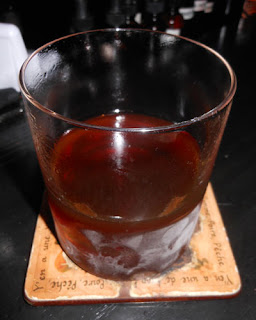
Rather good although Cutty Sark is a more gentle and less smokey blended Scotch than Compass Box's King Street. Perhaps its mildness is what allowed the dry vermouth and other ingredients to shine out so well. As I enjoyed the drink, I could not help but think that Andrea's dad was smiling down on me for drinking Cutty Sark; however, he would have preferred just the Scotch on the rocks instead.

Friday, April 6, 2012

[canboulay]

3/4 oz Scarlet Ibis Rum
3/4 oz Bowmore Islay Scotch
3/4 oz Averna
1/2 oz Barolo Chinato
1/4 oz Demerara Syrup
2 dash Mole Bitters

Stir with ice and strain into a rocks glass pre-rinsed with 3 spritzes of Del Maguey Chichicapa Mezcal. Twist an orange peel over the top.

For my second drink at Craigie on Main, bartender Jared Sadoian took my suggestion for a brown, bittered, and stirred drink and set to work. What he concocted reminded me of a Scotch and rum Black Manhattan (rye, Averna, Angostura Bitters); given the aromatized wine aspect, I had dubbed the style in the past a Brown Manhattan. With the Trinidad rum, demerara syrup, and the smoky notes from the Scotch and mezcal, I thought about how some islands burn their sugar cane fields before harvest in order to make the process easier and require less manual labor. In Trinidad, the burn is called Canboulay from the French cannes brulées meaning "burnt cane," and it is celebrated with a harvest festival that includes calypso music and a masquerade carnival. Since the drink needed a name, I figured Canboulay would make for a fine place holder for the time being.
The smoke notes and orange oils paired rather well on the nose. The Averna's caramel and the Barolo Chinato's grape dominated the sip, and the swallow began with the smoky Scotch followed by the rum. The swallow ended with Averna's herbal flavors with lingering chocolate, cinnamon, and clove notes. While the swallow was sweet, the sip was surprisingly drier; Andrea's reaction to this sweet swallow was to comment that "it's like candied Scotch!" Jared mentioned that the demerara syrup in retrospect was probably overkill, and I surmise that he would make up the difference with additional Barolo Chinato in the future.

Friday, February 24, 2012

eastern promise

1 1/2 oz Pierre Ferrand Ambre Cognac
1 oz Cocchi Barolo Chinato
1/2 oz Zucca
1 barspoon Jeppson's Malört

Stir with ice and strain into a coupe glass rinsed with Caol Ila Scotch.

Wednesday last week, Andrea and I paid a visit to Craigie on Main where bartenders Ted Gallagher and Jared Sadoian were behind the stick. When I asked Ted if he had any new drink ideas, he did not miss a beat and pulled out the bottle of Jeppson's Malört. I had completely forgotten than he had taunted me a week or two earlier with a photo of the stuff on Facebook. Malört is a bitter Swedish style of schnapps made domestically and sold in Chicago that is renowned for its bad taste and the faces people make when trying it. Ted gave me a taste, and I was surprised at how delicious it was with its gentian, minty, and wormwood notes. Ted surmised that people might not like it since it is low on the sugar content to balance the bitterness, but after tasting so many nonpotable bitters, I was unphased.
For a drink, Ted suggested the Eastern Promise named after the hope that his friend would bring him back a bottle of this European-styled spirit. The Eastern Promise's Scotch rinse paid dividends on the aroma for it contributed an alluring smokey note. The chinato's grape filled the sip, and the swallow began with the Cognac that led into the chinato and Zucca notes. The Malört worked quite well to impart a light, lingering bitter note to the aftertaste.

Wednesday, February 15, 2012

[latest buzz]

3/4 oz Grappa di Moscato
3/4 oz Cristinalda Brandymel Honey Liqueur
3/4 oz Vergano Americano Chinato
3/4 oz Lime Juice

Shake with ice and double strain into a wine glass.

Two Mondays ago, Andrea and I ventured over to Brookline Village to eat dinner at Pomodoro. For a drink, I was eyeing the house Margarita and bartender Stephen Shellenberger asked if I wanted something in a similar style but with funkier ingredients. The most intriguing one he used was a Portuguese honey liqueur flavored with herbs. For the liqueur's base spirit, a moonshine brandy from the arbutus (sometimes called the medronho or strawberry tree) fruit is made by the local farmers. The farmers either trade the spirit for the use of the land or sell it to the liqueur maker directly. With a grappa as a spirit, a chinato for complexity, and lime juice for crispness, the drink took form as a curious Daisy. The honey liqueur played an integral roll in the drink and it first appeared in the aroma along with some floral notes. The lime, grape, and honey flavors filled the sip, and the swallow offered up more robust grape notes with the Brandymel's honey funkiness.

Sunday, January 15, 2012

a few of my favorite things

1 1/2 oz Rittenhouse 100 Rye
1/2 oz Vergano Americano Chinato
1/2 oz Cynar
1/2 oz Aperol
1 dash Bitter Truth Orange Bitters

Stir with ice and strain into a rocks glass. Garnish with an orange twist.
For a second cocktail at Bergamot, bartender Paul Manzelli made me A Few of My Favorite Things. With the name based off of a song from The Sound of Music, there were none of the things Mary Martin or Julie Andrews loved. Luckily, Paul's favorite things were more in my mood than raindrops on roses and whiskers on kittens. The drink's aroma presented the Aperol and orange oils with a darker note from either the Cynar or Vergano at the end of the inhale. The sip was rather full flavored with grape and Aperol notes, and the swallow concluded with rye and Cynar elements.

Wednesday, December 21, 2011

wayback

1 1/2 oz Fidencio Mezcal
1/2 oz Cocchi Barolo Chinato
1/2 oz Carpano Antica Sweet Vermouth
1/4 oz House Picon Liqueur
1/4 oz Agave Syrup
2 dash House Aromatic Bitters
1 dash Black Tea Bitters

Stir with ice and strain into a cocktail coupe. Twist a lemon and an orange peel over the top and discard.

For our second round at Deep Ellum, bartender Max Toste had some off-menu ideas that he wanted to try out on us. The drink Max made me was the Wayback which featured one of the three Fidencio Mezcal products the bar now carries, a pair of robust aromatized wines, and a trio of bitter elements to round off the drink. The Wayback began with an agave and red grape aroma that was accented by the citrus oils from the twists. The sip was a full-bodied cherry-grape flavor with orange notes from the Picon; Andrea described its texture as "velvety." The mezcal appeared on the swallow and its intensity was smoothed out by the sweet wines and agave syrup. Indeed, certain aspects of this drink reminded me of the Independent's This, That, the Other.
For Andrea, Max wanted to show off his variation of the Metexa. I had recommended this recipe when we saw him at Hawthorne and he mentioned that he had reformulated his house Swedish Punsch. His alteration of this 1937 tequila aperitif was as follows:
Metexa (variation)
• 1 1/4 oz Cocchi Americano
• 3/4 oz Housemade Swedish Punsch
• 1/2 oz Fidencio Mezcal
• 1/2 oz Blanco Tequila
• 1 squeeze Lemon Slice (1 dash juice)
• 1 dash House Orange Bitters
Shake with ice and strain into a cocktail coupe. Garnish with a lemon twist.
Both the aroma and the sip were dominated by Cocchi Americano and lemon notes. Next, the swallow shifted the focus to a smooth tequila and mezcal flavor, the Punsch and bitters' spice, and a lingering smokiness.

Wednesday, October 5, 2011

merchant's wife

1 oz Berkshire Mountain Distillers Ethereal Gin
1 1/4 oz Watermelon Shrub (*)
1 oz Dolin Dry
1/2 oz Boroli Barolo Chinato
2 dash Angostura Bitters

Shake with ice and strain into a Collins glass filled with fresh ice. Top with 1 oz soda water, garnish with a sprig of opal basil, and add a straw.
(*) while not how Craigie on Main makes it (see text below), one recipe for watermelon shrub is here.

Two Tuesdays ago, Andrea and I paid a visit to Craigie on Main where Ted Gallagher and Jared Sadoian were tending bar. On the menu was a delightful sounding drink, the Merchant's Wife, that included watermelon shrub in a highball format. When I inquired about the drink, Ted commented that they had a lot of vinegar pressed watermelon from the kitchen, and the shrub was a combination of cold and hot methods that utilized cider vinegar and plain sugar. I was intrigued; therefore, I asked Ted for the Merchant's Wife but requested that he not tell the merchant though.

The opal basil provided an attractive centerpiece to the Merchant's Wife; despite its different coloration, this cultivar is not too much different from normal basil, and its aroma worked well with the hint of watermelon that poked through. The sip came across as a citrussy red wine flavor with a bit of carbonation. Perhaps the citrus flavor was a combination of the bubbles and the shrub's vinegar since there was no citrus other than peel notes in the gin and vermouth. The sip also contained cinnamon from the Angostura Bitters that complemented the Barolo Chinato flavors. Finally, the swallow showcased the watermelon and the gin. Overall, the Merchant's Wife was rather savory from the vinegar in the shrub and from the herbal notes in the gin and wines, and it would probably make for a great aperitif.

Tuesday, January 13, 2009

[bourbon el presidente]

2 oz Four Roses Bourbon
1/2 oz Luli Chinato
1/2 oz Rhum Clément Creole Shrubb
1 barspoon Fernet Branca

Stir with ice and strain into a rocks glass.

For my next cocktail, I asked Hugh for a whiskey drink and he had an idea that stuck with the Creole Shrubb theme. The base spirit he went with was a new-to-Eastern Standard bourbon, Four Roses; while I did not taste it alone, reviews of it suggest that it has a pleasing floral or fruit nose to it. To the whiskey and orange liqueur, Hugh added in a bit of Luli, a white wine-based chinchona bark-infused vermouth. The Luli's floral notes mixed well with the Creole Shrubb and Four Roses, and the quinine and other botanical flavors in it helped to lead in to the bitters of the Fernet Branca. Over all, the cocktail was very much a Bourbon El Presidente with a notable bitters signature. Hugh appeared pleased when I commented that it seemed like a drink recipe that I would envision Chuck Taggart to be enjoying and writing about it in his blog.

Tuesday, November 18, 2008

[little celery]

1 1/2 oz Sazerac Rye
1/2 oz Luli Chinato
1/2 oz Cynar
1/2 oz Aperol
1 dash The Bitter Truth's Celery Bitters

Stir with ice and strain into a cocktail glass. Or 3 cordial glasses.

Since Andrea had been at Eastern Standard for a while before I got there, it was time to go not too long after I got there. But still leaving enough time for Hugh to mix up a nightcap for us. He had been scanning the shelves for other things that would complement the Bitter Truth's Celery Bitters after making the rhum cocktail for me. He had spotted the Cynar and thought that the artichoke-herbal funkiness of it would work rather well with the celery bitters.

Hugh designed the cocktail similar to the Little Italy, with rye (this one was with the Jackson Cannon barrel that the distillery made up for Eastern Standard), Cynar, and a chinato instead of a sweet vermouth. And he also added in some Aperol and the bitters. Chinatos are vermouths that use quinine (China in Italian). Most chinatos use a lusty and full-bodied Barolo red wine as the base, but the Luli uses a white moscato as a base. One blog described it as, "less intense and a touch sweeter than more traditional Chinatos but still has incredible floral aromatics, lots of kaffir lime, peaches, kumquat, ginger, thyme flowers, basil, jasmine, and hibiscus flavors."

The end product was very vegetal and made for a good nightcap and digestif. Interesting how after not having had a Cynar cocktail in almost a year (I gave Mike at Highland Kitchen the recipe for a Little Italy since he did not know what to do with "that stuff") that I have had two Cynar cocktails chosen for me in consecutive nights. To me, that is a good omen!