Thursday, March 31, 2011

groovy child

1 1/2 oz Hendrick's Gin
3/4 oz Noilly Prat Dry Vermouth
3/4 oz Lime Juice
2 heaping barspoon Guava Jelly
1 barspoon Simple Syrup

Shake with ice and double strain into a cocktail glass. Garnish with 3 juniper berries.

Last Saturday, Andrea and I drove out to Worcester to visit the Higgins Armory. Since Andrea was in the mood to go to a museum and I remembered that Hilary Scott's exhibition there was ending in a few months, it seemed like a good day for a road trip. After looking at a lot of old armor and Hilary's surreal art work, we drove into downtown Worcester for dinner at the Citizen (unrelated to the Citizen in Boston). When we sat down at the bar, bartender Dave Delaney greeted us and remembered meeting me at Tales of the Cocktail last summer. As we looked over the drink menu, we noted that there was a combination of classics like the Martinez and the Boulevardier and a handful of house originals; surprisingly, there were neither vodka drinks nor light beers on the menu (lucky for them, they did have vodka at the bar)! The drink that caught my eye first was the Groovy Child for it called for guava jelly. Beside my enjoyment of marmalade in a recent drink, I was curious for I had only seen guava jelly called for in 19th century punch recipes. Indeed, Dave explained that he got the idea from Jerry Thomas' Barbados Punch. While I spent the whole time drinking the Groovy Child pondering the name, I only later made the connection that it was taken from a line in the Bob Marley song "Guava Jelly."
The juniper berry garnish helped to supplement the aroma of the Groovy Child especially since Hendrick's is a less juniper-forward gin. The lime and guava jelly elegantly paired up to conjure a tropical sip; guava jelly has been described as a less sharp lemon rind flavor, so it worked well with the lime. The lime helped the sip transition into the swallow where these notes lingered to pair up with the gin and dry vermouth. With the drink on the slightly tart side, the Groovy Child was a decent drink to have before our first course arrived.

Wednesday, March 30, 2011

standish arms

1/2 William Penn Rye (1 1/2 oz Redemption Rye)
1/4 Italian Vermouth (3/4 oz Vya Sweet Vermouth)
1/4 Grapefruit Juice (3/4 oz)
1 dash Peychaud's Bitters

Shake with ice and strain into a cocktail glass.

For my second drink on Friday, I found the Standish Arms in Pioneers of Mixing at Elite Bars: 1903-1933. The recipe reminded me a lot of Jackson Cannon's Honey Fitz that I had at Tales of the Cocktail last summer. Here, the recipe contains rye and sweet vermouth instead of the Honey Fitz's dark aged rum and honey syrup, but the proportions, grapefruit juice, and Peychaud's Bitters are all the same. Moreover, the De Rigueur and Brown Derby #2 are whiskey-based versions of the Honey Fitz sans bitters. Next, I was curious and pondered what the drink could be named after. There was a Standish Arms built in Brooklyn in the Beaux Arts style; the hotel was built in 1903 which puts it in the right time era for the publication. While many famous real and fictional characters (including Clark Kent) stayed in the hotel and apartments there, I could not confirm if there was a restaurant or bar there that would support this idea. Since there could be other Standish Arms as the inspiration, it was time to move on and drink.
The Standish Arms presented itself with a rye aroma spiked with anise notes from the Peychaud's. The sip contained the fruit notes from the grapefruit juice and Vya vermouth's red wine base. Meanwhile, the swallow contained the rye, spice, and a little crispness from the citrus. Indeed, the grapefruit and sweet vermouth paired surprisingly well and each complemented the rye too. Furthermore, the grapefruit and sweet vermouth pairing reminded me of the D.J., a drink created at the Detroit Athletic Club where the Last Word was born (in addition, both the D.J. and the Last Word share a resemblance). Overall, the Standish arms was rather smooth and drinkable yet flavorful enough to keep one's attention to the end of the glass.

Tuesday, March 29, 2011

novara

1 1/2 oz Gin (Knockabout)
1/2 oz Campari
1/2 oz Passion Fruit Syrup (Trader Tiki)
1/2 oz Lemon Juice

Shake with ice and strain into a cocktail glass. I added a lemon twist.

On Friday before dinner, I opened up the Big Bartender's Book and found a rather tempting cocktail created by Jamie Boudreau called the Novara. Jamie based the drink off of Kaiser Penguin's Orange Viola that appeared in Imbibe magazine a few years ago. For a name, Jamie made reference to Novara, Italy, where Campari was created back in 1860.
The Novara began with a lemon and Campari aroma. The sip was a fruity combination of the lemon and passion fruit, and the swallow contained the Campari and gin notes. What was most intriguing was that the components melded into a rather tangerine-like swallow. It was the most interesting modulation of Campari that I had experienced since the Carnivale (a/k/a Pisco Disco); in that drink, the pairing of Campari and Maraschino liqueur tricked me into thinking that the amaro was Aperol instead. Jamie also found the combination in the Novara fascinating and compared it to what he experienced in Paul Harrington's Jasmine.

casper sour

1 1/2 oz Vodka (Vesica)
1/2 oz Simple Syrup (1:1)
1/4 oz Rice Wine Vinegar

Stir with ice and strain into a cocktail glass. Garnish with a lemon twist.

For Thursday Drink Night on Mixoloseum last week, the theme was "Animosity." The concept was to use an ingredient that you hate or neglect. I first started in my liqueur section and pulled out the dustiest of bottles including Chambord, Parfait Amour, and a few others that get little use. Inspiration still did not hit. I took a step back and considered vodka. Even for Mixology Monday's vodka theme, I chose a robustly flavored drink, the Sputnik, to present. There, the vodka helped to dilute the intensity of Fernet Branca in a Sour-type drink. Joking around with the concept of a less flavored drink, someone on Mixoloseum came up with the name of a "Casper" (the Friendly Ghost) Martini. From there, I toyed with the idea of a minimalist Sour drink.

I first considered making a solution of citric acid powder, but I was unsure of the concentration to use (note: for future reference, lemon and lime juice are 5-6% citric acid or around 1.1 grams per ounce of water) and how I could balance it with simple syrup. Instead, I thought about vinegar. From my experiments and notes on vinegar-based fruit shrubs, I felt comfortable on how to balance the vinegar's acid content (BTW: vinegar is also at a 5% concentration, albeit with a slightly different pKa) with sugar. While plenty of other people have used flavored shrubs and gastriques, what about an unflavored one? Or one that just used a flavorful vinegar alone? I first looked at my apple cider vinegar but it was near the end of the bottle and full of particulates; next to it was a nice bottle of rice wine vinegar and I decided to give it a go.
For a drink name, I harkened back to the Casper idea and dubbed the experiment the Casper Sour. The drink's nose was a lemon oil aroma that meshed well with the hints of the rice wine vinegar. Upon tasting it, I was rather pleased with the savory sweet and sour sip and the dry rice wine swallow. Indeed, for what I was expecting to be a flavorless yet crisp drink had a beautiful light sake sort of effect. While I have never tried or comprehended the allure of a Dirty Vodka Martini, the Casper Sour gave a glimpse at why people might enjoy something like that especially since most olive brines contain vinegar in addition to the salt.

Monday, March 28, 2011

blue parrot

1 oz Batavia Arrack
1 oz El Dorado White Rum
1/2 oz Grand Marnier
1/2 oz Bols Blue Curaçao
1/2 oz Lemon Juice

Shake with ice and strain into a highball glass filled with crushed ice. Top with a ~1/2 oz Henri Bardouin Pastis float, add a straw, and garnish with a wide lemon twist.

On Wednesday last week, I met Andrea at Eastern Standard for dinner. For one of my drinks, bartender Josh Taylor made me the new house original, the Blue Parrot, off of their menu's Tikisms section. I later discovered that there is another Blue Parrot that is rather reminiscent of the Surfer on Acid and contains Captain Morgan's Parrot Bay Coconut Rum, Maui Blue Hawaiian Schnapps, and pineapple juice. Luckily, the only things these two Blue Parrots have in common are rum and blueness. But wait, blue Curaçao at Eastern Standard? When I asked Josh about it, he stated that they had it left over from a post-Valentine's Day event a while back. I was there that night back in 2009 when the theme was 4th of July (in February) and recalled the red, white, and blue drinks (I believe that I tried the red before switching over to beer-and-Fernet-shots in exchange for my drink tickets). Josh was amused when I pointed out that the stock now had over 2 years of dust on it.
I was wary of the drink idea at first, but the base of Batavia Arrack and El Dorado white rum won me over. Essentially, the Eastern Standard Blue Parrot is a rum Sidecar (a/k/a X.Y.Z.) served over crushed ice with a pastis float. The Blue Parrot greeted me with a lemon and anise aroma from the twist and pastis float, respectively. Once I got over the awe of the blueness, I took a sip which contained the citrus notes from lemon juice and orange liqueurs. The swallow though contained the bite of the Batavia Arrack and white rum coupled with the crispness of the lemon juice. Toward the end, I reached the comforting anise-flavored bomb from the float which distracted me from the eerie blue-stained crushed ice in my nearly drained glass.

strange acquaintance

1 1/2 oz Blended Scotch (Famous Grouse)
1 oz Ruby Port (Taylor Fladgate)
1/2 oz Lemon Juice
1/2 oz Egg White (1/2 Egg White)
1/4 oz Ginger Syrup (Ginger People)

Shake once without ice and once with. Strain into a Collins glass (highball glass) filled with ice cubes and 1 oz of spicy ginger ale (Natural Brew Outrageous Ginger Ale). Garnish with a lemon twist and a Maraschino cherry (Luxardo).

Last Tuesday, I finally made the Strange Acquaintance from the most recent issue of Imbibe magazine (March/April 2011). The recipe calls for Blenheim Spicy Ginger Ale which I could not find, but I was able to locate Natural Brew's Outrageous Ginger Ale (at Harvest Co-op in Central Square) that sounded like it would make a fair substitution. Natural Brew's product has ginger juice in it in addition to ginger extract (most ginger ale is extract only a/k/a "natural flavors") and thus falls somewhere between regular ginger ale and ginger beer. The drink was created by bartender Wesley Wolf from the Lantern Restaurant in Chapel Hill, NC. While Wesley points to the Japanese Fizz that appears in Dale Degroff's books as his drink inspiration, I was reminded of the classic Chicago and Elk's Own Cocktail. Regardless of which of the three recipes one considers, the addition of ginger syrup and ginger ale takes this drink in a different direction. Once mixed, the Strange Acquaintance began with a lemon, port, and ginger aroma. On the tongue, lemon and port flavors on the sip preceded the ginger and Scotch notes on the swallow. Overall, the Strange Acquaintance could do no wrong.

Sunday, March 27, 2011

:: effect of glass temperature ::

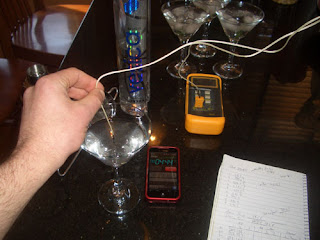
While it is always stressed that chilling glassware is an important step in making great drinks, how important is that to the end result? Moreover, some bars will cool their glassware in freezers while others will chill them with melting ice or ice water. While obviously the freezer is more optimal, how does that difference translate into the final drink temperature? To test that, I devised an experiment to address these questions using a Vodka "Martini" as a standard drink.

Materials:
• 30 oz Vesica Vodka (80 proof)
• 9 Libbey Martini Glasses
• Freezer
• Cobbler Shaker
• Fine Strainer
• OXO Measuring Cup
• Ice from Tovolo Trays from Freezer
• Digital Thermometer with Thermocouple (-58°F to 2372°F, ±0.1°F)
• Timer Application on Droid Phone
• Digital Scale

Protocol:
• Measure room temperature and freezer temperature.
• Chill 3 glasses in freezer for over 90 minutes.
• Chill 3 glasses with ice cubes with some water.
• Measure temperature of ice water before use.
• Keep 3 glasses at room temperature.
• Add 3 oz vodka and 4 ice cubes to cobbler shaker. Shake 30 seconds.
• Double strain to remove ice shards.
• Measure temperature every 30 seconds for 5 minutes while gently stirring with temperature probe.
• Ice water dumped 15 seconds before straining. Glasses removed from freezer 15 seconds before straining.
• Do a round of shaking to measure initial temperature before straining.
Caveats:
• Yes, I shook a Vodka "Martini" but it is a quicker technique than stirring and is a consistent method. Moreover, taste and texture of the drink were unimportant here.
• Different glass sizes and shapes will affect the end result. Here, the 9 glasses are comparable to each other, but not to other glasses.
• Ice temperature (from freezer or wet ice) will affect results.
• Room temperature will affect results.
• Different drink compositions will change the amount of alcohol, sugar, and other solutes in the drink and may effect temperatures.
• My thermometer was never calibrated.
• Initial temperature (t=0) was only measured once as a separate experiment. Performing it for each run would have disrupted the experiment. This data point is only there as rough estimate for each trial's initial time point.
• Glasses were not handled or drank from (which would otherwise normally happen).

Data:
• Average Glass Weight: 237.4 grams (range 231.1-244.3 grams)
• Room Temperature: 59.1°F
• Freezer Temperature: 13.1°F
• Ice Water Temperature: 33.6°F
• Vodka (shaken for 30 seconds) Temperature: 24.9°F

• Data presented as average of triplicate runs:
Average Temperature (30-300 seconds):
• Room Temperature Glass: 31.0°F
• Ice Water Chilled Glass: 29.1°F
• Freezer Chilled Glass: 26.6°F

Differences in Average Temperature (30-300 seconds):
• Room Temp - Ice Water: 1.9°F
• Room Temp - Freezer: 4.4°F
• Ice Water - Freezer: 2.5°F

Differences in Temperature at 30 & 60 seconds:
• Room Temp - Ice Water: 1.2 & 1.7°F
• Room Temp - Freezer: 2.7 & 3.8°F
• Ice Water - Freezer: 1.6 & 2.1°F

Conclusions:
Initial temperature of the glassware before straining does effect the temperature of the drink. The freezer-chilled glassware provided the coldest drinking experience but only provided a drink that was 2.5°F colder than an ice water-chilled glass in this experiment. The freezer-chilled and ice water-chilled glassware were better than unchilled glassware by 4.4°F and 1.9°F, respectively, over the time course. The differences, however, were not as great in magnitude when the first sip might be taken (somewhere between 30-60 seconds after straining).

Choice of glassware would matter greatly. In a cocktail glass, the stem and base do not play a large role, whereas in a rocks glass, the thick base would act as a large heat sink. Moreover, freezers will chill the whole glass whereas ice water will mainly chill the cocktail glass' bowl. Future experiments could address these difference such as by measuring the temperature time courses of coupes and rocks glasses as well as different styles of cocktail glasses.

So what does a 1, 2, or 4 degree difference mean to the perception of a drink? Obviously, this will vary by drink composition and some drinks will be only slightly less pleasant to drink warmer whereas others' balance will begin to crumble. Over the 5 minute time course, an unmolested drink changed about 3 degrees in this experiment. Perhaps making the same drink twice, strained 5 minutes apart and sampled simultaneously, would help to answer that.
Be sure to read the other experiments:
• Part 2: Kinetics of Glass Cooling
• Part 3: Effects of Glass Thickness on Drink Temperature
Friday, March 25, 2011

emily shaw's special

1/2 Brandy (1 1/2 oz Martel VS Cognac)
1/4 Lemon Juice (3/4 oz)
1/8 Cointreau (3/8 oz)
1/8 Sweet Vermouth (3/8 oz Vya)

Shake with ice and strain into a cocktail glass. I added a lemon twist.
For my second drink on Monday night, I opened up Ted Saucier's Bottoms Up and was lured in by the Emily Shaw's Special. The drink was credited to Emily Shaw's Inn in Pound Ridge, New York; though the recipe was published in 1951, the Westchester establishment was still open up until last year. What drew me to the Emily Shaw's Special was how it was a variation of a Sidecar with some of the sweetness coming from Italian vermouth instead of solely from orange liqueur. While the Vya sweet vermouth donated additional flavors and aromas, what was most intriguing was how reducing the orange to lemon quotient affected the flavor balance. While the classic Sidecar recipe is an equal part orange liqueur to lemon juice ratio, many recent recipes have a sweeter 2:1 ratio that stresses the orange flavors more than the lemon. Here, the orange to lemon ratio was skewed in the other direction and it really changed the perception of this drink; it made me notice how the Sidecar is more of an orange-driven drink than I first appreciated and how pushing the lemon notes forward altered the drink greatly. Indeed, I found the experience worthwhile especially as an extension of thinking about the history of the Sidecar including the Crusta as its precursor.

coffey park swizzle

1 oz Barbancourt 4 Year Rum (Old Monk)
1 oz Amontillado Sherry (Lustau)
1/4 oz Velvet Falernum
3/4 oz Ginger Syrup (Ginger People)
3/4 oz Lime Juice

Swizzle in a highball glass filled with crushed ice. Add a straw and garnish with 3 dashes of Angostura Bitters on top of the drink. A photo of the drink elsewhere shows a mint sprig garnish as well (see text) and I used a lime twist instead.

On Monday, I opened up the Big Bartender's Book and found a recipe by Alexander Day of Death & Company in Manhattan. The drink was a swizzle named after Coffey Park in the Red Hook section of Brooklyn, and the combination of lime, ginger, and fortified wine reminded me of the Port of Funchal and G.M. Gurton's Punch. The Coffey Park Swizzle called for Barbancourt 3 Star Rum; since I lacked it, I decided to give my dusty bottle of Old Monk Rum some love. While it is a darker, richer rum, I felt that it would fit in fine as well as donate some interesting vanilla notes to the drink. Lastly, the StarChefs website has a photo of the drink and shows a mint sprig in addition to the Angostura Bitters float as a garnish. Since it is not mint season here yet, I subbed in a lime twist for extra aromatics.
The Coffey Park Swizzle possessed a lime and Angostura Bitters aroma that had a pleasing vanilla note from the Old Monk Rum. The dark rum presented itself again in the sip where it joined the lime flavor; moreover, the swallow was rich with ginger and clove notes as well as the sherry's nuttiness. Indeed, I was quite pleased with how well the dark rum and the Amontillado sherry paired up. Finally, the drink ended with the last few sips containing the clove and spice bomb from the Angostura Bitters similar to the Bitter End.