Thursday, August 4, 2011

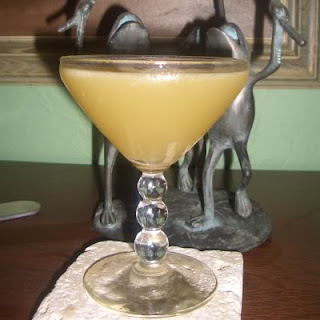
chocolate daisy

Juice of a Lemon (3/4 oz Lemon (*) Juice)
1/2 glass Spanish Brandy (1 oz Pedro Domecq Fundador Solera Reserva)
1/2 glass Port Wine (1 oz Taylor Fladgate Ruby)
1/3 glass Raspberry Syrup (2/3 oz)

Shake with ice and strain into a glass filled with chipped ice. Garnish with fruit.
(*) "Lemon" in the Caribbean generally means lime (same word), but I figured lemon would go better with brandy and port than lime would. Lime is more traditional though.
One of the books I purchased at Tales of the Cocktail was The Art of Making a Cocktail, a 1927 Cuban cocktail book reprinted by Mixellany. On a first pass, the Chocolate Daisy stood out as a good place to start. Here the name has as much to do with cacao products as the classic Coffee Cocktail does with a cup of joe; however, both of them have a base of brandy and port which can mix to create a brownish hue. While Daisies are a well-established class of syrup- or liqueur-sweetened Sours, there is a Chocolate Daisy plant that was discovered in the early 1800s in Texas and northern Mexico. Jean-Louis Berlandier, the French-Swiss physician and botanist who discovered it, named it after the chocolate odor that is released when the petals are plucked from the flower head. Instead of that aroma, the drink proffered a brandy and port one that included the orange slices that we used a garnish. The port's grape notes continued on in the sip along with the lemon, and the raspberry appeared on the swallow along with some dryness from the brandy's barrel aging. In retrospect, the raspberry would have worked well enough with lime to overcome my lemon-brandy pairing bias, but either way, this drink recipe will be tasty.

irma la douce

1 1/2 oz Hendrick's Gin
1/2 oz Green Chartreuse
1/2 oz Cucumber Juice (*)
1/2 oz Lemon Juice
1/2 oz Grapefruit Juice
1/4 oz Simple Syrup

Shake with ice and strain into a cocktail glass. While the book lists no garnish, a cucumber wheel would do no harm.
(*) Peel, blend and pass through a sieve. Muddling instead of blending will work, albeit less efficiently.

When I got back from Tales of the Cocktail, my garden was in full swing. Back in May as I planted my cucumber seedlings, I was hoping that the crop would be good enough this year to make a certain cucumber-based drink a common occurrence. That recipe is the Irma La Douce which was created by the ladies of LUPEC Boston for their Chartreuse event at Green Street back in 2007. The drink was named after a movie starring Shirley MacClaine where she played a Parisian prostitute who wore bright green stockings. With Green Chartreuse and cucumber juice to work the theme, the recipe was a smash hit that night and we have made it several times since. Luckily, the ladies published it in their Little Black Book of Cocktails so we have access to it on our shelves.
The Irma La Douce's aroma was a combination of the cucumber and Green Chartreuse; the former's fresh vegetal notes transitioned well into the liqueur's herbal ones. The sip was a gentle citrus flavor that was softened greatly by the cucumber and simple syrup, and the swallow contained the botanical complexity of the gin and Chartreuse.

Wednesday, August 3, 2011

souracher

3/4 oz Rittenhouse 100 Rye
3/4 oz Carpano Antica Sweet Vermouth
3/4 oz Campari
3/4 oz Lime Juice
1/2 tsp Rich Demerara Syrup (2:1)

Shake with ice and strain into a highball glass filled with fresh ice. Top with Fentiman's Ginger Beer, add a straw, and garnish with a lime wheel.

Saturday evening during Tales was the Imbibe Magazine happy hour that featured Citizen-Worcester's Dave Delaney and Teardrop's Dave Shenaut serving up the winning and runner up cover drinks, respectively. Unfortunately, Delaney's Charentes Shrub ran out before I got there; however, luckily Shenaut still had enough ingredients to make me his Souracher.
The Souracher's lime wheel garnish contributed greatly to the drink's aroma. Next, the sip was a combination of grape and lime flavors, and this was chased by rye and Campari on the swallow with a lingering ginger zing. Overall, the Souracher was a refreshing drink that was much like a citrus-ginger 1794 highball.

the pink pout

1 3/4 oz Macchu Pisco La Diablada Pisco
1/4 oz Boudier Crème de Cassis
1/2 oz Peach Juice
1/4 oz Lemon Juice
3 dash Chocolate Bitters

Shake with ice and strain into a cocktail glass. Garnish with freshly grated dark chocolate.

On Saturday at Tales, I visited "The Sexuality of Pisco Varietals - The Art of Pisco Blending" tasting room which was less of a typical tasting room and more of a free seminar. Peruvian law allows eight grape varietals to be used in pisco production, and the Peruvian farmers classify each of the grapes in colorful, but not X-rated sexual terms. Here are a handful of these descriptors:
Quebranta grape - the Macho man
Moscatel grape - the Sofia Loren
Torontel grape –the Metrosexual
Italia grape – the 15 year old coquettish girl that wears a lot of perfume
Mollar Grape - the Dandy
One of the drinks served was Eastern Standard's Kevin Martin's Carnivale that I had written about when one his fellow bartenders made me the drink. Another was from Rachel Sergi of the Jack Rose in Washington, D.C. Her drink, the Pink Pout, utilized Macchu Pisco's La Diablada Pisco that is a combination of a Quebranta as a base nonaromatic and Moscatel and Italia for aromatics. The Pink Pout worked great as a name as the aromatic grapes put the drink in the realm of Sofia Loren and the 15 year old coquettish girl.
The Pink Pout began with a chocolate and peach aroma. The fruity sip presented berry and lemon flavors, and the swallow continued on with peach and chocolate bitters notes along with the pisco brandy. Indeed, I was quite impressed at how well the peach and chocolate flavors blended together and worked to complement the pisco here.

:: embury and the side-car ::

On Friday, my two talks were "Who's Your Daddy? A Mai Tai Paternity Test" and "David Embury and The Fine Art of Mixing Drinks." For the former, it is easier for me to refer you to Beachbum Berry's Remixed book (pages 64-72) and a brief summary in his blog; since I am not a Tiki historian, I will not attempt to do the talk any justice or reword Berry's written efforts. For the latter, it would also be easy to refer you to David Embury's The Fine Art of Mixing Drinks, for presenter Robert Hess did not stray too far from the facts laid out in the book itself; however, Hess' analysis and focus on certain points seemed like it would make for an interesting post without the need to relate the entirety.

One reason Hess did not stray too far is that very little is remembered about Embury. The basics like how he was born in 1886, graduated from Cornell and then Columbia Law School in 1908 and 1916, respectively, published the book in 1948, and died in 1960 are recalled in his obituary. Moreover, we do know through Brian Rea that Embury did frequent bars but that he was a lousy tipper. Hess attributed the impetus for the book to be Embury being fed up with the state of post-Prohibition bartending and he set about to change that (apparently, not through positive reinforcement via generous gratuity). Intriguingly, he was not a bartender save for one at his home and parties, but he was a consumer and an opinionated one at that. The book is more of a opinionated tome than a recipe book, although there is no shortage of recipes in the book.

Beside sharing his views on the purpose of a cocktail, the basic components, why the best ingredients should be used, and glassware selections, he described a lot about how cocktails are constructed by analyzing 6 basic cocktails: the Martini, Manhattan, Old Fashioned, Daiquiri, Side Car, and oddly the Jack Rose. Of these 6, Hess chose the Side Car to focus on in a liquidy sense. Embury described the Side Car as, "This cocktail is the most perfect example of a magnificent drink gone wrong. It was invented by a friend of mine at a bar in Paris during World War I... Unfortunately, however, the proportions are usually stated as equal parts of lemon juice, Cointreau, and brandy. This may not be a bad formula for a midafternoon drink, but for an aperitif it is simply horrible because of its sickish sweetness." Backtracking for a moment, part of Embury's 6 points of "What, then, is a cocktail?" is that it must whet the appetite, not dull it; therefore, anything "over-sweetened, over-fruit-juiced, over-egged, and over-creamed" ruffled his feathers. Clearly, the cocktail has more uses and times to imbibe it than the ones Embury stressed. But his belief that it "must have sufficient alcoholic flavor... yet must not assault the palate with the force of an atomic bomb" becomes apparent when you look at his preferred proportions.
Side-Car Cocktail from Harry's ABC of Mixing Cocktails
1 part Brandy
1 part Cointreau (Triple Sec)
1 part Lemon Juice

Side Car De Luxe from Embury's The Fine Art of Mixing Drinks
8 part Cognac or Armagnac
1 part Cointreau of Triple Sec
2 part Lemon Juice

Sidecar as served at the Robert Hess household
4 part Brandy
2 part Cointreau
1 part Lemon
These were the three recipes Hess proffered and he did not cover the sugared rim that is commonly associated with the drink today. Not only is the sugared rim not in the original, Embury insisted that the drink received no decoration save for a twist of lemon if desired. Hess related his initial struggles with the Sidecar recipes he found for they called for bottled sour mix, and the resultant drinks were quite unsatisfying to him. And perhaps quite unsatisfying for Embury which motivated him to write his book.

As a laboratory example, Hess had the cocktail apprentices mix up each one of the three Sidecar recipes above for the room. While I preferred the equal parts one for it has the proper balance of citrus to liqueur for my tastes (albeit light on the brandy notes), most people seemed to share Hess' sweet tooth and preferred his recipe. Very few people selected Embury's tarter version; however, tart drinks stimulate salivation and help prepare the body for a meal. Given Embury's predilection for preprandial drinks, his tarter formula makes sense. Also note that Embury's recipe is a hefty slug of brandy with the orange liqueur and lemon acting strictly as minor modifying ingredients; Embury believed that the spirit should be 50% or more of the total volume, although here it is closer to 73%.

Two interesting points where brought forth. The first came by way of Audrey Saunders who pointed out that not every ratio of sweet to sour will work for each drink; at the Pegu Club, they experimentally test each brand of Cognac to find the proportions that worked to achieve their preferred balance. The second came by way of the audience. The audience did propose their favorite recipes such as 1:1:3/4 and 3:2:1 (brandy:triple sec:lemon); however, one person mixed the original, Embury, and Hess recipes in equal parts and declared it his favorite. So what was it?

Since each recipe can be summed up as 3, 11, and 7 parts, and each is a prime number, using a common denominator of 231 and taking the average was the answer:
Brandy : Triple Sec : Lemon
77 : 77 : 77 Original
168 : 21 : 42 Embury
132 : 66 : 33 Hess

2.48 : 1.08 : 1 AverageInterestingly, this matched my preference for equal parts of triple sec to lemon juice. Moreover, if you were in Boston and requested a Sidecar at Eastern Standard and at Drink, this recipe would be between Eastern's 2:1:1 and Drink's 2:1/2:1/2 structures with this average being closer to Eastern's.

Clearly, I cannot do Embury's The Fine Art of Mixing Drinks or Hess' 90 minute talk proper justice in a blog post, so I recommend reading the book. While originals and out-of-print reprints are still around, Muddle Puddle Books has re-printed it with an introduction, not surprisingly, written by Robert Hess and Audrey Saunders. Amidst the aspects that may raise your ire are a lot of good words of wisdom. Furthermore, the book is perhaps one of the first treatises on the classifications of drinks and how to manipulate them to roll your own recipe creations.

Tuesday, August 2, 2011

thai chi-chi

2 oz Belvedere Intense Vodka (*)
1 1/2 oz Housemade Cream of Coconut
1 oz Pineapple Juice
1/2 oz Lime Juice
1/2 oz Thai Basil Syrup (**)
8 Drop Pimento Dram

Shake with ice and strain into a rocks or highball glass filled with fresh ice. Grate nutmeg over the top and garnish with a brandied cherry on a pick.
(*) Drink apparently works quite well with rum subbed here.
(**) One recipe I found online was 8 oz of boiling water added to 8 oz sugar and 3 oz of Thai basil leaves. Stir to dissolve sugar, let steep until cool, and then strain and bottle.
I think my absolute favorite drink at the Bar Room Brawl was the Thai Chi-Chi served by Portland's Teardrop. Luckily, one of the two cocktail apprentices making drinks on the Waking the Spirits Cemetery Excursion two days later was Thomas Klus, a bartender at the Teardrop, and he was able to email me the recipe for the drink off of his iPhone. The drink name seems to be a play on T'ai Chi Chih, the meditative Chinese martial arts, and with Thai elements like lime, coconut, pineapple, and Thai basil, the name switch made a lot of sense. While the drink was served to me as a Belvedere Vodka recipe, Thomas hinted that it would make a great rum drink as well. Of course, I completely missed the obvious and thanks to Sylvan of Tasty Libations for pointing it out, that the drink is based off of the Chi-Chi, the vodka-spirited Piña Colada; I completely forgot that drink existed.
Above is a photo of a Teardrop bartender making my second Thai Chi-Chi -- yes, the drink was that good, and unfortunately, it might have prevented me from giving another drink at the Brawl a try. However, I have no regrets. With one foot planted in the Painkiller camp, the drink could do no wrong. The coconut provided a rich creaminess and the Thai basil added an extra element to make the drink a bit more Asian-inspired than Caribbean.

king of the road

1 oz Hennessy VS Cognac
1 oz Beefeater Gin
3/4 oz Dolin Blanc Vermouth
1 barspoon Crème Yvette (1/8 oz)

Stir with ice and strain into a coupe glass. The recipe I received stated no garnish and reflected the drink I was served, but one I found on the web listed the gin as 3/4 oz and a blackberry on a pick as the garnish. The Roger Room regularly has the drink on their menu with Plymouth Gin.

On Friday night at Tales was the infamous Bar Room Brawl. Competing in a 5-way mix off were Boston's Eastern Standard, Chicago's Sable, Portland's Teardrop, Los Angeles' Roger Room, and San Francisco's Burritt Room. As I made my rounds, there were two drinks I picked out for sharing here. The first one was the King of the Road created by bartender Damian Windsor; many thanks to Roger Room's Jason Bran who replied to my Twitter request and emailed me the proportions. Overall, the recipe resembled the dry vermouth variation of a Blue Moon or a perhaps a Trilby with the base spirits split between gin and brandy.
Despite there being only a barspoon of Crème Yvette, the drink possessed an attractive reddish purplish hue that was quite pleasing to the eye. The Dolin Blanc definitely tied the drink together for it added sweetness to smooth out the Cognac and gin; in addition, it contributed floral notes that worked rather well to complement the Yvette. Unfortunately, I did not have the chance to try the three other drinks that the Roger Room was serving up that night, but I was able to read about them here.

flip royal

2 oz King's Ginger Liqueur
1 oz Rooibos Tea Syrup (*)
1 dash Angostura Bitters
1 Egg

Shake with ice and strain into a rocks glass. Top with 2 oz soda water and garnish with a pinch or two of spice mix (grated cinnamon, nutmeg, and coffee).
(*) According to CocktailMusings, Jackson makes this syrup with twice the rooibos tea. After infusing and straining, he adds an equal part of sugar (1:1 syrup). When cool, he salts to taste (a little under a tsp salt per quart).
Another drink I had at Anchor Distilling Company's "The Boston Cocktail Experience" tasting room was the Flip Royal by Eastern Standard's Jackson Cannon. Jackson's drink featured King's Ginger, a liqueur created in 1903 for King Edward VII. Unfortunately, I did not have a chance to taste the spirit straight or side by side with Domaine de Canton to see how it stacked up, but it did taste good in this drink. Here, the aroma was predominantly coffee and nutmeg on the nose from the spice mix with a hint of the cinnamon poking through. Moreover, the sip was rather creamy and filled with floral notes from the tea syrup, and the swallow was all about the ginger that prolonged into the aftertaste.

Monday, August 1, 2011

causeway

1 1/2 oz English Harbor 5 Year Rum
1 oz Senior's Curaçao of Curaçao
1 barspoon Luxardo Maraschino Liqueur (1/8 oz)
4 dash Angostura Bitters

Stir with ice and strain into a rocks glass. Garnish with orange oils from a twist.

On Friday afternoon at Tales, wedged between my "Who's Your Daddy? A Mai Tai Paternity Test" and "David Embury and The Fine Art of Mixing Drinks" talks was an event I was looking forward to. It was Anchor Distilling Company's tasting room entitled "The Boston Cocktail Experience." There I would have the chance to have eight of the bartenders who serve me cocktails in Boston serve me drinks in New Orleans using Anchor/Preiss Imports' portfolio. When I walked up to Ben Sandrof's table, I felt flattered at he reached over and grabbed an extra printout of the recipes; he explained as he handed it to me that he knew that I was coming. That is one of the many ways Boston bartenders have made me feel welcomed in the cocktail community, and it certainly made my job easier as I explored the room in the time before my next seminar. "Footloose and fancy freelancer" was how Ben was described for he no longer regularly tends bar save for his low-key Sunday Saloon speakeasy events. Sandrof's drink was called the Causeway which he described as either a name for a road near the water or for a means to an end. Apparently it was not named after the Boston rock club near North Station, but it was worth asking (at the time I was thinking of the Channel Club which was located near his previous bar, Drink in Fort Point, resides today). With the nautical theme of the English Harbor Rum, the road along the water seemed to match up perfectly.

The twist over the Causeway provided orange oils that worked well with the rum's caramel aroma. Similarly, the sip was rich with the rum's aged molasses notes along with the Curaçao's orange flavors. The rum continued on in the swallow where it interacted with the Angostura Bitters' spice and the Maraschino' funky notes to round out the drink. Overall, the Causeway had a classic feel to it and reminded me of the Fancy Rum Cocktail.
El Camino
• 2 1/2 oz Chinaco Reposado Tequila
• 1/2 oz D'Aristi Xtabentún Honey Liqueur
• 2 eye droppers Bittermens Mole Bitters
Stir with ice and strain into a rocks glass.
Speaking of a classic feel, I also wanted to mention the drink of Trina Sturm of Trina's Starlight Lounge. Her El Camino utilized an interesting Yucatán honey and anise-flavored liqueur called Xtabentún. Although it is fortified with rum instead of tequila, the end result was very much in line with a Mexican Rusty Nail, albeit one with some extra anise and chocolate notes instead of heather and peat ones in the Scotch-Drambuie version.