Tuesday, November 15, 2011

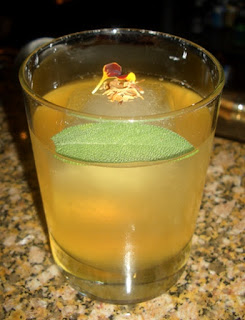
the michigander

1 oz Laird's Bonded Apple Brandy
1 oz Cynar
3/4 oz Lemon Juice
3/4 oz Honey Syrup (2:1) (*)

Shake with ice and strain into a Double Old Fashioned glass with ice. Garnish with a grapefruit twist.
(*) Our honey syrup was made with Mike Graney's honey from Jamaica Plain, MA, and available at Sherman Market in Somerville and elsewhere. I wrote about one of his honeys in the post on Bergamot's Honey Bearer drink.

A short while ago, I was reminded by Rumdood of a drink one of his fellow bartenders at 320 Main created. Rumdood posted a link to the 320 Main blog that made reference to the first place I saw it, Cocktail Musings' Mixology Monday post back in June. The drink was called the Michigander created by Jason Schiffer as he missed his home state. Jason explained, "My favorite time of year is Fall. I get nostalgic about the chill in the air, the earthiness of burning leaves, and the sweet smells of apple cider." Though we are in New England, the Michigander seemed like the perfect drink on an autumnal night two Saturdays ago.
The Michagander's nose was a balance of bright grapefruit oil notes and dark herbal Cynar ones. The sip was sweet and floral from the honey and this worked rather well with the lemon and apple flavors. Next, the swallow presented the Cynar herbal notes in conjunction with some earthier honey flavors. While apple brandy and Cynar seems like such a natural combination, the only other drink I have had it in is the Rosemary's Baby from the first Rogue Beta Cocktails book.

Monday, November 14, 2011

you'll shoot your eye out

2 oz Aged Rum (Old Monk)
1/2 oz Becherovka
1/2 oz Benedictine
1/4 oz Cinnamon Syrup (BG Reynolds)
3 dash Angostura Orange Bitters

Stir with ice and strain into a cocktail glass or a rocks glass with a large ice cube. Garnish with an orange twist.

After the Expatriate two Fridays ago, I began to flip through the most recent issue of Imbibe Magazine and spotted some interesting recipes in their spiced drinks section. One that sounded appealing and did not require any kitchen time on our part seemed to be A Christmas Story reference, namely You'll Shoot Your Eye Out. The drink was created by Mathias Simonis of Distil in Milwaukee, Wisconsin and featured a bounty of spice notes from Becherovka, Benedictine, and cinnamon syrup. Since I opted for Old Monk Rum which is infused with vanilla, everything including the bitters contributed an herbal or spice element here.
The cocktail presented a bright orange oil aroma that was countered by dark rum notes. The rum's rich caramel aspect dominated the sip, and this gave way to a swallow containing cinnamon, vanilla, clove, and orange in addition to other herbal flavors. Andrea commented that this combination would make an excellent hot drink. I, however, found the drink a touch on the sweet side and wished I had gone the rocks glass with large cube for over time the ice melt's dilution would pleasantly cut the sweetness.

:: shakin' it up review ::

Last night was the Greater Boston Beverage Society's Shakin' It Up! event at the House of Blues. The evening was a fundraiser and prequel to the Boston Cocktail Summit, replete with seminars and parties, occurring in early October next year. The Greater Boston Beverage Society is the brainchild of Jamie Walsh of Stoddard's and Alexei Beratis from Of the Spirits Beverage Consulting as a means of elevating the Boston scene akin to Manhattan and Portland with their respective cocktail weeks. The photo above is how I was greeted by Todd Richman of Sidney Frank Importing Co. once I entered the first of two floors of the space. There was a pretty wide representation of spirits at the booths from the cultish Fernet Branca to the popular favorite of Jameson. Besides drinks, there were photo booths and swag give aways including the Fernet Wheel of Fortune.
One of the highlights was the bartender battle with teams representing each side of the river. The Boston side consisted of Domingo-Martín Barreres of Market, Naomi Levi of Eastern Standard, Tyler Wang of No. 9 Park, and Jess Li of Citizen, and the Cambridge side showcased Kelly Unda of Harvest, Sabrina Kershaw of Noir, Aaron Butler of Russell House Tavern, and Tony Iamunno of Grafton Street. The competition was a combination of drink trivia for control of the mixing followed by the question-answerer crafting the classic cocktail to be judged by Brother Cleve. Major props go to Aaron Butler who had the mindfulness to bring an Oxo Double Jigger up on stage with him. Some of the drinks made were the Ward 8 (Tyler), Sidecar (Aaron), Sazerac (Sabrina), and Ramos Gin Fizz (Naomi). The competition was close, but the Cambridge side missing a critical question cost them the event, and the Boston side walked away with the $500 prize.


I garnered a bit of gossip that night too. Joe Fee of Fee Brothers was there as a sponsor of the event, and he spoke of the new bitters flavor, Fee's Gin Barrel-Aged Orange Bitters, that should be out in March of 2012. Joe commented that many bars were using a 50:50 mix of his West Indian Orange Bitters and Regan's, and he wanted to created something that split the difference. He acknowledged that his West Indian Orange Bitters are a bit sweet, but it is his grandfather's recipe and he was not going to change that. Instead, he created these to be drier, spicier, and aged in barrels previously containing Old Tom Gin. Also, I spoke with Ryan McGrale about the soon-to-open Hawthorne and he gave me a photo preview on his iPhone. The bar seems to be modeled after Death & Co. and other New York City bars where most of the seating is away from the bar. Due to the constraints of the space, there will be a 12 person or so bar in the front room with a communal long table right behind it, and a satellite bar in the side room that will have a more limited menu. Around the rest of the space are lots of couches, comfy chairs, and bookshelves full of art and hand-selected books. I also heard rumors about Patrick Sullivan's soon-to-open Brick & Mortar. Apparently, the menu will focus on vermouth-based and other stirred drinks with less focus on citrus; I have no problem with that concept if it is true.
My best of the event awards:
• Best Sample: Prichard's Rye Whiskey with a close second of Downslope Wine Barrel Aged Rum, both distributed by Origin Beverage Co.
• Best Swag: A Fernet Branca shirt! When I spun the wheel I swear it landed more on tattoo, but the rep was quite generous and asked what size I wore.
• Most Suprising Combo: Jägermeister and root beer?! I had my doubts that it would be too sweet, but it worked well with a bounty of herbal notes. Gary Regan would probably approve of this.
• Strangest Photo Booth: Beefeater Gin featuring girls dressed up in Carnivale outfits. Apparently, the British empire stretches further than I thought.
• Best Booth Personality: Kraken Rum's deep sea diver as pictured above.

Sunday, November 13, 2011

expatriate

1 1/2 oz Cocchi Americano
1 oz Laird's Bonded Apple Brandy
1/2 oz Lustau Amontillado Sherry
2 dash Celery Bitters (Homemade)

Stir with ice and strain into a rocks glass containing a big ice cube. Garnish with an orange twist.
On Friday night before dinner, I decided to make the Expatriate that I had spotted in TastingTable's best cocktails of 2011 article. The recipe was created by Ciaran Wiese, the bar manager at Scott & Co. in Tucson, Arizona, and was described as a "fall-friendly harmony of apéritif wines, applejack and bitters." Since I was a fan of Ciaran's Old New York Cocktail, I was definitely willing to give this one a go. In the drink, the scent of the orange oils from the twist joined the citrussy wine aromas of the Cocchi Americano. The sip was fruit-driven with a combination of apple, citrus, and grape flavors, and the swallow showcased the sherry's nuttiness that came across almost as a cola-like flavor. Finally, the celery notes from the bitters appeared at the end to round off the drink on an slightly more herbal note.

Friday, November 11, 2011

mata va'ha

3/4 oz Amber Rum (Don Q Gold)
3/4 oz White Rum (Don Q Cristal)
3/4 oz Kümmel (Helbing)
3/4 oz Pineapple Juice
1/2 oz Lime Juice
1/2 oz Passion Fruit Syrup (BG Reynolds)

Shake with ice and strain into a rocks glass filled with crushed ice. Carefully ignite and float a 1/4 oz of 151 proof rum (El Dorado) Blue Blazer style.

Last week for Thursday Drink Night on the Mixoloseum chatroom, the theme revolved around a recent incident in the South Pacific. On the island of Nuku Hiva, the charred remains of a German adventurer were found and people blamed the indigenous people who have had a history of performing human sacrifice. Perhaps there was intrigue involved in this unrelated to the natives or perhaps old habits die hard. Regardless, the theme involved making Tiki drinks using at least one German ingredient; the incorporation of fire was indeed a plus. Since I was out at the No. 3 Gin event that night (although I did catch the tail end of the TDN event when I returned home), I prepared my recipe in advance and emailed it to SeanMike of Scofflaw's Den to post.

For a German ingredient, I selected kümmel which worked so well in the pair of rather related rum drinks, the Lupe Velez and Kingston Heights. In place of those two drinks' orange juice and allspice dram, I utilized pineapple juice, lime juice, and passion fruit syrup to round out the recipe. The flaming aspect was ignited overproof rum dripped from a metal jigger; perhaps increasing the rum from a 1/4 to a 1/2 ounce would allow the spirit to burn longer, but the result was still effective as shown in the photo to the right. Lastly, for a name, I called the drink the Mata Va'ha after the islanders' yearly Eyes Open festival that they hold in December.

The Mata Va'ha began with the aroma of the burned but still potent overproof rum that was floating on top of the drink. While the first sip or two contained a lot of this strong rum flavor, it later gave way to sweet lime notes in later sips. The pineapple, passion fruit, and kümmel's caraway and other spice notes pleasantly rounded out the swallow.

:: science of cocktails ::

Last night I attended a lecture at Harvard University hosted by Dave Arnold, faculty of the French Culinary Institute and one of the bloggers for Cooking Issues, and Harold McGee, a scientist and author of some seminal books about the chemistry of food and cooking. I had previously heard Dave speak at Tales of the Cocktail's "Science of Shaking" seminar back in 2009 and he did cover some of that material last night. I was familiar Harold McGee through his writing, particularly On Food & Cooking, and I discussed some of his work in my notes about eggs post.

Dave started the talk by focusing on juice clarification and carbonation. The process of clarifying fruit juices via agar agar gelling followed by centrifugation (other compounds and processes work well too) removes a lot of the color and cloudiness; with that removal is a loss of flavor including bitterness. For carbonation, clarification of fruit juices is necessary to avoid horrible foaming problems. In a similar rationale, the particulates in citrus juice are necessary to give the desired texture to citrus drinks during shaking. As I will mention in a bit, these particulates can trap air, and removing the particulates can control the gaseous components in the liquid better.

The other process for clarification that was discussed does not require a centrifuge. While Dave encouraged bartenders to own centrifuges, namely a 3 liter scale one with 4 swinging buckets, they can run $8-10,000 new but can be had for $1-2,000 used (or $500-1000 used and broken if you are a fixer-upper type). Instead, there are wine fining technologies that use ionic charges to pick up particulates and precipitate them through gravity alone. Chitosan was one of his preferred compounds; it is made of chitin from the shells of shrimp or other crustaceans and contains multiple positive charges to bind things. In conjunction with Kieselsol which has multiple negative charges, it will strip out these bitter components and particulates in fruit juices without the need of a centrifuge. Dave did say that he was searching for vegetarian options to recommend. Both of these compounds can be bought at wine making shops.

With the topic of carbonating drinks, Dave warned bartenders to drop the alcohol concentration in drinks for two reasons. One is that people generally drink carbonated beverages faster and the other is that carbonation can increase the perception of alcohol which can be unpleasant to some. For carbonation systems, Dave recommended getting a tank and regulator system set to 40 psi; the whole rig can be bought for around $150. The other option is using chargers which can get expensive at 75 cents per tube (versus $15 to fill a large tank) and pricey if multiple carbonation cycles are required. The first part of carbonation should be the removal of air since air is the enemy of carbonation as it encourages foaming. Options are squeezing out (if using a plastic soda bottle system), pulling a vacuum, or adding a blanket of CO2. Multiple rounds of carbonation (upwards of 3-4) will help. In between rounds, the number of nucleation sites for foaming will be depleted. Clarification of fruit juices will help remove many of these nucleation sites as mentioned above. The four points to improve carbonation were: colder, clarification, air removal, multiple rounds of carbonation.

Since carbon dioxide is more soluble in alcohol than in water, more CO2 is needed. Why? Because the tongue cannot detect air in solution but only gases leaving the liquid. For the same feeling on the tongue, there needs to be more gas pressure.

Harold McGee took over as Dave set off to make drinks for the room. Harold spoke about alcohol and the biological purposes for microbes to make it -- namely to poison off competitors from eating their food sources. Most bacteria cannot take more than a percent or two of alcohol save for acetobacter (see the notes about shrubs post). Next, Harold moved on to the strange chemical qualities of ethanol as compared to water and how much stranger things get when the two are mixed. The first demonstration was mixing 250 mL of water with 250 mL of ethanol. Both started at room temperature of 21.4°C, but after mixing, the volumes were less than the expected 500 mL (closer to 490 mL) and warmer than expected at 27.9°C. While diluting liquor warms it up, Harold assured the room that the cooling effect of ice would easily make this change negligible. In a chart of the various difference of the density, boiling and melting points, and the like of water and ethanol, Harold focused on two important differences: vapor pressure and surface tension. Ethanol has a higher vapor pressure meaning that it wants to leave as a gas more, and water has a higher surface tension meaning it is attracted more to other water molecules (great molecular stickiness). With these differences along with boiling point, distillation can be achieved.

When water and alcohol are mixed, there are other changes besides volume and temperature. First, the mixture becomes much more viscous than either of the starting components such that it gives a greater mouthfeel. Relating to the volume differences, the minimum occurs at 80% alcohol due to how the alcohol interacts with the water molecules. The hydrophobic end of ethanol molecules will interact and fill the holes in between water molecules and will increase the efficiency of molecular packing. Things got a bit technical with nuclear magnetic resonance data showing the different ways ethanol and water can interact (3E-H2O and E-6H2O), and Harold commented that some people believe that these difference affect vodka flavor. The impurities would effect which interactions are favored and can affect mouthfeel and flavor.

In terms of aroma, alcohol molecules can cluster aroma molecules via ethanol's hydrophobic end. This process isolates these molecules and protects them from our senses. In diluting the spirits, the ethanol concentration drops and these aroma molecules are less happy in aqueous solution and volatize so we can detect them.

Dave took over with the science of shaking versus stirring. For a detailed explanation, I will direct you to one of his articles. The main points are:
• 99% of chilling power of ice comes from the melting process; initial temperature of the ice matters less.
• There is no cooling without dilution, and no dilution without cooling (assuming the ice is in the drink).
• The more water that is trapped in crenulations in wet ice, the more dilution there will be without cooling. "Crap ice" from a machine will work just as well if the trapped liquid water is stripped away.
• Ethanol helps to drop the freezing point of the solution so sub-0°C/32°F temperatures are possible.
• Ice size in shaking does not matter as all equilibrates in terms of dilution and chilling in around 12 seconds. All styles fall with in a 1-2° range.
• More important than shaking technique is straining technique. The amount of ice shards that pass through will effect temperature and dilution.
• Stirring is less efficient so ice size matters.
• To get consistency in stirred drinks, the time, size of ice, rate of stirring matter greatly.
• Stirring produces warmer but less diluted drinks than shaking.
• While liquid nitrogen can cool down drinks, it is harder to use on a small scale. If used, adding it to the glass first will allow better mixing. Adding it after, and the liquid nitrogen will remain on the surface more.
• Liquid nitrogen is great for chilling glassware though (see my 3 part series on the effect of glass temperature on the drink for why cold glassware is important).
There was a demonstration on the effect of red hot pokers to make Colonial era drinks using a high proof spirit and a low proof one like beer, cider, or wine (in addition to sugar and perhaps a citrus element and salt). Instead of giving great details, please see these two New York Times articles about the red hot poker and recipes (including the stove top version). Additional notes are as follows:
• The basic premise behind the process was taking one molecule (sugar) without an aroma and converting it into hundreds or thousands of molecules, some of which have aromas.
• As things are heated, they get more bitter and burnt so more sugar is needed to compensate.
• Remember to lower the alcohol concentration for heat increases our detection of alcohol.
• Hot drinks are better served in a wide bowl like a tea cup to dissipate the alcohol aroma better. Irish Coffee mugs are too narrow and concentrate stinging alcohol aromas.
The last part was about emulsifiers and stabilizers to make oil-based simple syrups. Instead of fat washing which can capture a subset of the flavor components, this process captures them all as well as including the rich mouthfeel of the fats and oils. Gum arabic helps to emulsify oils and xanthan gum prevents these oil droplets from coalescing. The combination can be found in Tic Gums products like their 301S product. Using these in conjunction with a stick blender will allow oils to be put into syrups and buttered rums from having the fat float to the surface. As a demonstration, Dave and Harold made a drink using a pumpkin seed oil syrup; for every 1 1/2 oz, there was 1 oz of 1:1 simple syrup and 1/2 oz oil, and this added a glorious flavor and thickness to the drink.

Dave ended the talk by giving a big hint for drink creators. If a drink tastes flat, try adding a pinch of salt before you sink it in frustration.

Thursday, November 10, 2011

r.l.

1 1/2 oz Old Raj 110 Gin
1 oz Alvear Solera 1927 Pedro Ximenez Sherry
1/2 oz Carpano Antica Sweet Vermouth
1/2 oz Clarified Lime Juice

Stir with ice and strain into a cocktail glass. Garnish with a faux lime twist (see text).
For my last drink at Clio, bartender Todd Maul offered me the R.L. as a nightcap. The drink brought together rich, sweet grape notes from the Pedro Ximénez sherry and Carpano Antica and cut them with an overproof gin and clarified lime juice. For a garnish, Todd prepared "twists" using lime juice thickened with xanthan gum, painted on sheets, and frozen before being cut into strips. Unlike traditional lime twists, the citrus oils did not fill the aroma and instead the gin was able to shine through. The sip was a rich grape flavor mostly from the Pedro Ximénez, and addition sherry notes appeared on the swallow along with the gin botanicals. Finally, the clarified lime juice provided a rather pleasant aftertaste here. As the drink warmed up, the faux twist began to soften and donated an extra citrus note and intriguing feel when swallowed.

the hunter

2 oz Sage-infused Santa Teresa Rum
3/4 oz Honey-Bourbon-Lemon Syrup
3/4 oz Sparkling Cider
1/2 oz Clarified Apple Cider
1 dash Willet 110 Rye
1 dash Smoking Ban Bitters

Stir with ice and strain into a rocks glass flavored with cinnamon smoke and containing a large ice cube. Garnish the ice cube with mace, flower petals, and a small sage leaf.

After the crowded No. 3 Gin event at Eastern Standard, I decided to relax at the bar at Clio a few blocks away. One of the drinks that bartender Todd Maul wanted to show me was the Hunter where he strove to recreate a Fall afternoon in a glass. The last time he tried to capture a seasonal feel like this was in April with the Spring in the Afternoon. The similarities between the two drinks included a botanically infused rum. For the Spring drink, it was a fresh and clean fava bean leaf, and here it was an dark, earthy, and spiced sage leaf. Another was the smoke-flavored glass; for the drink in April, Todd utilized a smoldering dried black loomi lime, and here it was cinnamon.
The smoke worked rather well here to fill the Hunter's nose, and unlike many smoked drinks, there was not an acrid burnt taste on the sip. Instead, the sip portrayed a very apple flavor that was complemented by the honey and citrus notes from the syrup. The honey continued on in the swallow where it mingled with the rum and whiskey elements. With the darker flavors, the apple and honey notes, and the smoke reminiscent of burning piles of leaves, the Hunter did indeed capture many of the elements I associate with Autumn.

Wednesday, November 9, 2011

mind the gap

1 1/2 oz No. 3 Gin
3/4 oz Grapefruit Juice
3/4 oz Martini & Rossi Sweet Vermouth
1/2 oz Cardamom Syrup
1/4 oz Simple Syrup
2 dash Angostura Bitters

Shake with ice and strain into a cocktail coupe glass.

Last Thursday, I attended the No. 3 Gin release party at Eastern Standard. After having one of the three cocktails, the Mind the Gap which I will discuss in a moment, I had a chance to speak with Dennis Carr, the VP of Sales from Anchor Distilling, and Gregory Fitch, the local rep from Preiss Imports. While discussing the gin which they represent and distribute, they acquired me a tasting sample in addition to describing the gin's genesis.

The botanicals in the gin are described as three fruits, three spices. The fruits are juniper, orange peel, and grapefruit peel, and the spices are coriander, angelica root, and cardamom. While there is a lot of implication that the recipe is stripped down and simplified, it is nowhere as minimalistic as Death's Door Gin which in juniper, coriander, and fennel seeds, but less than say Beefeater which has 9. From the first whiff of No. 3, there is no mistaking that this is a gin. In crafting the spirit, the distillers did not shy away from juniper like many of the newer gins on the market like New Amsterdam. One of the other notes that came across rather robustly was a delightful grapefruit peel that was stronger than the orange peel one; indeed, the grapefruit here was much more intense than in Beefeater 24. The coriander notes helped to supplement the citrus flavors and also donated peppery notes that worked well with the cardamom. Angelica root is the 6th ingredient, and this earthy note has always been difficult for me to pick out; it has been described as a botanical which functions to tie the others together. I am not sure which of the six ingredients reminded me a lot of Bombay Sapphire, but it was the lingering herbal clean note; it is a note that I associate more with Gin & Tonics than cocktails for some reason.

The name No. 3 has a lot of symbolism for the brand. The easy answers are the 3 fruits and the 3 spices, the event was held on the 3rd of the month, and the 3 drink cocktail list. The gin was created for Berry Bros. and Rudd who are London's oldest wine and spirits merchant with 3 centuries of experience (actually 313 years). The real No. 3 relates to their address on St. James's Street in London. The gin itself is not made in the UK, but in Schiedam, Holland, where they make it to Berry Bros. and Rudd's specifications on pot stills. So far I have seen the gin in a few liquor stores around town including Ball Square Liquors in Somerville and Marty's in Newtonville for $40 per 750mL.
The first cocktail I tried was the Mind the Gap that bartender Kevin Martin made for me. The drink's name pays tribute to the merchant's London address through a reference to their subway system's warning. The recipe was crafted to accent the gin's grapefruit and cardamom notes. With no twist garnish, the Mind the Gap's aroma was strikingly juniper forward. The sip offered the grapefruit and the sweet vermouth's grape flavors, and the swallow presented the gin's juniper, the syrup's cardamom, and the Angostura's spices. Of all the combinations, I was most impressed at how well the grapefruit and cardamom flavors interacted here.