Monday, April 13, 2015

:: notes on madeira ::

I just finished reading Alex Liddell's Madeira: The Mid-Atlantic Wine and wanted to make a list of the salient ideas in the book as a reference for myself and others. Besides having a love of madeira in cocktails, the restaurant I work in, Loyal Nine, has an interest in madeira due to the wine's Colonial history and thus we offer flights of the four noble varieties. While there are a lot of common table wines grown on the island, most of the interest is focused on the aged and fortified variety. At first, the wines produced a high enough acidity and alcohol content on their own to make it over on the hot, spoil-inducing voyage to the American colonies, but later fortification with distilled spirits became the norm starting around the 1750s. British restriction on the American colonies made madeira rather popular; the British banned all European products unless they were brought over on British ships leaving British ports. Madeira, however, despite being under Portuguese control, is an island closer to the shores of Africa than Europe and was exempt from these restrictions. More modern madeira production mimics the long, expensive process of being kept in hot ships' holds through heating the wine via a process called estufagem. Whether modern steam-jacketed heated tanks or more classical casks left in hot parts of buildings, this cooking process converts the wine into something almost unspoilable and capable of long aging. Like centuries long. In fact, the author includes his tasting notes on late 18th century madeiras that were often spectacular (although some had crashed over the years due to poor storage or other issues).

Notes on the four noble varieties of madeira from driest to sweetest:

Sercial
• Grape variety known on the Portuguese mainland as Esgano Cão or the "dog strangler" due to its "mouth-puckering, astringent acidity."
• Grows at high altitude, difficult to grow, only limited sites.
• Palest and driest of noble madeiras.
• Younger versions have orange and dried fruit notes. Nuttiness develops with maturity. With longer aging, flavors can fade but develop balsamic qualities.
• Great palate cleanser due to its high acidity.

Verdelho
• Different from Verdelho in Portugal but the same as the one from the Azores.
• Capable of growing in harsher environments and moderately high altitudes. Prefers to grow close to the sea.
• Slightly darker and sweeter than Sercial. Less brusque as well.
• Younger versions have honeyed, slightly chocolate, and candied citrus notes. Aging intensifies flavors.
• Great to be drank all through the day as acidity is balanced by a hint of sweetness. As an aperitif and with food as well.

Boal
• Grows at low altitudes on the south half of the island.
• Low yields but the grapes are compact bunches of small, sugar-laden grapes.
• Darkest grape of the four.
• Younger versions have a barley sugar aroma and caramel and dried fruit flavors such as apricot. With age, the wine seems less sweet.
• Mostly a dessert wine that works well with fruit and nuts or alone.

Malvasia a/k/a Malmsey
• Grape of Greek origin.
• Very sensitive to climate and only thrives at low altitudes in certain micro-climates that protect the vines from dampness and mildew.
• Grapes are often picked when the begin to shrivel which increases the sugar content.
• Lighter than Boal but of a similar dark tawny tone. Sweetest and richest variety of the bunch.
• Younger versions have a vanilla cream toffee aroma with a hint of meatiness along with caramel, marmalade, and barley sugar flavors. With age, the sweetness also becomes less apparent.
• A dessert wine best drank on its own (instead of paired with food).


Some notes on madeira were taken from this Denver Post article in addition to Liddell's book.

Friday, April 10, 2015

triple crown

1 1/2 oz Glasgow Scotch
1 oz Cocchi Sweet Vermouth
1/2 oz Brovo Amaro #14
2 dash Housemade Coffee Bitters

Stir with ice and strain into a cocktail glass. Garnish with a lemon twist.

For Andrea's first drink at the Baldwin Bar at Sichuan Garden II, she asked bartender Joel Atlas for the Triple Crown which turned out to be another of Ran Duan's creations. The amaro in this Bobby Burns variation was created along with the Brovo Distillery by bartender Mike Ryan who works at Sable in Chicago. The Brovo site describes #14 as, "Mike's amaro starts with Guatemalan chocolate married to thyme for a savory flavor. It moves through cinnamon, sarsaparilla, angelica, and vanilla. It finishes with a strong Gentian finish and is sweetened with agave nectar. It is a sophisticated chocolate flavor."
The Triple Crown offered lemon oil aroma that brightened the slight smoke notes emanating from the Scotch element in the drink. The Scotch continued on into the sip as a malt note that classically paired with the vermouth's grape. Finally, the swallow brought out the rest of the Scotch flavors that transitioned elegantly into a dark, bitter sweet finish.

Thursday, April 9, 2015

father's advice

1 1/2 oz Bacardi Gold Rum
1/2 oz Cardamaro
1/2 oz Punt e Mes
1/2 oz Amontillado Sherry
1/4 oz Giffard Banane du Brésil

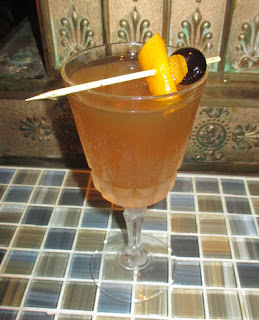
Stir with ice and strain into a cocktail glass. Garnish with an orange twist-cherry flag.

Two Tuesdays ago, Andrea and I made use of my night off to visit the Baldwin Bar at Sichuan Garden II in Woburn. There, we were greeted by bartenders Joel Atlas and Charles Coykendall. For a first drink, I asked Joel for "Ran's Banana" which he understood as the cocktail that won the Baldwin Bar's manager Ran Duan the Bacardi Legacy this year! With rum, a pair of bitter-herbal aromatized wines, and fruit notes from sherry and a touch of banana liqueur, I was definitely intrigued. The Father's Advice is not a cheeky banana-laden drink by any means despite my irreverent drink call. The name makes reference to how Ran recently became a father, and his father in turn bestowed upon him the wisdom that the goal of fatherhood is unconditional love and support in order to strengthen the concept of family. In the competition, Ran tied this concept to the Bacardi clan and their familial bonds, and that along with the stunning drink brought home the victory to (Greater) Boston.
In a glass, the Father's Advice began with an orange and cherry aroma that brightened darker herbal notes from some combination of Cardamaro, Punt e Mes, and sherry. The grape elements were rather strong in the sip where merely a hint of banana came through. Finally, the swallow showcased the rum along with the sherry's nutty, the Punt e Mes' complex bitter, and the amaro's herbal flavors.

Wednesday, April 8, 2015

headlong hall

1/2 part Dry Gin (1 1/4 oz Beefeater)
1/2 part Dry Vermouth (1 1/4 oz Noilly Prat)
2 dash Benedictine (1/2 oz)
2 dash Absinthe (1 barspoon Butterfly)

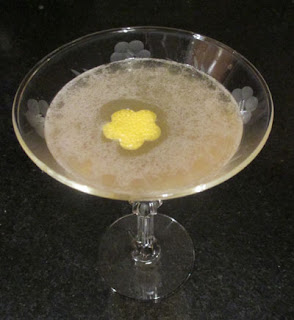
Stir with ice and strain into a cocktail glass. Garnish with a lemon twist.

After the You Is or You Ain't, I was still in the mood to continue the Martini variation theme. Luckily, I found my answer for a next drink, and it was in Crosby Gage's Cocktail Guide & Ladies' Companion from 1941 called the Headlong Hall. The name is a reference, I assume, to the first novel by Thomas Love Peacock written in 1815 about a group of eccentrics. Recipe-wise, the drink reminded me of something between a Caprice or Poet's Dream and a Joan Blondell.
Once mixed, the Headlong Hall shared a lemon oil aroma with hints of the absinthe's anise and the Benedictine's herbal elements. Next, the French vermouth filled the sip with a crisp dry wine flavor, and the swallow presented gin, minty herbal, and anise notes with a chocolate-like finish.

Tuesday, April 7, 2015

you is or you ain't

1 1/2 oz Langley's No. 8 Gin (GrandTen's Wireworks)
1/2 oz Suze Gentiane Liqueur (Salers)
1/2 oz Dolin Dry Vermouth (Noilly Prat)
1/4 oz Yellow Chartreuse

Build in a rocks glass, add ice, and stir. Garnish with a grapefruit twist.

Two Mondays ago, I was scanning the ShakeStir recipe database and spotted what was described as a White Negroni crossed with a Gin Manhattan. The drink was the You Is or You Ain't by Daniel Rutkowski of Middle Branch in Manhattan that he created for the site's basketball Final Four-themed contest, and I was drawn to it for it reminded me of an earthier Puritan Cocktail.
The You Is or You Ain't greeted the senses with a grapefruit aroma with hints of herbal notes. A light honey and wine sip gave way to gin, earthy, herbal, and floral flavors on the swallow. Indeed, I would definitely watch more basketball if this libation was being served.

Monday, April 6, 2015

to become small again

2 oz Kronan Swedish Punsch
1/2 oz Lillet Blanc
1/2 oz Suze Gentiane Liqueur
2 dash Lemon Bitters

Stir with ice and strain into a cocktail glass.

A few Sundays ago, I ventured my way down to Stoddard's for drinks. For a starter, I asked bartender Tony Iamunno for the To Become Small Again. I had previously spotted it on the menu and was intrigued by the ingredient combination, but I wanted the creator of said libation to make it for me. As for the name, Tony did not recall what the inspiration was other than something that he read, heard, or thought about around the time of the recipe's creation.
The To Become Small Again began with an earthy, herbal, floral, and pine aroma. Next, the sip was slightly caramel and tea-like in flavor. Finally, the swallow was earthy and herbal with lemon, methol, and pine notes and with a light tea tannin finish. Looking back in my notes, the combination of Swedish punsch and gentian liqueur was something novel to me that I hope gets continued in future recipes.

Friday, April 3, 2015

square root

3/4 oz Gin (Beefeater)
3/4 oz Aperol
3/4 oz Avèze Gentiane Liqueur (Salers)
3/4 oz Lemon Juice

Shake with ice and strain into a cocktail glass. Garnish with a cherry (subbed a lemon twist).
After the Strange Brew, I turned to a recipe that I had spotted on ShakeStir that reminded me of Sam Ross' Paper Plane but with a more botanical and earthy drive to it. That drink was the Square Root crafted by Jesse Vida of Manhattan's Dead Rabbit Grocery & Grog as well as Dutch Kills. Once mixed, the Square Root offered a lemon aroma with fruity accents from the Aperol. The fruitiness continued into the sip with lemon, orange, and rhubarb flavors, while the swallow went a bit more earthy with gin and gentian notes with a tart rhubarb swallow. Moreover, the combination of gentian liqueur and Aperol reminded me of Colin Shearn's Paper Trail.

Thursday, April 2, 2015

strange brew

2 oz Tanqueray 10 Gin (regular Tanqueray)
3/4 oz Velvet Falernum
1 oz Pineapple Juice
1/2 oz Lemon Juice

Shake with ice and strain into a pilsner glass (Highball) filled with crushed ice. Top with Green Flash's West Coast IPA (2 1/2 oz Founder's All Day IPA), garnish with mint (lemon twist instead), and add a straw.

Two Saturdays ago, I was working my way through reading the Death & Co. Cocktail Book when I spotted the Strange Brew, a curious Tiki-beer cocktail, for the second time in the text. The recipe was attributed to Thomas Waugh back in 2008, and the concept stemmed from the idea of mixing beer with fresh fruit like the Germans do with their radlers. Thomas' favorite combination was pineapple and IPA which inspired this drink. For a name, he dubbed it Strange Brew after the B-side of EMF's "Unbelievable" single (instead of the original version performed by Cream).
After a bit of shaking, straining, and prep work, it was time to taste. The Strange Brew offered a lemon oil nose instead of the mint one via the prescribed garnish; this aroma actually worked rather well with the sip which was fruity with a touch of malt. The swallow was rather complex with pineapple, juniper, grapefruit, lime, and clove notes; indeed, I was impressed at the bounty of citrus flavors here from the beer's hops, the falernum's lime, the gin's botanicals, and of course the two juices.

Wednesday, April 1, 2015

the upset

1 1/2 oz Pisco
1/2 oz Oloroso Sherry (Lustau)
1/2 oz Honey Syrup (1:1) (*)
1/2 oz Lemon Juice (*)

Shake with ice and strain into a cocktail glass. Garnish with freshly grated nutmeg (I subbed a lemon twist) (*).
(*) Adapted from the original which was 3/4 oz lemon juice, 1/2 oz 2:1 honey syrup. Also, it called for a nutmeg garnish that I did not spot when assembling the drink. Very similar to his Prospector at Kask.
After the Youngs, I wanted to use the remainder of the freshly squeezed lemon juice, so I turned to a recipe that I had spotted on the ShakeStir site called the Upset. The Upset was crafted by Tommy Klus whom I last met at Kask in Portland, OR, and this was his submission to the website's Final Four basketball-themed drink competition. Once shaken and strained, the Upset shocked the nose with lemon, floral, and nutty aromas. Next, the sip shared honey and lemon flavors with hints of grape, and the swallow ended things off with earthy floral notes on the buzzer beater.