Tuesday, May 8, 2012

8th and collins

1 1/2 oz Pisco Quebranta (Macchu Pisco)
1/2 oz Anchor Genevieve (Boomsma Oude Genever)
3/4 oz Lemon Juice
3/4 oz Simple Syrup
2 dash Angostura Bitters
1 Egg White

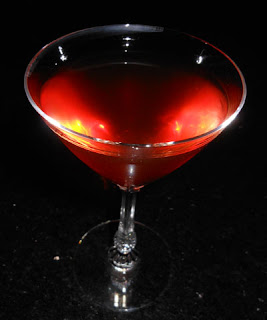
Dry shake the egg white and lemon juice. Add rest of ingredients and ice. Shake, strain into a cocktail glass, and garnish with 3 drops of Angostura Bitters.

After the Stormy Mai Tai, our quest for the unusual led us to the first edition of the Rogue Beta Cocktails book. There, I spotted the 8th and Collins which reminded me a bit of the Rosy John that Charles Baker wrote about in his South American Gentleman's Companion. Like the Rosy John, the 8th and Collins by Chicago's Mike Ryan utilized a split spirit pisco and gin/Genever mix in the egg white-laden Sour. Well, technically Mike's recipe called for an American Genever replica (Genever, like Cognac, is a protected geographical product); since we lacked Anchor's Genevieve, I opted for a true Genever in its place.
The 8th and Collins' Angostura Bitters garnish paid dividends on the aroma where it joined the pisco notes that seeped through the egg white froth. The sip offered up a creamy lemon and malt mix, and the swallow began with the pisco's funky brandy notes and ended with the Angostura spice and perhaps some of the botanicals from the Genever.  Overall, with the Genever and bitters, it was an interesting variation on the classic Pisco Sour.

Monday, May 7, 2012

stormy mai tai

1 1/2 oz Angostura Bitters
3/4 oz Orgeat (Ferrara Orzata)
3/4 oz Curaçao (Senior Curaçao)
1 oz Lime Juice

Build on crushed ice in a rocks glass and swizzle to mix (shaking with ice and straining into rocks glass filled with crushed ice would be equally as effective). Float light rum (1/2 oz 10 Cane) and garnish with mint.

Every so often, our blog's analytics alerts me that the post on the Trinidad Sour receives traffic from a post Paul Clarke did about the recipe I wrote about. The original was created by Giuseppe Gonzalez when he was a bartender at Brooklyn's Clover Club, and it is a crafty inversion of a standard cocktail formula such that the bitters play a significant role with an ounce of Angostura Bitters. In the comments of Paul's post, Giuseppe left the recipe for an Angostura-heavy companion cocktail, the Stormy Mai Tai, that seemed rather curious and tempting. As an inverse bittered Mai Tai with the rum used as an accent and the bitters used as the base spirit (true, bitters do not appear in the regular Mai Tai), I saved this recipe until our mint patch had returned to full swing and I was up for a challenging drink. For the orgeat, instead of the subtle but very wholesome B.G. Reynolds syrup, I opted for a flavorful but extract-laden syrup from Ferrara since I figured that it needed to stand up to the robust flavors in the mix.
With this much Angostura Bitters in the drink, I was a little afraid to use a wood swizzle stick in fears that it would stain red and I substituted a metal bar spoon as a swizzle instead. The mint garnish contributed greatly to the drink's nose along with hints of the light rum that was lurking underneath the sprigs. The rum float dominated the flavor of the first few sips before the Angostura's cherry notes, the lime juice, and the Curaçao's orange entered into the sip. Finally, the Angostura's spice filled the swallow and were soothed by the orgeat's almond notes.

improved whiskey cocktail

2 oz Rittenhouse 100 Rye
1 barspoon Gomme Syrup (1/8 oz)
1 barspoon Maraschino Liqueur (1/8 oz)
4 dash Angostura Bitters

Stir with ice and strain into a rocks glass rinsed with 2 spritzes of Vieux Pontarlier Absinthe. Twist a lemon peel over the top and discard.

For my other drink at Craigie on Main, I asked bartender Ann for the Improved Whiskey Cocktail that just appeared on the menu. I first had an Improved Cocktail for the 19th century-themed Mixology Monday where I made a Improved Gin Cocktail. There, I explained the two major improvements over the Fancy Cocktail which was an Old Fashioned gussied up with a dash or two of Curaçao, the hot new cocktail ingredient of the day, and which appeared in the 1862 edition of Jerry Thomas' book. The improvements showed up in the 1876 update of Thomas' book where the Fancy's Curaçao was swapped for Maraschino and the new hot ingredient -- absinthe. I also revisited the drink at the Bols Genever release party where the Improved Holland Gin Cocktail was showcased as a classic use of the spirit. However, I had never had the drink as a whiskey one, and I decided to take the Craigie's menu's suggestion that it was a good time to try it.
Much like a Sazerac, the Improved Whiskey Cocktail began with a lemon and anise nose. The malty sip led into a hot, flavorful rye swallow with light Maraschino notes and spice from the Angostura Bitters and absinthe. The drink did veer from the Sazerac for it lacked the specific color and flavors of Peychaud's Bitters and possessed the extra funky, nutty notes of Maraschino on the swallow.

Friday, May 4, 2012

[great king street]

3/4 oz Great King Street Blended Scotch
3/4 oz Cardamaro
1/2 oz Punt e Mes
1/2 oz Maraschino Liqueur
1 barspoon Crème de Mûre
1 dash Mole Bitters

Stir with ice and strain into a rocks glass. Twist a lemon peel over the top and discard.

Two Wednesdays ago, Andrea and I ventured over to Craigie on Main. For a starter, bartender Jared Sadoian suggested a Manhattan (or Red Hook) variation he was working on that utilized a new blended Scotch from Compass Box. He said that they were so pleased with the Great King Street Scotch that it might replace Johnnie Walker Black Label at the restaurant. When I was given a taste, I was impressed at how the soft the malt notes were such that it reminded me of an Irish whiskey, albeit one with a moderate amount of smoke notes.
The drink began with a lemon oil aroma that later gained smoke and grape accents. The grape notes did appear early on the sip though from a combination of the Punt e Mes and Cardamaro. Moreover, the Punt e Mes and Cardamaro's bitter notes played a large role on the swallow along with the Scotch's peated smoke. Finally, the drink's finish showcased the Maraschino and blackberry; as the drink warmed up, the blackberry began to play a greater role in the flavor balance.

mary's sock drawer

1 1/2 oz Bols Genever
1/3 oz Rhum Clement Creole Shrubb
1/2 oz Lime Juice
1/2 oz Grand Classico

Shake with ice and strain into a cocktail glass garnished with Grand Classico paint (remainder from roto-vap, boiled down to thicken).

The other drink bartender Todd Maul made for me at Clio was Mary's Sock Drawer which is part of the homage, along with Mary's Liquor Cabinet, to the other Clio bartender.  Apparently, Mary counters by referring to the Sock Drawer as the Bitter Todd.
The Mary's Sock Drawer began with a malty aroma that was complemented by herbal notes from the Grand Classico. The malt continued on into the sip where it paired with the citrus notes that seemed to be derived more from the orange liqueur. The lime though came through stronger on the swallow along with the Grand Classico bitter flavors and the Bols Genever's wormwood and other botanical notes.

Thursday, May 3, 2012

capetown

1 1/2 oz Housemade Swedish Punsch
1 oz Lemon Juice
3/4 oz Gutierrez Colosia Sangre y Trabajadero Oloroso Sherry
1 dash Orange Bitters

Shake with ice and strain into a wineglass garnished with white port paint (roto-vapped and boiled down to thicken). Garnish with a lemon twist.

Two Mondays ago, after attending the Plymouth Gin competition at the Hawthorne, I headed down the street to visit bartender Todd Maul at Clio. While perusing the menu, Todd brought over the "Random Drink Monday" drink, the Capetown. I had made the Capetown before from the vague recipe in the Pioneers of Mixing at Elite Bars: 1903-1933, and it was interesting to see how Todd interpreted it. Todd upped the fruity quotient of the drink by increasing the lemon juice and sherry, and he opted for a sweet oloroso sherry instead of the Lustau East India Solera one I picked.
The Capetown offered up a lemon oil and sherry aroma. The sip was a tart lemon that became a touch sweeter and more grape driven as it warmed up. Next, the swallow contained sherry and the Swedish Punsch's rum and dry tea finish; indeed, I was impressed at how well the Punsch and sherry worked together here. The most notable difference between the two Capetowns was that this one was a bit more citrus forward that mine.

french alaska

2 1/4 oz Citadelle Gin
3/4 oz Bergamot Syrup (*)
1/4 oz Yellow Chartreuse
1 dash Scrappy's Lavender Bitters

Stir with ice and strain into a coupe pre-rinsed with spritzes of Pernod Absinthe. Garnish with a flowering lavender sprig.
(*) Slice up Bergamots and cover with sugar overnight to extract oils from the peel. The next day add water. End product is a combination of oils and juice.

Two Sundays ago, Andrea and I were celebrating our anniversary at Journeyman, and afterwards we stopped into Backbar for a nightcap. The drink that bartender Sam Treadway made for me was the French Alaska. Based off the classic Alaska, the drink added extra French notes to the original's Yellow Chartreuse by utilizing a French gin, French absinthe, lavender frequently associated with Provence in France, and Bergamot orange which grows in southern France.
The lavender sprig garnish contributed greatly to the drinks aroma along with the absinthe's anise notes. The sip was a lightly citrus-tinged honey flavor that led into an herbal gin and Yellow Chartreuse swallow. Lastly, the lavender returned on the finish via the floral bitters in the mix.

Wednesday, May 2, 2012

cradle of life

3/4 oz White Rum (Banks 5 Island)
3/4 oz Spiced Rum (Kraken)
1/2 oz Orgeat (BG Reynolds)
1/3 oz Lemon Juice
1/3 oz Orange Juice
1/3 oz Lime Juice
2 dash Angostura Bitters

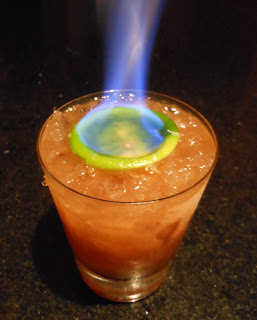
Shake with ice and strain into a rocks glass containing crushed ice. Garnish with an inverted spent half lime shell filled with a 1/2 oz Green Chartreuse. Ignite the Chartreuse. Half a minute or so later, blow out the flame and mix in the Chartreuse before drinking.

Two Saturdays ago, we were in a bit of a Tiki mood, so I decided to make the Cradle of Life from Food & Wine: Cocktails 2011. The recipe was the creation of Karin Stanley, a bartender at Long Island City's Dutch Kills, for Manhattan's PKNY that was opened by two of her old co-workers. Besides being stunning, the flaming Chartreuse helps to warm and extract aromatic oils from the lime shell.
The Chartreuse and lime oils filled the drink's aroma even after the flame was extinguished and I had dumped in the liqueur. The sip was a pleasing combination of citrus, almond, and spice, and the Chartreuse and funky rum blend wrapped up the swallow. Indeed, the Chartreuse definitely added a bit of pizzazz to the drink as it had in other Tiki libations including the Pago Pago and Bikini Atoll.

yachting club

2/3 Holland Gin (1 oz Bols Genever)
1/3 Dry Vermouth (1/2 oz Noilly Prat)
2 dash Simple Syrup (1/4 oz)
2 dash Peychaud's Bitters
1 dash Pernod (1/8 oz Pernod Absinthe)

Stir with ice and strain into a cocktail glass.

After the Old England, I began to peruse our 1975 edition of Patrick Duffy's The Official Mixer's Manual. There I spotted the Yachting Club which appeared like a lemon twist and rocks glass away from a Sazerac variation. The drink began with the aroma of Genever's malt and absinthe's anise. The malt notes continued into the sip with perhaps some grape elements from the vermouth, and the swallow contained the herbal flavors from the Pernod and the Genever. Overall, it came across a bit different than a traditional Sazerac with its lighter body and flavor profile, but not all that different from the Gin Sazerac John Gertsen made me with Anchor Steam Genevieve.