Monday, August 1, 2011

far east algonquin

1 oz Bulleit Rye
1/2 oz Lemon Juice
1/2 oz Pineapple Juice
1/8 Simple Syrup (2:1?)

Muddle a green cardamom pod with the simple syrup. Add rest of ingredients and ice, shake, and double strain into a cocktail glass. Garnish the foam from the pineapple juice with a drop of Angostura Bitters.

One of the drinks from the Central American themed-section of the Diageo Cocktails Around the World Happy Hour was created by Ryan Fitzgerald of San Francisco's Beretta. While often associated with other parts of the world, pineapple and cardamom are two major agricultural exports from Central America, so this variation of the classic Algonquin worked quite well with the theme. Ryan enthusiastically explained how the pineapple and cardamom combination was quite mysterious for it was difficult to tell the individual components apart; moreover, these elements worked rather well with whiskey. Indeed, pineapple and cardamom is a great combination that I have experienced in the Punky Monkey and the Indian Summer.
The Far East Algonquin started with pineapple and spice from the Angostura in the aroma, and this pineapple note continued in the sip along with lemon juice. Next, the rye's spice and the cardamom on the swallow finished the drink. While the lemon juice did dry out the drink akin to the classic's French vermouth, it and the cardamom took the Far East Algonquin in a fruitier, more exotic, and easier to drink direction.

hong kong cocktail

3/4 oz Bulleit Rye
3/4 oz Cocchi Americano
3/8 oz Pimm's No. 1
1 dash Regan's Bitters

Stir with ice and strain into a cocktail glass (1-1/4:1-1/4:5/8:2 dash is closer to a standardized 3 oz recipe).

The third drink I selected to write about at the Diageo Cocktails Around the World Happy Hour was created by Jackson Cannon of Eastern Standard in Boston. The Hong Kong Cocktail is his variation of a Manhattan that was "imagined to be created in the time of the British Admiralty's occupation of Hong Kong by an Italian-born steward named Giuseppe Reganini." Perhaps that Giuseppe Reganini is an allusion to Gary Regan whose orange bitters recipe donates some extra fruit notes to this cocktail.
The Hong Kong Cocktail began with a faint dark and citrus aroma. The sip was a rich vermouth-fruit combination from the Cocchi Americano and Pimm's that somewhat approached a classic Italian vermouth flavor. Finally, the Bulleit Rye finished the drink with spicy grain and barrel flavor that was supplemented by the bitter's orange peel notes. The more I thought about this delightful recipe, the more I realized that it reminded me of Jackson's Rye and Dry that appeared on the Pimm's section of the Eastern Standard menu back in 2008. The Rye and Dry, however, was a bit more earthy and called for dry vermouth and mole bitters in place of the Cocchi Americano and orange bitters.

Sunday, July 31, 2011

indochine

3/4 oz Zacapa 23 Rum
1/4 oz Green Chartreuse
3/8 oz Lime Juice
1/4 oz Simple Syrup
5 Thai Basil Leaves

Shake with ice and double strain into a rocks glass with fresh ice. Garnish with a piece of candied ginger.

In the Asia section of the Diageo Cocktails Around the World Happy Hour, I enjoyed a drink by Eryn Reece of Mayahuel in Manhattan. Instead of the tequila drink I was expecting, Eryn chose Zacapa 23 as her base spirit. Eryn's drink was called Indochine, and it brought together French elements like Chartreuse and Southeast Asian elements like Thai basil leaves and lime. With Green Chartreuse, lime juice, and basil, the drink composition reminded me of a rum-driven, Chartreuse-light Silent Order or perhaps a Chartreuse instead of vanilla syrup and Punt e Mes Surbiton Road.
The Thai basil presented itself first as a glorious aroma that preceded the lime sip. Next, the basil added an herbal element to the swallow that helped bridge the gap between the rum and Chartreuse. I do not recall my drink being garnished with candied ginger, but perhaps that could add some extra spice notes to the drink.

Saturday, July 30, 2011

bernardino's bulleit

1 oz Bulleit Bourbon
1/4 oz Fernet Branca
1/4 oz Lemon Juice
3/8 oz Black Pepper Simple Syrup (*)
1 tsp Goya Mango Jam

Shake with ice and double strain into a rocks glass filled with fresh ice. Garnish with a lemon twist.
(*) While I did not ask Misty how she made her syrup, an adaptation of Todd Thrasher's recipe is 1 cup water, 1 cup sugar, 1/4 cup coarsely cracked black pepper corns. Bring water to a boil, add sugar and stir until dissolved, add pepper corns, and turn off heat. Let stand for 20 minutes, strain, bottle, and refrigerate. 3/4 oz of vodka will help preserve the syrup. In a pinch, muddling a few pepper corns and letting them sit with the Bourbon for a few minutes would probably work (in conjunction with regular simple syrup).

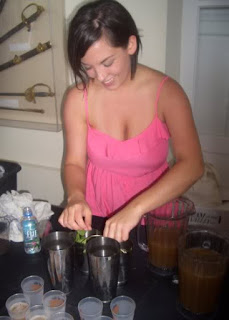
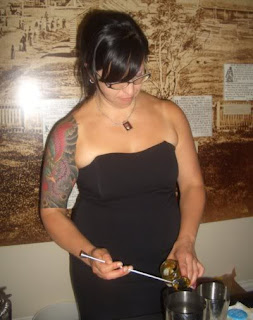
On Thursday evening, I attended the Diageo Happy Hour. The theme was "cocktails around the world" replete with a passport book akin to the drink golf parties back in college. Except here, instead of 18 holes, there were 42 plus a few hydration stations where you could get a stamp as well. A few people wondered why I was entering my own stamps at the stations; I had to explain that I was making tasting notes and the stamp section was great white space. Needless to say between good conversations and needing to be somewhat sober enough to enjoy dinner at the Green Goddess later that evening, I only tried a fraction of the drinks. Out of those, I picked 4 to report on: two from Asia, one from Central America, and this one from Drink's Misty Kalkofen from South America.
Misty's Bernardino's Bulleit had two elements from South American cuisine. The most obvious one was the mango jam which contributed a great flavor and mouthfeel to the drink. The other was the Fernet Branca which is one of the favored spirit of Argentina; the Bernardino part of the drink's name made reference to this for Bernardino Branca was the creator of this elixir back in 1845. Once mixed, the drink provided a citrus bouquet with lemon oils from the twist that combined with an almost orange-like aroma from the mango. Next, the sip was a mango-citrus flavor that had a thickness from the jam's pectin content, and the swallow contained the Bourbon with an element of spice and bitterness from the black pepper syrup and Fernet Branca at the end.

Friday, July 29, 2011

corpse reviver no. 17

1 oz Rittenhouse 100 Rye
1 oz Calvados
1 oz Lillet Blanc
3/4 oz Lemon Juice
3 dash Peychaud's Bitters

Shake with ice and strain into a cocktail glass. Garnish with a Luxardo Maraschino cherry.

At "The Bad, Bad Boys of Saloons" talk, authors Christine Sismondo and James Waller (*) explored the seamier side of the bar trade. Despite all of the talk about craft bartenders who have raised bar standards through the last century and a half, plenty of saloon owners were filling the opposite end of the spectrum and this talk was to honor them -- about drinking wrong. The Anti-Saloon League that gained force leading up to Prohibition summed up these saloons as:
The saloon is the storm center of crime; the devil's headquarters on earth; the schoolmaster of a broken decalogue; the defiler of youth; the enemy of the home; the foe of peace; the deceiver of nations; the beast of sensuality; the past master of intrigue; the vagabond of poverty; the social vulture; the rendezvous of demagogues; the enlisting office of sin; the serpent of Eden; a ponderous second edition of hell, revised, enlarged and illuminated.
However, as our talk's hosts point out, bad bars are homes to people, too. Immigrants often received charity at these establishments, and they, gay men, politicians, and frontiersmen made these places a part of their life. Often, these places were written about in a pathological way; meanwhile, the rich at the Waldorf-Astoria were deemed to be drinking right even when they started in the morning.

The immigrant section of the talk discussed the rise of the German beer gardens. While these establishments were often villainized, they were generally family friendly places that served lower proof drinks than most other bars. With World War I looming, the Anti-Saloon Leage targeted them as aiding and abetting the German Reich. Both the beer gardens' and the saloons' prices were often controlled by the brewers which caused some financial difficulties. While the beer gardens kept a more respectable air, many saloons needed to supplement their income to survive, and thus, they were sometimes forced to add amenities such as gambling and prostitution to make up for the price control. This gave the Anti-Saloon League even more ammunition. For more on the beer halls, Maureen Ogle's Ambitious Brew: The Story of American Beer was suggested reading.

Besides a sense of community, these saloons offered a safe drinking source. Even though the tenement housing's water was not as polluted as the Europe they had just fled, safety was still on their mind. Furthermore, the saloons offered an escape from their tiny, cramped living quarters. The speakers cited Upton Sinclair's The Jungle as a good literary reference to this time period.

Moving on to politics, the concept of buying votes through booze, such as in Tammany Hall, was discussed. While the article in the The Balance and Columbian Repository gained fame for where the cocktail was mentioned and later defined in 1806, the point of the article was the vast tally sheet of drinks that were purchased in trade for votes. All that booze was for naught, save for giving cocktail historians an artifact to study, since that candidate in the end lost the election. The outrage against the buying of votes supported the idea that Prohibition was not about drinking per se but about controlling its distribution and sale. Sismondo and Waller offered up Jack London's John Barleycorn as a love letter to a bar that included a glimmer of how a bar worked in election time; there local politicians made the rounds, the booze flowed like water, and in one parade London joined in on, he did not even know or care who he was campaigning for. While some politicians were drinkers, others had to pretend to drink if they wanted to get elected; many were spotted and slammed in the press for leaving bars walking perfectly straight.

The final section of the talk dealt with gay and leather bars and the political unrest leading up to the gay rights movement. One of the most famous ones they discussed was the Stonewall Inn. The Stonewall, like the Sewer and the Snakepit, offered up protection for gay men and women to live their lifestyle. With that came a price which included an expensive cover charge, exorbitant drink prices, watered down drinks, backed up toilets, and the like. Between the mafia who ran the establishment and the police who continually raided it, there was eventually a major uprising that led to four nights of rioting in Greenwich Village in June of 1969.

Somewhere in the middle of the talk, after a PBR had been proffered and a Muleskinner mixed up, a Corpse Reviver was served (recipe above). It was provided as an example of a breakfast drink, and by today's standards, drinking first thing in the morning is a bad idea; such bad ideas are often linked to bad bars. This drink had a fruity lemon and apple sip, and the swallow brought out the lemon's crispness and the rye's barrel-aged notes.

During the question and answer session, they were asked about the difference between a bad bar and a dive bar, the answer was, "A bad bar is one a hipster won't go into, but a dive bar they will."

(*) Christine's latest book, America Walks into a Bar: A Spirited History of Taverns and Saloons, Speakeasies and Grog Shops and James' latest volume of his series, Drinkology: The Art and Science of the Cocktail are both available on Amazon.

el toro

1 oz Root Liqueur
1 oz Milagro Silver Tequila
1/2 oz Cynar
1/2 oz Lapsang Souchong Tea Syrup (2:1 with Demerara Sugar)
1 pinch Salt

Stir with ice and strain into a cocktail glass.

At the Art in the Age tasting room at Tales, they had their Root and Snap liqueurs which are rootbeer-like and ginger offerings, respectively, but they also had their newest product, Rhuby -- a rhubarb liqueur. While the Rhuby was available for a taste, there were two bartenders from the Franklin Mortgage & Investment Co. in Philidelphia making drinks with their other two products.
The first drink I tried was by bartender Colin Shearn (on left in photo below) who mixed up Root liqueur along with tequila, Cynar, and a smoky tea syrup. The El Toro began with a rootbeer-like aroma punctuated by agave notes. In the sip, the tea shined through and worked well with the birch flavors, and the swallow was a combination of rootbeer and smoke notes that were chased by the tequila at the end.
The other drink I tried was by bartender Al Sotack (on right in photo above) who mixed with Snap. Perhaps taking a page from last years Tales talk entitled, "The Smooth and Creamy History of the Fern Bar," this one was called the New Fern Order:
New Fern Order
• 1 oz Snap Liqueur
• 1 oz Banana Chip-Infused Pampero Rum (*)
• 3/4 oz Punt e Mes
• 1/2 oz Cream
• 1/2 oz Martinique Cane Syrup (sub 1:1 Simple Syrup)
Shake with ice and strain into a cocktail glass. Garnish with a stripe of Fee's Aromatic Bitters on top.
(*) 2/3 of a quart (perhaps a pound or 20 oz?) of dry banana chips per 750 mL of rum. Infuse for 20-40 minutes, and strain.
The Fee's Aromatic Bitters provided a glorious cinnamon note to the nose. True to the theme, the sip was rich and creamy; the swallow though contained the banana and rum notes followed by a lingering ginger and spice note that provided a pleasant zingy finish to the otherwise smooth drink.

:: tales odds and ends ::

There were plenty of interesting things that ended up in my notebook that were not "best of" moments or drink recipes (and some were "best of" parts that I missed in my last post), so here is a list in no particular order or relation:

• There needs to be a name for the acid reflux and dry throat that everyone suffers from by day 2 or 3 of Tales of the Cocktail. Tales Syndrome? Monteleone Malaise? Tuenneritis? Suggestions welcomed.
• Most Dada moment goes to the talking box in the Hendrick's Gin "Enchanted Forest" tasting room. Basically, inside the box (made up of 4 hinged slatted door sections) was a man with a French accent reciting absurd sound poetry. I ended up standing next to the box and feeding him words which he rifted off of. The tasting room's description did include an Einstein quote that read, "The most beautiful thing we can experience is the mysterious. It is the source of all true art and science." Well, part of the mystery evaporated when the gent stepped out of the box to catch a breather, but I did have a good conversation with him about the Fluxus movement and recommended he check out Ubu.com archives.
• One way to spot a true Tales or New Orleans veteran is that they will not go to Cafe du Monde wearing black. It is impossible to keep that massive heap of powdered sugar from staying put. Regardless, it is still hard to talk and eat beignets without uncomfortably inhaling that sugar. Besides black, white items of clothing, especially white pants, need to be avoided during Tales since the spilled drink stains can make you appear like a sloppy drunk. Stylish drunk is of the highest order according to the Cocktail Virgin aesthetic.
• The most interestingly absurd party locale would have to go to Zu Bison Grass Vodka. True, the William & Grant party in the World War II Museum (the whole museum!) was epic and visually stunning, but Zu held their event in a roped off area in the middle of Bourbon Street! Between the chaos of the mechanical bull bison and the rest of the mayhem inside, there was outside on the street where the typical partiers and lights and visuals of the Hustler Club et al. resided.
• Best headwear award goes to Hollis Bulleit of the Bourbon and now rye clan. Of the 3 times I saw her and captured her hats, this one was one of the most bizarre; through other photo albums, I know that there were more hats that I missed, and I bet her hat boxes took up more luggage space than my suitcase and backpack combined. Runner up would Brother Cleve who presented at the "The Art of Pisco Blending" seminar wearing a Luchador mask (although in Peru, it would be a Cachascanista mask). And honorable mention to Drink bartender Bryn Tattan's wacky duckling mask.
• Favorite neighborhood to walk through was the Marigny. My first year, it was definitely the Garden District with its distinctive and grand architecture and large and well manicured lots. The Marigny, on the other hand, has more of the feel of New Orleans -- quirkier architecture, flowering vines growing over people's roofs, and a more approachable and soulful feel. Definitely worth the walk to the other end of the French Quarter to explore this neighborhood.
• That view of the Marigny was also supported by our tour guides on the "Waking the Spirits" cemetery excursion. The tour was sponsored by Herbsaint, although sponsored is a rough term since it was the most expensive thing I did at Tales; however, on the mini-bus, we had two great bartenders who mixed up Corpse Reviver #2s and Death in the Afternoons for us as we drove through the cemeteries. There were two places that we got to go out for photo opportunities: one was the family tomb of Henry C. Ramos, creator of the Ramos Gin Fizz, and the other was the the family plot of J. Marion Legendre, inventor of Herbsaint. After one of the bartenders poured out a little Herbsaint for Mr. Legendre, he left this cup as a respectful token of our visit.

Thursday, July 28, 2011

angel version

1 oz Boulard Calvados
1 oz Broker's Gin
1/2 oz Marie Brizard Apry
1/2 oz Punt e Mes
>1/4 oz Lemon Juice
14 drop Angostura Bitters
6 leaf Mint

Stir with ice and strain into a rocks glass filled with fresh ice. Express the oils out of a piece of orange peel and garnish with it.

For my last drink that night at Cure, I requested Turk Dietrich's Angel Version from the man himself. Turk explained that he took the Angel Face from the Savoy Cocktail Book, an equal parts drink of Calvados, dry gin, and apricot brandy, and made his own variation of it. Turk kept the dual base spirits but split the apricot brandy into apricot, Punt e Mes, and lemon juice and added some mint and Angostura Bitters to the mix.
Here, the orange twist paid great dividends to the drink's aroma and worked well with the apricot flavors that came out later in the drink. The sip was rather fruity with lemon, grape, and apple notes, and the swallow was a contrast of apricot and bitter notes from the Punt e Mes and Angostura Bitters. Indeed, the counter balance of the apricot flavor and the dark herbal ones made for a very stunning effect.

king vittorio's cobbler

2 oz Zucca Rabarbaro Amaro
3/4 oz Lemon Juice
3/4 oz Simple Syrup
1 Strawberry

Muddle strawberry. Add rest of the ingredients and ice. Shake and double strain into a rocks glass filled with crushed ice. Garnish with a slapped mint leaf and another strawberry.

For my second drink at Cure in New Orleans, I asked bartender Turk Dietrich for the King Vittorio's Cobbler created by Neal Bodenheimer. I was quite impressed when Turk replied by asking me if he had made me a Cobbler the last time I had been there. Keep in mind that was a little over a year ago, but apparently that Sherry Cobbler was delicious enough for both of us to remember. Besides my appreciation for the drink style, the combination of Zucca and strawberry was rather tempting. For a name connection, there is a bar in Milan that is called Caffè Miani and nicknamed Zucca. This cafe is located in the Galleria Vittorio Emanuele at the Piazza del Duomo. As for the "king" part, this expensive shopping arcade was named after King Vittorio Emanuele II who ruled over Italy for 17 years until his death in 1878. And yes, they do serve Zucca at the Zucca now.
Indeed, the strawberry paired quite well with the dark notes of the Zucca on the nose. Next, the sip was a sweet strawberry and lemon taste, and this was followed by a clean flavor from the rhubarb root and other botanicals in the Zucca. For such a simple drink, it had a lot of character and the Cobbler format was perfect for the presentation.