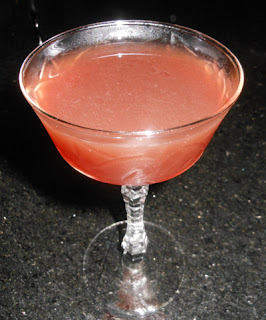
Monday, September 17, 2012

somerville cup #2.1

1 slice Lemon
1 slice Cucumber
1 1/2 oz Pimm's No. 1
~6 oz Bud Light Lime

Muddle the cucumber and lemon slice. Add the Pimm's and ice, shake, and pour into a pint glass. Top with the beer and add a straw.

Two Tuesdays ago, Andrea and I had dinner at Trina's Starlite Lounge. Since I had a beer with my meal, I decided to stick with the hops-y theme and checked out the beer-cocktail section of the menu. I narrowed my picks down to two, and from those, bartender Beau Sturm recommended the Somerville Cup, which was their playful take on a classic Pimm's Cup, over the Framingham Mojito. Despite there only being a single slice of cucumber in the drink, the cucumber contributed greatly to the drink starting with the aroma. The beer's malt and carbonation worked rather well with the Pimm's berry flavors on the sip. The cucumber returned on the swallow along with lingering citrus notes from the beer and the muddled lemon slice.

waterloo sunset

2 oz Tanqueray Gin
1 oz Martini & Rossi Rosé Vermouth
1 oz Pedro Ximenez Sherry
1 dash Bittermens Burlesque Bitters

Stir with ice and strain into a rocks glass rinsed with Lillet Blanc. Garnish with an orange twist.

Two Mondays ago, we made our way down to the South End to have drinks at Toro. For a first beverage, I asked bartender Andy McNees for the Waterloo Sunset. Andy explained that he had always wanted to name a drink after that Kinks' song. For ingredients, he described how the gin represented the English and the Lillet represented the French in the battle; as for the sherry, his answer was that Toro was a Spanish restaurant after all.
The orange twist's oils welcomed the nose and prepared the mouth for the grapefruit-citrus sip that also contained robust grape notes from the sherry. Most of the sherry flavors though were in the swallow along with the gin's juniper and the bitters' spice and light pepper heat. Stylistically, the Waterloo Sunset reminded me of the Buckminster at Highland Kitchen.

Friday, September 14, 2012

eva péron

This month's Mixology Monday theme, "Equal Parts" (MxMo LXV), was picked by me, and my challenge was to "Find or concoct a drink recipe that has an equal parts recipe -- those simple drinks where only one jigger is needed despite how many ingredients are added. These recipes have gained a lot of popularity as classics like the Negroni and Last Word have resurfaced, and variations of these equal part wonders have become abundant."

I was amused that I was a week out and still did not have a clue as to what I was going to make for my own theme. Most of the equal parts drinks I could think of off the top of my head I had already tried and written about before; therefore, I started looking. When local bartender Daren Swisher mentioned on Facebook that Imbibe Magazine had written about his Tom Terrific on their website, I checked out what other drinks were there. The one that caught my eye also appears in their The American Cocktail book that came out earlier this year called the Eva Péron by Darren Crawford of San Francisco's Bourbon & Branch.

Eva Péron served as the First Lady of Argentina from 1946 until her death in 1952, and she was much loved such that the Argentinian Congress gave her the title of "Spiritual Leader of the Nation." Also much beloved in Argentina is Fernet Branca which has become their national drink. Most of the Fernet there is drank with Coca Cola or soda water. Here, in Crawford's tribute to the country, it is mixed with ginger beer. Since it appeared like a gussied up Fernet Buck, I was game to give this recipe a try.
Eva Péron
• 1 oz Fernet Branca
• 1 oz Sweet Vermouth (Cocchi)
• 1 oz Ginger Liqueur (King's)
• 1 oz Lime Juice
Shake with ice and strain into a Collins glass filled with ice and 1 oz of ginger beer (AJ Stephans). Garnish with a lime wheel. I added a straw.
The lime wheel garnish added a brightness to the Fernet's menthol-herbal aroma in the drink. A sharp, carbonated lime sip led into a rather gingery swallow with a moderate Fernet menthol finish. Overall, it was sweeter and more complex than Deep Ellum's Fernet Buck but on a similar wavelength.
Normally, I thank this month's host and the person running Mixology Monday here. However, that is me on both accounts. So instead, I want to thank Paul Clarke for his inspiration in creating Mixology Monday as a way to bring together beverage bloggers from around the globe to unite; honestly, it has been the best way for me to bolster my RSS reader with great blogs, and I use this event to seek out kindred spirits. And I would also like to thank Paul for his efforts to carry Mixology Monday through 64 events! I have been with MxMo since event XXX, and it is truly an honor for Paul to entrust his brainchild with me. So cheers to Paul as well as to everyone else who participates each month to help make Mixology Monday one of the best blogger events on the web!

chinook

1 1/2 oz Redemption Rye
3/4 oz Aperol
3/4 oz Lemon Juice
2 dash Fee's Grapefruit Butters

Shake with ice and pour into a rocks glass. Garnish with a lemon wedge and add straws.
For a second cocktail at Highland Kitchen, I asked Jimmy Lane for the Chinook. Jimmy attributed the drink to Will Quackenbush, but I did not get a chance to ask Will about the back story on the name. The lemon wedge garnish provided much of the drink's aroma, and the lemon continued on into the sip along with the Aperol and the rye's maltiness. The lemon carried on into the swallow where it accented the rye and was complemented by the bitters' grapefruit notes. Overall, the Chinook was slightly on the tart side and if that was problem, a quarter ounce of simple syrup should fix that easily as would switching to a 3:2:1 ratio.

haymaker

3/4 oz Maker's Mark Bourbon
3/4 oz Dry Vermouth
3/4 oz Triple Sec
3/4 oz Lime Juice

Shake with ice and pour into a rocks glass. Garnish with an orange twist and add straws.

Two Sundays ago, we paid a visit to Highland Kitchen where Will Quackenbush and Jimmy Lane were tending the bar. For a first cocktail, I was lured in by the drink of the day which was the Haymaker. When I asked Will about the history, he thought that the drink got entered into their cocktail book by way of the B Side Lounge. The research I did suggested that it was probably created during the B Side days and perhaps served there, but I found no evidence that the drink was created here in Boston. I was definitely drawn in to the drink for it reminded me of the Snake in the Grass from the Café Royal Cocktail Book except with Bourbon and lime instead of gin and lemon.
The orange twist's aroma prepared the mouth for a white wine and lime-orange sip where the orange predominated. The lime did appear on the swallow where it accented the Bourbon notes.

Thursday, September 13, 2012

:: drink & tell now available on amazon! ::


Drink & Tell is just that -- a cocktail historian's tour of Boston, a city he knows and loves. Included are over 500 drink recipes created and served by more than 40 bars and restaurants in Boston. While there are plenty of recipes inside from heavy hitters like Eastern Standard and Drink who have basked in well-deserved international attention, the author also hopes to bring to light the other establishments which have crafted amazing drinks through the years to help make Boston a cocktail town. Drink & Tell is perfect for the home bartender, for the Boston barfly looking for a memento, and for trade bartenders near and far for inspiration on improving the cocktail scenes in their cities.
http://www.amazon.com/Drink-Tell-Boston-Cocktail-Book

Wednesday, September 12, 2012

murderer's cocktail

1/3 Calvados (3/4 oz Morin Selection)
1/3 Swedish Punsch (3/4 oz Kronan)
1/3 Rum (3/4 oz Plantation Barbados)
2 dash Absinthe (1/8 oz St. George)
1 dash Bitters (1 dash Angostura)

Stir with ice and strain into a cocktail glass.

On Saturday a week and half ago, I spied the Murderer's Cocktail from Harry McElhone's Barflies and Cocktails. The book provided a bit of history of how the recipe was created by Robert Coates, a detective novelist who wrote the Dada-esque The Eater of Darkness. The recipe provides the warning that "Exits should be plainly marked and fire-extinguishers provided at all times when this cocktail is served"; however, the recipe is not as boozy as some of the drinks in the collection and perhaps was an allusion to some of Coates' plot twists.
The Murderer's Cocktail provided a minty-anise aroma from the absinthe that coupled with the fruitiness of the Calvados. The sip showcased the brandy's apple and the rum's caramel flavors, and the swallow was full of richness, herbal notes, and spice. Of the three main ingredients, I was surprised that the Calvados was the most identifiable. Moreover, Andrea commented that the drink would probably make an excellent Autumnal cocktail with apple on the sip and the cinnamon-like notes on the swallow.

pago pago

2/3 jigger Brandy (1 oz Pedro Domecq Fundador Solera Reserva)
1/3 jigger Dry Vermouth (1/2 oz Noilly Prat)
1/3 jigger Crème de Cassis (1/2 oz G.E. Massenez)
Juice 1/2 Lime (1/2 oz)

Shake with ice and strain into a cocktail glass.

Two Thursdays ago, I was flipping through the Chicago Bartenders 1945 Bar Guide and spotted the Pago Pago. It was not the Chartreuse-laden Pago Pago from the 1940 The How And When cocktail book, but a brandy and cassis one that seemed less tropical but just as solid.
This Pago Pago had a rich aroma with a hint of fruitiness from a combination of the brandy and cassis. The sweet cassis' berry contrasted the lime's crispness on the sip, and the swallow offered the brandy with the tartness of the cassis, lime, and dry vermouth. Overall, the drink's structure reminded me of the rum-based Sunshine from Paul Harrington's Cocktail: The Drinks Bible for the 21st Century.

Tuesday, September 11, 2012

pacer

2/3 Scotch (2 oz Famous Grouse)
2 dash Sweet Vermouth (1/2 oz Cocchi)
1 dash Benedictine (1/4 oz)
1 dash Yellow Chartreuse (1/4 oz)
1 dash Orange Bitters (Regan's)

Stir with ice and strain into a cocktail glass.

After the Stockyards, I turned to Pioneers of Mixing at Elite Bars: 1903-1933 for inspiration. There, I spotted a Bobby Burns-like drink that caught my eye for it added extra savory notes with Yellow Chartreuse to supplement the Bénédictine.
The Pacer offered up a Scotch aroma with some sharper herbal notes perhaps from the Benedictine. The whisky's malt joined the orange and grape flavors on the sip, and the swallow proffered the rest of the Scotch along with the Benedictine and Yellow Chartreuse's complexity. The liqueurs were surprisingly flavorful even in such small amounts, and my only regret was not using a slightly smokier Scotch or spiking in a barspoon of an Islay whisky for a similar effect.