1 oz. Tequila (Partida's Blanco)
1 oz. Cointreau
1 oz. Fresh Lime Juice
Shake with plenty of cracked ice and strain into a good-sized cocktail glass. Fred disprefers the use of a salt-rimmed glass, but if you're into that kind of thing, coat the rim with lime and dip into a dish of kosher salt before decanting.
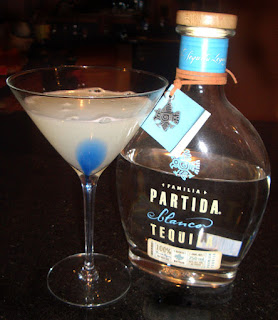
Fred and I have a dream bar set-up at home for a couple of amateurs (at least as far as bartending toys and booze selection go). For the past couple of years that we've been into craft cocktails, I've deferred to Fred's bartending skills, happy to have him choose and mix. Lately I've thought, "why should he have all the fun?" I love to get all technique-y, and back in my youth (before I was seduced away by software development) I was an analytical chemist. So I've been picking up the shaker myself, concentrating on learning to make some of the classics. Fred's already written about my first foray - a basic
martini. After that, I really got cracking - literally. I'd been schooled months earlier in the importance of properly chilling and
waterizing a cocktail. One of my toy purchases back a few months ago was a lovely vintage ice cracker. It's a stainless-steel ball connected to a bakelite handle by a stiff spring. Fred always looks so cool when he uses it. I also wanted to master the Boston shaker. So, having a wide streak of masochism in my nature, I decided that my next cocktail would be a
Ramos Fizz. The Ramos Fizz requires lots of cracked ice, which provides a proper surface area and topology to help emusify the egg white. It also requires lots of shaking, 5 minutes at a minimum. These 5 minutes (to be fair, Fred shook for the middle minute thirty) gave me plenty of opportunity to experiment with different shaking techniques [1]. I found a variant of
Tommy's technique (a two-handed, two-part shake whose rhythm reminds me of how someone would shake a tambourine) to be the most comfortable.
When I came home from work last Thursday with a bag full of limes, I decided to make one of my personal favorites, a margarita. In looking up recipes, I decided to try Ted Haigh's recipe from
Vintage Spirits & Forgotten Cocktails. While the margarita hardly qualifies as a forgotten cocktail, the properly-made classic version has certainly been neglected. Haigh's version used equal parts instead of the more common sidecar ratio (3 parts spirit, 2 parts orange liqueur, 1 part citrus juice), and as a result was rather on the sour side. The Partida definitely held up in the flavor profile, its honeyed smokiness probably worked better in this ratio than a less mellow blanco would have. Substitution of Grand Marnier for the Cointreau would also work with this ratio to make it less sour. Fred remained unconvinced of the margarita's charms, but I found this recipe to be refreshingly tart.
[1] OK,
someone should do a write-up of the various shaking techniques used by Boston's finest bartenders, complete with pictures, or possibly even video.

 the pineapple or grapefruit juice we had just purchased, and the Hawaiian seemed intriguing and refreshingly appropriate given the warm evening. The drink had a delicious frothy caramel-pineapple flavor and was surprisingly dry with a slight degree of sharpness. The dark rum gives the drink its character, and Andrea wondered how Old Monk would have worked instead of the Goslings especially with Old Monk's vanilla notes. I wondered though if the drink was missing something such as a liqueur like curacao or apricot. It would provide some sweetness and more depth.


 1 1/2 oz Gin (Beefeater)
 While drinking the Peacock, the absinthe flavors hit you on the first part of the sip. This is followed by the Cognac's butteriness, and then, lastly on the swallow, the Amer Picon bitters shine through. The absinthe though not overwhelming relative to the Cognac did seem to dwarf the Amer Picon a bit.
 This month's
 1 oz Clement Rhum Agricole


 2 oz Dry Gin (209 Gin)
 The 2017 collection of 855 drink recipes, bartender tributes, and essays on hospitality from CocktailVirgin's Frederic Yarm. Available at
  The 2012 collection of 505 drink recipes, techniques, and Boston bar recommendations from Frederic Yarm. Available at


 Posts
Posts

