Sunday, November 8, 2009

elk's own cocktail

3/4 oz Rye Whiskey (Rittenhouse 100)
3/4 oz Port Wine (Ramos Pinto Ruby)
Juice of 1/2 Lemon (3/4 oz)
1 tsp Sugar (1/4 oz Simple Syrup)
1 Egg White

Shake once without ice and once with. Garnish with a slice of pineapple.
Last night we decided to stay in and hang out with our sick kitty, Sadie. Sadie insisted that we open up the Trader Vic's 1948 Bartender's Guide and pick out a drink. Well that's more of a back story than we could find on the drink that we eventually selected, the Elk's Own Cocktail. Despite my searching, there was no history for it such as it being created at an Elk's Lodge bar or other. The Elk's Own recipe fell somewhere between a classic Manhattan and a Rye Sour, and it made good use of the egg whites and partially zested lemon we had left over. The drink itself had a pretty ruby color underneath a frothy white head; flavor-wise, it was sweet and lemony with the balance shifting more toward tart on successive sips. The egg smoothed out the rye and citrus notes, and it and the port provided an elegant richness to the Elk's Own Cocktail.

Saturday, November 7, 2009

bonita applebum

1 oz Laird's Applejack
3/4 oz Fernet Branca
3/4 oz Drambuie

Stir with ice and strain into a rocks glass. Twist an orange peel over the top and drop in.

On Thursday, Andrea and I attended the Fernet Branca Industry night at the Franklin Southie co-hosted by DrinkBoston. On the menu, besides shots of Fernet in ice shot glasses, were 6 cocktails created by bartenders across town. The one that caught my eye was the Bonita Applebum created by Emma Hollander of Trina's Starlight Lounge. Joy Richards was one of the two bartenders behind the bar that night and was the one who made me this drink. The bright orange nose led into a rather nice late autumn cocktail. The Drambuie's honey flavor and mouthfeel balanced the sting and bite of the Fernet Branca and it worked well with the light apple notes. At the swallow was the Fernet's lingering menthol herbalness. Without seeing the proportions, the drink had an Old-fashioned cocktail feel to it, although after later receiving the recipe, it does not appear as such. My one complaint was that the apple flavors were not rich enough for me. Laird's Applejack is only 35% apple-derived (the rest is grain neutral spirits), while Calvados or Laird's Bonded, both 100% apple spirit, would have worked better with this recipe to give a more fall feel to the drink.

See the other recipes served that night at the DrinkBoston blog!

beaux arts

1 oz Dry Gin (Aviation)
1/2 oz Sweet Vermouth (Dolin)
1/2 oz Dry Vermouth (Dolin)
1 tsp Pineapple Juice
1 tsp Orange Juice
2 dash Anisette (Herbsainte)

Shake with ice and strain into a cocktail glass. Note: this recipe is double the original volumes.
On Wednesday night, I found the scrap of paper that I had written the Beaux Arts Cocktail down on, and decided that it was time to give it a try. The recipe was from our 1948 Bartender's Guide by Trader Vic and seemed like an interesting variation on the Income Tax or Bronx cocktail. I also found the Beaux Arts in Stan Jones' book (which is where CocktailDB acquired their recipe) that ups the juices slightly to a 1/4 oz each (1 tsp is 1/6 oz); however, I decided to go with the older recipe. When tasting the cocktail, the vermouths were detectable first on the sip followed by the orange and pineapple juices. Next, the gin and then the Herbsainte's anise notes rounded out the swallow. The pineapple came across more as an aroma than a flavor; moreover, it donated a nice lacy froth over the top of the drink. The Beaux Arts would make an excellent pre-dinner drink -- while it is light, there is a lot going on flavor-wise to prepare one's palate.

Friday, November 6, 2009

oriental

1/2 Rye Whiskey (1 1/2 oz Sazerac 6 Year)
1/4 Sweet Vermouth (3/4 oz Dolin)
1/4 White Curacao (3/4 oz Curacao of Curacao)
Juice of 1/2 Lime (~1/2 oz)

Shake with ice and strain into a cocktail glass.

Earlier in the week, I realized that I had been neglecting the Anvil's 100 Drink list and my goal of goal of completing it by the end of 2009, so I scanned the 13 remaining drinks and picked out the Oriental for I was in the mood for some rye. I opened up the Savoy Cocktail Book and found the recipe which I scaled to 3 oz (plus 1/2 oz juice) pre-melt. Perhaps back in 1930, scaling to 2 oz might have been more proportional to the size of that era's limes, or would make for a slightly drier drink with today's limes. The Savoy gives a brief history of the drink, "In August, 1924, an American Engineer nearly died of fever in the Philippines, and only the extraordinary devotion of Dr. B-- saved his life. As an act of gratitude, the Engineer gave Dr. B-- the recipe of this cocktail." I have no clue how anecdotal that story is, but I was game for trying such a drink of thanksgiving.
On the nose, Andrea picked up a lot of the rye aromas whereas I focused more on the citrus. The spice of the rye and the bite of the lime were decently balanced by the sweetness of the curacao and vermouth, although the precise intended ratio of citrus to sweet is unknown due to the imprecise ratios in the recipe besides the variability in lime size. Our chosen ratio was in the medium range for our taste buds and was not overly sweet. Perhaps I needed a Dr. B, for while drinking the Oriental, I kept detecting phantom orgeat notes. Overall, the Oriental was a bit more intriguing than your average rye sour although not a superlative cocktail in my book. Perhaps it would be more enjoyable and refreshing on a warmer night reminiscent of the Philippines instead of a chilly November one.

Wednesday, November 4, 2009

helen the pacific

3/4 oz Lemon Hart 80 Demerara Rum
3/4 oz Neisson Rhum Agricole (*)
3/4 oz Lime Juice
1/2 oz Luxardo Maraschino Liqueur
1/4 oz St. Elizabeth's Allspice Dram
1/4 oz Velvet Falernum
1/4 oz Grenadine
1/4 oz Simple Syrup

Shake with ice and strain into a Tiki mug filled with crushed ice. Add straw and garnish with a lime twist and a cherry.

I eventually did acquire a Tiki drink at Drink's Tiki Sunday night. When Cali Gold came by to discuss drink options for our second round, I asked for her for a Tiki drink that I have not had before. She replied that Sam Treadway just made one with rhum agricole and asked if that would be acceptable. And how could I say no to rhum agricole?

The drink, Helen the Pacific, was created by Tiki enthusiast Randy Wong who was sitting behind us at the center bar. Randy's Tiki interests go beyond the libation as he leads an exotica band, the Waitiki 7, which we had a chance to see at the Beantown Sippin' Safari Tiki fest held at Pho Republique two years ago. I could not confirm if the drink's name was a take on the 1968 World War II movie, Hell in the Pacific starring Toshiro Mifune, but it seems likely.

Helen the Pacific had the citrus, allspice, and clove flavors from the lime, dram, and falernum in the front part of the sip. The Maraschino notes became more evident in later sips and followed the citrus and spice wave. Surprisingly, the rum flavors were more elusive which is odd since rhum agricole is often not that subtle. Overall, it was well balanced and a delight to drink although I wish the rum flavors were a little stronger. However, many drinks of the genre shoot to mask the flavor of the alcohol so perhaps it was more authentic that way.

(*) Post note: I emailed Sam and asked which rhum agricole he used, and he replied, "I used the blanc... but Randy Wong believes that the Gold makes it infinitely better".

Tuesday, November 3, 2009

leathercoat

2 oz White Horse Blended Scotch
1 barspoon Roxbury Russet Apple Butter (see text below)
2 dash Fee's Whiskey Barrel Aged Bitters

Stir in a rocks glass with a large ice chunk. Garnish with a sage leaf.

Two nights ago, Andrea and I went to Drink and sat at the ice bar where John Gertsen was tending. Although it was Tiki Sunday, the drink that John suggested that I try first did not follow the night's theme. However, it was one that Misty Kalkofen recently created for a dinner at Eastern Standard in honor of Jill DeGroff's new book, Lush Life: Portraits from the Bar. The star ingredient of this Fall cocktail was apple butter made from Roxbury Russet apples which are believed to be the oldest cultivar of apples grown in the United States. The apples originated not too far from the bar in Roxbury, now a suburb of Boston, during the mid 1600s. The drink is named after the cultivar's nickname of "leathercoat" due to the apple's rough, russeted skin. As for the apple butter recipe, John seemed to suggest that Misty followed a standard recipe and used shredded apples, sugar, cider vinegar, and some salt and cooked it down to the consistency of maple syrup. John stated that they used the peels which are rich in flavor but left out the cores which contain a large part of the pectin. And note, there are commercially available apple butters on the market if you do not feel like making your own batch (although you will have less choice in the apple varietal).
The Leathercoat had a rich Scotch and cinnamon nose with hints of chlorophyll from the sage leaf garnish. The apple butter contributed a considerable mouthfeel to the drink and worked rather well flavor-wise with the Scotch and cinnamon (from the bitters). Overall, the Leathercoat was a delightful Old-fashioned style cocktail with a pleasant degree of smokiness, spice, and tart apple goodness which worked well with the autumn night.

Monday, November 2, 2009

golfer's special

1/3 Cherry Brandy (1 oz, Trimbach Kirsch, see text)
1/3 Dry Gin (1 oz, North Shore Distillers No. 6)
1/6 Lillet Blanc (1/2 oz)
1/6 Lemon Juice (1/2 oz)
1 dash Orange Bitters (Angostura Orange)

Shake with ice and strain into a cocktail glass.
On Friday night, I flipped through the 1937 Café Royal Cocktail Book looking for a drink to make; the Golfer's Special seemed rather intriguing with the cherry brandy and Lillet so we decided to give it a go. The identity of "cherry brandy" was a little confusing but I figured it meant kirsch instead of a cherry liqueur such as Cherry Heering or Maraschino since an eau de vie better matched the subtlety of Lillet in my mind than the other forms. Indeed, the Golfer's Special was delightful with kirsch and gin flavors up front and lemony and Lillet flavors on the swallow. The drink was rather dry and tart over all, and while it was enjoyable to drink, it made me wonder if I had made the proper choice. Therefore, I made the drink with Cherry Heering and switched the gin to a hardier one, Beefeater. While the drink was no longer sharply dry, the Heering was too dominant and it donated a syrupy, winey component to the mix and made my mind think that there was Dubonnet in it. Although I did not try Maraschino liqueur, I did add a barspoon of simple syrup to my first drink which seemed to split the difference in sweetness without masking the more subtle flavors. The touch of sugar made the drink a bit less sharp and might be a good addition to the Golfer's Special for many people when making the recipe with a dry eau de vie.

Saturday, October 31, 2009

:: ice geeking ::

Preparing drinks can be facilitated by owning the proper tools. While a lot of people have spoken about the shakers, jiggers, and the like, very little has been written about ice tools. Ice plays a critical part in the drink making and enjoying experience, and its shape and size can effect everything from the preparation to the presentation. Here, I will talk about some of my more recent purchases in regards to processing small format ice and I will point you in the right direction if large format ice is your thing.

The ice tapper is the most frequently used tool in my arsenal; it is used to crack ice cubes into smaller pieces. Smaller pieces of ice have a greater surface area and thus cool drinks down quicker (given the same amount of ice). This can be advantageous during stirring and shaking many drinks. An exception to this is egg drinks where you want more froth which is best generated with large cubes; however, I have seen bartenders use a mix of cubes and cracked ice to promote both cooling and frothing. Surprisingly, it does not take a lot of force to break ice (although for more fine crushing, it does). With square cubes (made in Tovolo Perfect Cube silicone ice cube trays), it takes about 3 taps. The trick is not to tap the same side multiple times in a row, but to turn the cube to a new side each time. Each tap sets up cleavage planes that lead to the cube ending up anywhere from 3-12 pieces depending on your force, the tool, and the ice. While harder taps do work well, it does end up scattering ice fragments across your kitchen. In the photo are three of our crackers. The bottom one is a new one we bought at the Boston Shaker and, despite seeming rather light, is rather effective. The middle one is a vintage one we found in an antiques store in Somerville, NJ. Besides the cool Bakelite handle, the heavy ball and spring combination can generate a good amount of ice cracking power with very little hand movement. The top one is another vintage piece, a simple barspoon. Yes, the back side of the barspoon you already own will crack ice quite well. It does not have the springiness in the shaft that the other crackers do, but it will work quite well.

Ice tappers can only do so much. For a glass full of chipped ice for Tiki drinks or Juleps, tappers would become tedious besides the pieces being often larger than desired. One of the more useful tools which spares you the horrible noise of the electric blender is the manual ice crusher. Pictured above is an older Art Deco Ice-O-Mat reproduction I bought on eBay. Metrokane makes a few styles of ice crushers (the Boston Shaker sells one) and there are often vintage (especially wall-mounted) ones in antiques stores. While ours is stylish, it has a low ice capacity (2-3 at a time) and only produces one size of ice. The newer ones can hold more cubes in the hopper and will do two sizes depending on which way you crank the handle (as well as often have a vacuum to attach it to the counter).
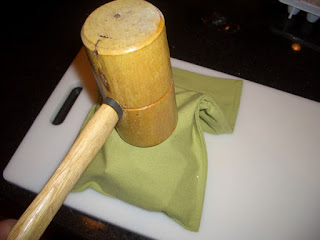
For even finer ice, a very satisfying tool is the Lewis bag. The Lewis bag is nothing but a tough canvas bag that you load the ice into, fold over the opening, and then smash the ice with a mallet or meat tenderizer. The bag pictured above is a hand-stitched one we bought at the Boston Shaker which is rather well made (besides coming in a variety of colors). We also have a canvas bank bag (seen below the ice tapper and Ice-O-Mat above) which works well but is not as thick, well-seamed, or attractive as the handmade ones, but was a lot cheaper and come in a variety of sizes. And for the DiYers out there, follow bartender Josie Packard's lead and sew your own! The one she did for Drink uses thick canvas that is triple-stitched via a sewing machine (according to the bartenders there, it is more likely to give out in the center than through the stitching when being used). For a striking implement, I got a pair of his and hers factory seconds mallets off of eBay. I was tempted by some of the vintage ones but got frustrated with the bidding wars and went with something off of the buy-it-now list. The end result is finely crushed ice (although larger sized pieces will be in the mix depending on how thoroughly you smash away) which was perfect in our Sherry Cobbler.
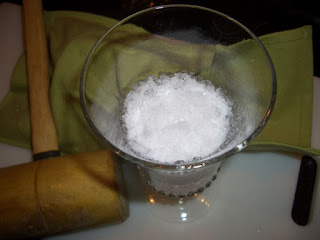
This list of ice processing tools is by no means complete; for example, I have seen ice crushed via wood muddler in a mixing glass. And there are plenty of ice geeks who want to go even more old school and render large format ice down into the proper size and shapes of their choosing. Drink in Boston, for example, purchases 50 pound ice and uses a variety of shavers (think wood planes for ice), cleavers, and ice picks. The shavers seem to work the best in terms of generating the finest ice without electricity albeit with a bit of time and effort. For some of the best ice picks I have ever seen, go visit Cocktail Kingdom and look at their Japanese ice picks. The rest can be found in various antiques stores (although I have no clue how long John Gertsen of Drink searched for his bar's tools).

Thursday, October 29, 2009

marco-antonio

1/3 Juice of a Grapefruit (2 oz)
1 tsp Maraschino Liqueur (Luxardo)
2 oz Gin (Beefeater 24)
1 tsp Grenadine (Homemade)
1/2 Egg White

Shake 10 seconds without and 30 seconds with ice. Strain into a cocktail glass.

Last night, I was thinking about the Josephine Baker and decided to flip through the pdf of the 1935 La Florida Cocktail Book from The Florida Bar in Havana, Cuba. One recipe that appealed to me was the Marco-Antonio perhaps due to Marco (technically Marconi after the Marconi Wireless) pestering me at the time by continuously jumping up on my computer desk for attention. The recipe reminded me a bit of the Hawaiian which I remembered as a gin drink (although we made it as the dark rum version). The Marco-Antonio's measurement for the juice made me wonder what volume of liquid would be in a 1935 grapefruit. I ended up choosing an equal parts ratio to make the drink neither too boozy nor too juicy, besides figuring that a vintage grapefruit was probably the juice equivalent of a navel orange of today (cerca 6 oz). Also, a similar recipe on CocktailDB supported the equal parts concept:
Edith Day Cocktail
• 1 1/2 oz Grapefruit Juice
• 1 1/2 oz Gin
• 1 Egg White
• 1/2 tsp Sugar
Shake with ice and strain over a glass filled with crushed ice.
For a gin, I chose Beefeater 24 which has some rather strong grapefruit notes although many of the gin flavors were lost or subdued in the egg-juice mix. The grapefruit carried over in the nose and the drink was rather sweet tasting. The gin notes did appear briefly on the sip after the fruit wave, and the Maraschino popped out at the end of the swallow. The egg white provided a good head on the drink and some smoothness to the drink, all while not seeming like an egg drink (at least the way they do with straight spirits). If we had chosen to use a third of a modern grapefruit, the drink would have been larger than most of our cocktail glasses and would have probably made for a good highball drink instead. Perhaps some tonic water or champagne could add some extra zip in that format. As for zip in this format, the Maraschino did add some complexity although some cocktail bitters such as Peychaud's or orange, whether added in the mix or added dropwise to the egg white froth surface, might have been a nice touch.