Friday, November 9, 2012

mai ta-ipa

2 oz Cruzan Aged Rum
1 1/2 oz Ninkasi IPA Beer
1 oz Lime Juice
3/4 oz B.G. Reynolds Orgeat
1/2 oz Bols Triple Sec

Shake with ice and strain into an ice filled Collins glass. Garnish with a cherry and a cocktail umbrella (he was out when he made mine), and add a straw.

For my last drink at Metrovino in Portland, I asked bartender Jacob Grier for one of his famous beer cocktails. After he named off two, I stopped him and asked for the beer-laden Mai Tai variation called the Mai Ta-IPA. His rationale for mixing in the beer was to add a hint of bitterness from the hops to the classic Mai Tai which is more of a sweet-sour drink. While Jacob sometimes makes this drink with a split of aged and white rums, here he made it with a lighter bodied aged one.
beer cocktail mai tai ta-ipa jacob grier metrovino portland
Whatever housemade cherry recipe Metrovino uses paid generously in the aroma department where it joined the beer's hops. The lime and malt sip was chased by sweet hoppy beer, rum, almond, and orange liqueur flavors on the swallow. Indeed, the addition of beer to the classic IPA added an intriguing effect -- both lightening the body while contributing bitter notes for contrast.

Thursday, November 8, 2012

walking spanish

1 oz Bols Genever
3/4 oz Amontillado Sherry
1/2 oz Cardamaro
1/2 oz St. Germain

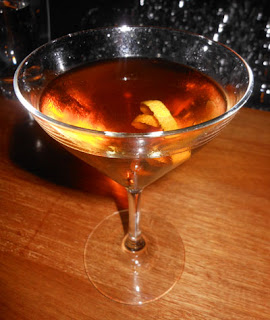
Stir with ice and strain into a cocktail glass. Garnish with an orange twist.

The drink Andrea started with at Metrovino was one that I had been eying too. Bartender Jacob Grier actually took his inspiration from a Boston-born drink, Stephen Shellenberger's Alto Cucina. I later found on Jacob's blog the origin of the drink's name. He writes, "The name comes from the Tom Waits song, which few customers recognize but I love it when they do. 'Walking Spanish' is used as slang for the prisoner's stoic final walk on Death Row, or more generally for going somewhere unpleasant against one's will." The Spanish origin of the sherry was the tie-in with the name.
jacob grier bols genever metrovino portland walking spanish
The orange twist's oils joined the Genever's malt on the nose. A sweet grape and malt sip was followed by strong nutty sherry notes and subtle St. Germain, Cardamaro, and Genever-derived floral and botanical ones.

midnight shift

1 1/2 oz Novo Fogo Gold Cachaça
3/4 oz Cynar
3/4 oz Sweet Vermouth
1/4 oz Galliano
2 dash Mole Bitters
1 dash Absinthe

Stir with ice and strain into a rocks glass filled with fresh ice. Garnish with an orange twist and add a straw.

Wednesday night during Portland Cocktail Week, we walked over to Metrovino to sit at Jacob Grier's bar. I have been following Jacob since his early blogging days, and we have made some of his drinks, including the Mexican Turnover and Curse of Scotland, at home. Therefore, it was a moral imperative to make it over to his bar when we were in town.
portland metrovino jacob grier midnight shift novo fogo cynar
The cocktail I started with was the cachaça-based Midnight Shift. The drink's orange twist played heavily into the aroma and led into a caramel and grape sip. The swallow offered up the grassy cachaça flavors, Cynar's brooding herbal notes, Galliano's vanilla and star anise, and the absinthe's anise followed by a lingering funk from the sugar cane spirit.

:: blogger to writer ::

blogger writer cocktail getting paid paul clarke lou bustamonte greg harned imbibe seriouseats tastingtable food&wine sfweeklyAfter my talk on Wednesday at Portland Cocktail Week, there was a Drink-Write seminar on how to make the transition from blogger to writer. The three panelists were Lou Bustamonte of SFWeekly, TastingTable, and Food&Wine, Paul Clarke of CocktailChronicles, Imbibe, and TastingTable, and Greg Harned of SeriousEats and Hoochlife. Instead of writing out the quotes and comments chronologically, I will organize them by speaker:

Paul Clarke:
• Blogging has no word counts, no deadlines, no editor. It serves as a good resumé to show off your knowledge base.
• When approaching a publication, understand them and their angle to show that you have done your homework.
• In building up a community of writer friends, you can bitch about bad editors as well as send work your friends way. The Mixoloseum chatroom was a great resource for that.
• Rule #1: Do not be an asshole. Maintain visibility with an editor but keep it short with at most 2-3 ideas pitched. Send a few items and wait a week or two, then send a brief reminder email. If no follow up, wait a month or two. If not, let it go and learn to take a hint.
• Trend stories! Editors love the "top 5 or 10 best/hottest ____" articles.
• The most fun stories are related to people. You can get a lot of mileage on a profile on a crazy distiller or other. Pitch story and mention the people.
• Work for free (once you are established)? Hell no! (*) Unless you are doing it for yourself.
• "Fuck you, pay me." Problems with editors in regard to scope creep, expansion with or without pay expansion. Need to set up parameters to be clear about what is expected from you and from them (i.e.: payment terms and deadlines).
• Paul recommended the Smile When You're Lying: Confessions of a Rogue Travel Writer book.
• Give no guarantees that you'll write about anything if you get something sent.
• Remember that glossy national magazines can still screw you over. Hierarchies of editors can end up causing a lot of editing requests. Fewer the better (i.e.: 2-5), but it only takes 1 editor to ruin your life.
• Show up to events, get to know people, be the face of your blog and your writing.

Lou Bustamonte:
• The weeklies are a great place to get a start. They generate a lot of content online, they pay, and look great on resumés.
• For freelancing, write and reach out with some ideas and pitches. Understand their style and house voice. Pitch ideas smartly. Do not overwhelm but keep communication going. Be nice and not too pestering.
• Build up a community of other writers. Talk to each other about good and bad sites; know what places to avoid.
• Doing things for free does not help you in any way once you are established (unlike doing a restaurant stage).
• Be transparent and honest especially when you are being paid off with a free product.

Greg Harned:
• A blog is a great means of building a compendium or portfolio of your work to reference for a new job.
• Learn how to pitch and market ideas to create a role for yourself.
• Writing needs to be leading to something (although not necessarily a direct correlation). Doing things for exposure (like podcasts and talk shows) for free, for example, is good.
• Go to more events, be more involved in community, and value networking highly. Meet as many new people as possible -- not always as a direct path but put out as many spokes to form a hub.

:: publishing your book ::

Below is the audio for the talk I gave with Natalie Bovis and Dave Stolte on publishing books. The moderator for the session was Camper English who provided this summary:
This seminar will give you the information needed to get your book idea into print, in one of three ways. Our speakers are Dave Stolte, author of the Kickstarter-funded Home Bar Basics; Frederic Yarm, author of the self-published Drink & Tell: A Boston Cocktail Book; and Natalie Bovis, who scored a two-book deal with a traditional publisher and since published a third. We’ll hear and how and why they published the way they did and open the floor to questions
publishing book natalie bovis dave stolte fred frederic yarm camper english portland cocktail week pdxcw
(photo from Natalie Bovis)
 
Click here to listen: DrinkWrite Seminar: Publishing Your Book, October 24, 2012 (for streaming or download).

portland cocktail week pdxcw natalie bovis frederic yarm dave stolteNatalie's Books:
Edible Cocktails: From Garden to Glass
Preggatinis: Mixology for the Mom-to-Be
The Bubbly Bride: Your Ultimate Wedding Cocktail Guide

Dave's Book:
Home Bar Basics (and Not-So-Basics)
or via his site's store: Home Bar Basics (and Not-So-Basics)

Fred's Book:
Drink & Tell: A Boston Cocktail Book

Wednesday, November 7, 2012

:: drink porn 101 ::

pdxcw portland cocktail week seminar photography jennifer farringtonThe first talk of the day on Wednesday at Portland Cocktail Week was given by Jennifer Farrington who I know best as the main photographer for Left Coast Libations amongst other projects. The title of her talk was "Drink Porn 101: Know Your ISO from Your Aperture."

Even though most photography these days is done with digital cameras instead of film-based ones, the basic concepts are still the same. The key to the image is the exposure which is all about the light or balancing the light and the dark.

ISO (or ASA): A measure of the film or sensor's light sensitivity. The higher the number, the more sensitive.
• Big ISO = grainier, more pixelated image
• Small ISO = tighter image
• If in low light = want a big ISO
• If in bright light= want a small ISO

Shutter Speed: The amount of time light is captured. Expressed as 1/x seconds.
• Small shutter speed = longer time open so blurry, light drag (i.e.: 1/2 second)
• Big shutter speed = shorter time open so sharp, freeze action (i.e.: 1/1000 second)
• Low light = want smaller shutter speed
• Bright light = want bigger shutter speed

Aperture: The size of the opening letting in light once the shutter opens.
• Small aperture (i.e. f2.8) = big hole, shallow depth of field
• Big aperture (i.e. f32) = small hole, wide depth of field
• Low light = small aperture needed
• Bright light = big aperture needed

Jennifer offered up a handy way to understand aperture. By making a small hole by curling over your index finger, hold your thumb out about 8 inches away. Note how you can focus on both your thumb and the distant wall in the background (i.e.: small hole, wide depth of field). Now open that hole up by sliding your curled index finger closer to that hand's thumb. Repeat the viewing of the other hand's thumb and the wall; note how you have to make a choice on which to focus on (i.e.: big hole, shallow depth of field).

Light:
• Get it. Beg, borrow, steal it.
• McGyver it using a light box, flashlights, smart phones, laptop with a white screen, candles, tea lights, walls, and windows.
• Utilize coasters for contrast. White will bounce light onto the glass and help.
• When using a flash, it will blow out what is closest. Put something dark behind the object so it will not be blown out.
• On-camera flash will often flatten the image. Trying to bounce the light can help.
• Detached flash at different angles and distances from the camera can produce a variety of effects.

Stabilize the camera:
• If you must shoot at small (slow) shutter speeds, stabilizing the camera is essential.
• Go in tight with the body (such as arms against the chest) for stability.
• Ground yourself (à la yoga)
• Setting the camera's timer so there is no jostling in pushing the button.

Shooting Angle:
• To personify the bottle, shoot upward at it.
• To make a person look heroic, shoot upward.
• To make a person look more flattering, shoot downward.

Digital Settings:
• Web: 72 dpi
• Print: 300 dpi
• Tif with LZW compression is the most popular file format.

To tell a narrative, perspective, scale, angle, distance (close up vs. panorama) will all play a role.

white buddha

2 oz Blanco Tequila
1/2 oz Green Chartreuse
1 oz Cucumber Syrup (1:1)
1 oz Lime Juice
1 oz Heavy Cream
1 Egg White

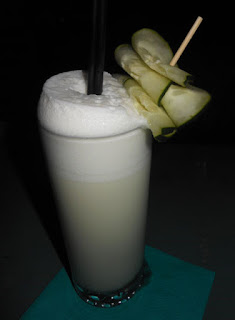
Shake once without ice and once with. Double strain into a Highball glass containing 1+ oz soda water. Garnish with 5-6 thin cucumber slices on a skewer and add a straw.

After leaving Central, we bumped into Jabriel Donohue, Portland's Drambuie equivalent to Boston's Tara Feely, walking by on the street (Jabriel is also the creator of the Pantorium). When we mentioned that we were looking for a late night dining spot, he recommended Lúc Lác. Daniel, the bartender at Teardrop, had also recommended that spot the night before, so with that double nod of approval, we set out. Lúc Lác is a Vietnamese place that opened a year and a half a go and serves a mean bowl of Pho. What we were not told is that they have a cocktail program as well. Adam, one of the two co-owners, described how the Portland community taught him how to bartend, and his proficient technique seemed to indicate the high level of instruction he was gifted.
luc lac Lúc Lác portland cocktail ramos cucumber
The menu item that caught my eye was the White Buddha which was a Ramos-style Fizz. The pairing of cucumber and Green Chartreuse reminded me of LUPEC Boston's Irma La Douce and perhaps the cucumber and Yellow Chartreuse Down at the Dinghy from Chez Henri's Rob Kraemer too. Here, the cucumber garnish contributed greatly to the drink's aroma. The creamy, carbonated sip yielded lime notes and vegetal ones from the cucumber. Next, the swallow offered tequila, Green Chartreuse, and cucumber flavors. The White Buddha was truly a delight to drink and complemented the cuisine superbly; indeed, I ran into someone at the Portland Cocktail Week USBG party a day later who was raving about this particular drink as well.

first rodeo

1/2 oz Del Maguey Mezcal Vida
1/2 oz El Tesoro Tequila
3/4 oz Luxardo Maraschino Liqueur
3/4 oz Yellow Chartruese
1/2 oz Lemon Juice

Shake with ice and strain into a coupe glass. Sink 1/4+ oz Campari.

The other drink I had at Central in Portland from Jade Brown Godfrey of Brooklyn's Bellweather was the First Rodeo. With Maraschino, Chartreuse, citrus, and spirit, the First Rodeo shared some similarities with the Last Word when being built despite having slightly shifted proportions. However, once the Campari was poured over the top and attractively sank to the bottom of the coupe Tequila Sunrise-style, it changed my thinking about the drink.
The mezcal and tequila components contributed greatly to the First Rodeo's nose. Lemon and Maraschino's cherry filled the sip, and the swallow showcased the agave, smoke, and savory Yellow Chartreuse flavors. Later, as the Campari began to enter the swallow, the Maraschino curiously switched from appearing in the sip to in the swallow.

deck hand

1 oz Bols Genever
1 oz Cardamaro
3/4 oz Kronan Swedish Punsch
3/4 oz Campari

Stir with ice and strain into a rocks glass containing a large ice cube. Twist a lemon peel over the top (this was omitted on my drink but included in others).

Tuesday evening after meeting with Natalie Bovis and Dave Stolte about our talk the next day at Portland Cocktail Week, I rendezvoused with Andrea and we headed over to Central. I had met Central's owner Dustin Knox while out at the Woodsman Tavern, so we put the bar on the list we were assembling throughout the week. When we showed up, it turned out to be a Campari and Del Maguey-sponsored event for cocktail week with two bartenders from New York City. I had no complaints about the products or the drinks; however, I felt denied of experiencing Central's menu. Therefore, I asked Dustin for a recipe or two that we could make at home (one of those drinks will appear on the blog next week) to get a better idea of what their drink program is about.
While Andrea was trying out the drinks of Marshall Altier of Manhattan's JBird, I focused on the libations Jade Brown Godfrey from Brooklyn's Bellweather. The first drink I tried was Jade's Deck Hand. The Genever aroma led into a malty sip with hints of bitter notes peaking through. The swallow was a combination of the Cardamaro's grape and the Campari's bitterness finishing with the Genever's wormwood and other herbal notes.