When Andrea and I traveled down to New Orleans for Tales of the Cocktail the first time in 2009, we went to Cure that first night on the Tuesday before things got underway. Cure had just opened a few months before in February of 2009, and it had already attracted the attention of the cocktail intelligentsia. I started my night off with the
Art of Choke made at the hands of Maksym Pazuniak, and I enjoyed it so much that I bought a copy of
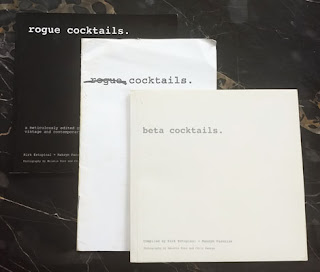
Rogue Cocktails from Maks that he and Kirk Estopinal had just put out. The front cover touted, "A meticulously edited guide to rare and unusual cocktails, vintage and contemporary, classic and original." By page 3, they launched into a manifesto that began with "Fellow bartenders and cocktail aficionados, the international cocktail renaissance is in danger of falling into a state of discontent and stagnation... It's time to surprise our customers and each other with something that challenges the palate, not just soothes it with familiar and balanced flavors."
The book then retorted that if you did not feel like reading the manifesto, they offered a softer list of philosophy. The first two points (and the fifth) were very influential when I conceived and wrote my
Drink & Tell: A Boston Cocktail Book. The first was that a bartender should be able to make the majority of the drinks without visiting a farmers market or having access to molecular mixology tools. True, there are some obscure ingredients that not every bar or home will have, but they should endeavor to carry them. The second was that drink prep should be limited to juicing without needing to make difficult syrups, tinctures, infusions, and foams; such difficult drinks were considered "drink porn" when put into cocktail guides. These first two points were bolstered by the book's opening quote by Kingsley Amis, "More practically, you will waste a lot of time -- unless of course you are simply using your drinks manual as dipsography, the alcoholic equivalent of pornography -- reading about concoctions that call for stuff you simply have not got at hand." Points three and four were that the recipes ought to be reproducible and that not everyone will love the results (although a good number will). Number five was that
Rogue Cocktails was a complement to books that contain the classics. They did not feel the need to take up space to offer the Sazerac or basic technique tutorials (which was critical since the book is only 40 pages long). Despite the fourth declaring that the drinks were not for everyone, the sixth pointed out that while the recipes may be complex and different, they need to taste good; they need to make some people rather happy. The final point was that the "roots of this book lie within the culture of the 19th century cocktails... the ingredients may be different, but the techniques certainly are not."
In my bringing together recipes from the Boston world for my 2012 book as well as the second compendium,
Boston Cocktails: Drunk & Told in 2017, there were many drinks that fit into this edgy category. Some that pop into my head immediately were John Gertsen's abstraction of the Pegu Club called the
Mission of Burma, Ryan Lotz's rethinking of the Martinez into
The Fritz, and Tom Schlesinger-Guidelli's reformulation of the Bijou into the tequila and Picon
Jaguar (my first exposure in 2007 to the fact that tequila could be utilized in a stirred drink). None of these drinks require a fancy syrup or infusion, all of them pushed boundaries yet were rather enjoyable, and all use common ingredients (save for Amer Picon in the Jaguar, but that was still available in Boston when the drink came out and we bought a bottle for our home bar from that lot). Moreover, none of these amazing experiences involved fancy garnishes: all of them had citrus oils with only one of them being dropped into the drink.
The last point is where I see the major shift over the last 10 years: presentation. While cell phones certainly had cameras in 2009, the social networking avenues were limited.
Instagram was not even founded until 2010, and it did not even begin to catch on until around the time when
Facebook purchased the app in 2013. I did not even post on the app until July 2014 (I had downloaded it before that since
Twitter impeded
Instagram images from coming through the feed in an effort to thwart
Facebook, and since I had downloaded it, I eventually I began using it). Somewhere around 2015, the cocktail world began to change. Soon, it was less about the flavors and unique combinations, and more about the vessel, the intricate garnish, the tiny wooden clothespin to hold the garnish, the hand-hewn ultraclear ice, and the presentation. The drink combinations more resembled basic drinks such as a Daiquiri with a botanical or two infused into the syrup and/or spirit; however, the local food media touted these drinks and bartenders as the hottest things for they were eye candy and articles about them drove web traffic. Some places like the Baldwin Bar and Backbar were able to combine the two with well thought out mixtures of ingredients and well composed presentations, but that seemed more like a minority. Around this same time came the period of "peak orchid" where non-Tiki bars were throwing hothouse-grown edible flowers onto every drink for it looked great on
Instagram. However, they began to look like every other drink with an orchid on top, and it added considerably to the cost of the drink. In 2009, the average cocktail in Boston was about $8-10; in 2014, it was $10-12; and in 2019, it seems to be $12-17. Having a great looking drink does indeed lessen the impact of having to pay
double for a cocktail a decade later.
Rogue Cocktails was forced to change their name by Rogue Spirits, and they came out with
Beta Cocktails as a 'zine in 2010 (reminiscent of the punk and indie rock ones I collected in the 1990s) and as a book in 2011. The quotes in the new book had changed such as opening with Charles Bukowski instead of Kingsley Amis via "Boring damned people. All over the earth. Propagating more boring damned people. What a horror show. The earth swarmed with them." David Wondrich got in on the act by providing a foreword where he described how he was so used to books amusing him with "interesting stories and snappy prose. I don't expect much from the recipe part... the classic ones are drawn from the same old books I've got and the new, creative ones are made with ingredients I don't have access to or techniques I'm too lazy to employ." Needless to say, Wondrich was pleased to write a foreword to the rebirth of the book concept through
Beta Cocktails. The manifesto was gone from print with an introduction in its place. It reiterated some of the points, and perhaps softened some of them hoping that the recipes would speak for themselves and would get you to think about cocktails in a different way. If it did not get you to reconsider drinks and techniques or at least offer an ace up the sleeve when a guest asked for something different "then it will probably fit in with the rest of your modern cocktail book collection (gathering dust)."
The punk rock feel of the brash cocktail recipe that works (albeit not for beginner palates) is a lot harder to find these day. The two camps that seem to have sprung up are the aestheticians and the hospitalitarians. I have already covered the former, but the latter I am quite pleased with. With this, you can get a good cold cocktail served with a garnish of warm hospitality. I remember when
Pegu Blog Doug visited me the last time from Ohio, and I took him to a bar that morphed into an image-driven one with fancy straws and plastic flowers for garnish. The drinks were definitely solid, but after our first round, I suggested that we move to an old school cocktail establishment nearby. There, they did not double strain their drinks, and garnishes were generally not fancier than a rough-hewn Y-peeled citrus swath or an orange slice moon; however, that was where we stayed for three or four rounds. The hospitality and lack of pretense allowed us to focus on catching up and talking about the world. The drinks were balanced, showed respect to cocktail history, and were on the low side for cocktail prices out there. It felt like home, and we stayed. True, I
Instagrammed the hell out of my one drink at the other place, but I fondly recall the moments spent at the last. When John Gertsen gave his seminal "it's not what's in the glass"
TedX Talk in 2010, I was rather skeptical especially after some of the delights that he had crafted such as the flaming until extinguished
Krakatoa, but later I came to understand it. Hospitality does suffer when the drinks take too long to make and the tools take too long to wash and reset. Michael Neff pointed this out at his
talk at Tiki by the Sea with his "I make the best paper airplane" demonstration. The
Rogue/Beta Cocktails tie in is that the drinks in those books frequently do not take more time than other cocktails to make, but it can impart that extra level of humanity to the guest who is craving something unique while not taking away from the time spent on treating the rest of the guests well.
It's now 2019, and I see a lot more effort in the media spent on which Old Fashioned or Hemingway Daiquiri recipe specs are the best. There is a lot more fine tuning of the classics than pushing of the boundaries. The boundaries that are being pushed are what garnishes, clear ice, and vessels are being used to the point that they may cost more than the ingredients to make the drink itself. Cocktail competitions that favor imagination and the like are seemingly rewarding the story and the presentation over the flavor and ingredient combination thought process. At my last visit to Cure in 2017, they were definitely still pushing out inventive cocktails, but it makes me wonder if the
Rogue Manifesto back in 2009 was important to get the next wave of bars to be noticed as "world class" before that died away to the power of the camera's eye.


 The 2017 collection of 855 drink recipes, bartender tributes, and essays on hospitality from CocktailVirgin's Frederic Yarm. Available at Barnes and Noble and Amazon.
 The 2012 collection of 505 drink recipes, techniques, and Boston bar recommendations from Frederic Yarm. Available at Amazon and Barnes and Noble.

 Posts


