Thursday, July 30, 2009

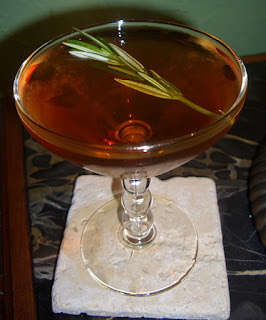
chrysanthemum cocktail

2 oz Dry Vermouth (Noilly Prat)
1 oz Benedictine
3 dash Absinthe (1/2 barspoon Pastis d'Autrefois)

Stir with ice and strain into a cocktail glass. Garnish with an orange twist.
On Sunday night, Andrea said that she wanted something vermouthy so I started flipping through our cocktail books. One that I spotted in the Food and Wine: Cocktails 2008 book was the Chrysanthemum Cocktail lifted from the 1930 edition of the Savoy Cocktail Book. Merging the histories from the two books, the drink was very popular on the S.S. "Europa" which was one of the great trans-Atlantic liners that carried cocktail-deprived Americans to Europe during Prohibition. The first notes in tasting this cocktail were the citrus flavors which work rather well with the vermouth. With the Benedictine liqueur's sugar content, the dry vermouth almost tasted like sweet vermouth and made Andrea think that the drink "tastes like candy". The drink's swallow was completed with the absinthe/pastis flavors pleasantly rolling in. The Chrysanthemum Cocktail was a delightful lower-in-alcohol drink which would serve as a good way to burn through your vermouth before it goes off with age.

Wednesday, July 29, 2009

clover club

2 oz Plymouth Gin
3/4 oz Lemon Juice
1 oz Raspberry Syrup (Housemade)
1 Egg White
1 dash Peychaud's Bitters

Shake all ingredients first without ice and then with. Strain into a wine glass.

For my second drink at Green Street last week, I asked Emily to make me the Clover Club off of their long cocktail list. Despite Andrea commenting that it was my second sweet pink drink of the week, bartender Andy McNees supported my choice and commented that it was his absolute favorite sweet egg drink. Moreover, Paul Clarke's article traces the history of the Clover Club back to a gentleman's drink. One reason I chose it was that Andrea abhors raspberry syrup so I knew that it was a drink better ordered out than prepared at home if I ever wanted to try one. The Clover Club recipe appears many places including Stanley Clisby Arthur's Famous New Orleans Drinks & How to Mix'em. Their version is lime juice and appreciates the extra added "ummph" that the dash of Peychaud bitters gives the drink and that Green Street chose to include in their recipe. Stanley also chastised the popular shortcut of using grenadine instead of raspberry syrup.

In this Clover Club, the raspberry flavor was strangely shaped by the egg white and lemon juice into something less berry flavored. The lemon and egg white hid the sugar content decently when the drink was cold but as the drink warmed up the sweetness became more apparent. Despite the drink's pink color, I could easily understand how the Clover Club was the signature drink of writers and lawyers at the Philadelphia club before Prohibition.

creole

1 1/2 oz Old Overholt Rye
1 1/2 oz Martini & Rossi Sweet Vermouth
1/4 oz Benedictine
1/4 oz Punt e Mes (*)

Stir with ice, strain into a cocktail glass, and garnish with a lemon twist.
(*) Postnote: this should be Amer Picon as seen in this post. Since most bars lack it, Green Street used Punt e Mes but Amaro Ciociaro, Bigallet China-China, and perhaps other liqueurs would make better substitutes.

Last Wednesday, Andrea and I went down to Green Street in Central Square, Cambridge. Even though we were given the long cocktail list, I ended up choosing the Creole off of their short cocktail list for my first drink. The drink that Emily made me was one of the many Creole cocktail recipes out there. This recipe, often referred to as Creole No. 2, was supposed to use Amer Picon but in its absence, Green Street substituted the part vermouth-part amari Punt e Mes. I enjoyed this drink for it was a rather vermouthy Manhattan with some complex notes from the Benedictine appearing at the end of the swallow. As the drink warmed up, the Punt e Mes' botanicals stood out more in the drink.

berry fizz

1 oz Plymouth Sloe Gin
1 oz Plymouth Gin
1 oz Strawberry-Infused Rosé Vermouth (Housemade)
3/4 oz Simple Syrup
1/4 oz Lemon Juice
1 Egg White

Shake with ice and strain into a water glass filled with ice. Top with soda, garnish with a lemon wedge, and add straw.

For my second drink at Eastern Standard, I asked Kit Paschal what he had been excited about making lately. Two of the drinks he mentioned used bartender Kevin Martin's strawberry-infused rosé vermouth which intrigued me greatly. I was reminded of the concept during Eric Seed's talk at the "Vermouth and Apertif Wine" seminar at Tales of the Cocktail this year. Eric mentioned an alpine strawberry-infused vermouth style that was rather popular in Europe but rarely makes its way over here. The Dolin company makes one called Chamberyzette so perhaps Eric's company Haus Alpenz will one day distribute it here stateside. I, therefore, chose to order one of these two drinks and to ignore Andrea's taunts that I was ordering a chick drink. Well I was, but it was in the name of academic research.

I got to sample the vermouth in a cordial glass and it was rather sweet and wormwoody. I had no clue how close it mimicked the French style or whether it even mattered much since the end result was tasty. The fizz itself was very sweet although the egg white did a good job of hiding a bit of the sugar in it. The sloe gin played well with the strawberry in the beginning of the sip followed by the gin and vermouth's botanicals at the end. Despite the taunts, the drink was rather good but the simple syrup could have been dropped entirely for my taste buds, especially since the rosé vermouth and sloe gin combination was already crafted for the sweet tooth in mind.

Monday, July 27, 2009

mount orohena

2 Lime Wedges
Mint
2 oz Rum Mix (* See text)
3/4 oz Spiced Simple Syrup (Cinnamon, Clove, Allspice)
6 drop Pernod
2 dash Angostura Bitters

Muddle lime and mint. Add rest of ingredients, add ice, and shake. Strain into a coupe glass filled with crushed ice and garnish with a mint sprig. Add straws.
Last Monday, Andrea and I decided to emerge from our home after a post-Tales of the Cocktail hiatus, and we went to Eastern Standard after a dinner at India Quality. For my first drink, I asked Kit Paschal for the Mount Orohena off of their Tikisms section of their menu. The other three cocktails in that section, the Mai Tai, Don's Zombie cerca 1934, and the Flying Dutchman, I have had before but the Mount Orohena either was new or it had evaded my attention until that point. The drink was created by Eastern Standard's bartender Bobby McCoy from what originally started as an Old Monk Rum, lime, and mint smash. From there, the rums were expanded from one to four: Appleton, Lemon Hart 80 Proof, Cruzan Blackstrap, and Bacardi Gold. The plain simple syrup was upped to a spiced one containing cinnamon, clove, and allspice which helped to transmogrify the drink. Although it was the last touch, the addition of some Pernod, which brought the drink's intrigue to a new level like it does in the 1934 Zombie recipe.

Overall, the drink had a pleasant mint nose that lead into a pretty complex drink. Of the rums, the Blackstrap lent a lot to the drink with its molasses notes. And in the syrup, the clove was most apparent to my taste buds. The Mount Orohena strongly captured the tiki feel and made for a rather refreshing summer beverage.

golden lillet martini

2 oz Aged Rhum Agricole (JM Rhum Gold)
1 1/2 oz Lillet Blanc
1/4 oz Limoncello

Moisten rim of cocktail glass with a lemon slice and lightly coat rim with brown sugar. Stir ingredients with ice and strain into said cocktail glass. Garnish with a lemon twist.
The weekend before last, Andrea was flipping through the Food & Wine 2008 Cocktails book that we got for cheap at the Crate & Barrel outlet store in Maine. When she spotted this recipe, I was a little taken aback by the name (see my disclaimer below), but something in the simplicity of the recipe combined with my love of rhum agricoles and Lillet took over. The recipe stems from The Edison bar in Los Angeles where John Gertsen and Misty Kalkofen, both of Drink here in Boston, recently did a guest bartending stint. Indeed, this drink was aggressively rhum agricole flavored. The citrus appeared at the end of the swallow where it mingled with some of the rhum's rubber notes. The combination of Lillet, limoncello, and the twist offered citrus flavors but not the tartness often associated with it. While I am not usually a proponent of sugared rims, the brown sugar in this one worked well with the rhum agricole to temper the rhum's rubber notes. And strangely, as the cocktail warmed up, the rhum agricole became less aggressive and let some of the other flavors come forward to achieve a better balance.

Disclaimer: CocktailVirginSlut does not promote calling drinks like this a Martini which should be reserved for gin with vermouth (and preferably a healthy slug of fresh vermouth, and personally other aromatized wines are fair game) and perhaps some bitters. Vodka ones are vodka cocktails, whiskey ones are Manhattans, and rum ones are Pirate Cocktails (although for some hypocritical reason I let the term Rum Manhattan slide). I was recently bothered by an interview with a collector of vintage barware published in Boston's Stuff@Night magazine. When asked what sort of Martini the man preferred, he answered "I don't believe that anything served up in a Martini glass is a Martini. A Manhattan served in a Martini glass is a Manhattan. It's a cocktail and people like them, but calling it some kind of Martini doesn't make it a Martini." And when he describes his preferred Martini, he declared "I can't drink gin, so I'd say anything with vodka" before describing his preferred Gibson recipe. Hmm.

Sunday, July 26, 2009

marigny cocktail

1 oz Apple Brandy or Calvados (Laird's Bonded)
1 oz Gin (Northshore No. 6)
1 oz Bianco Vermouth (Dolin Blanc)
1 barspoon Benedictine
3 drop Orange Blossom Water
1 dash Peychaud's Bitters

Stir with ice and strain into a cocktail glass. Garnish with a long orange twist.
As a post-Tales of the Cocktail segue, the theme for Thursday Drink Night at the Mixoloseum chatroom on the 16th was New Orleans cocktails. For the drink I created, I started with the concept of a Vieux Carre and created something that was more fruit and botanical based. The name I gave for it, the Marigny Cocktail, was christened after one of our favorite neighborhoods in New Orleans to get vegetarian food. The Marigny district was right off of the French Quarter and was full of funky restaurants, hip music venues, quaint bed and breakfasts, and a variety of old fashioned Creole cottages. To match the neighborhood, the drink had a bit of spiciness balance by some sweetness from the bianco vermouth.

I also created another drink later in the night for TDN which was a New Orleans-inspired smash named after the antiques store where the blogger cocktail hour was held at Tales of the Cocktail, M.S. Rau Antiques:
M.S. Rau
• 1/2 Lemon (in ~4 pieces)
• 2 sprig Mint
• 2 Sugar Cubes
• 2 dash Peychaud's Bitters
Muddle and then add the following:
• 1 oz Cognac
• 1 oz Rye
• 1 barspoon Herbsaint, Pastis, or Absinthe
Shake with ice and strain into a rocks glass. Garnish with a mint sprig.

Friday, July 24, 2009

rosemary's baby

2 oz Applejack (Laird's Bonded)
3/4 oz Cynar
3/4 oz Grand Marnier
1 dash Orange Bitters (Regan's)
1 dash Grapefruit Bitters (Homemade)
Rosemary

Place a quarter-sized amount of rosemary leaves in a mixing glass. Add Grand Marnier and set on fire. Once the fire dies off, add the remaining ingredients and ice, stir, and strain into a cocktail glass. Garnish with a rosemary sprig.

While at Cure in New Orleans, I was looking through their Rogue Cocktails book that I had just bought and spotted the Rosemary's Baby cocktail. It seemed rather alluring with its use of Cynar and apple brandy; however, I turned the page and forgot about the recipe since our home bar lacked Grand Marnier. A few days later at the On the Fly competition sponsored by Grand Marnier and Navan, I had scored a few nips of Grand Marnier and stowed them away in my backpack without much thought. It was not until we were back in Boston that I flipped through the Rogue once again and made the connection between the recipe and my swag pile! So for our Bastille Day cocktail, I bought some fresh rosemary sprigs and set to work.
The fire was certainly spectacular during the making of this cocktail and it added a certain toastiness to the end result. The Grand Marnier was not all that orangy in the mix but complemented the apple taste and seemed to decrease the Cynar's magnitude. The rosemary worked well with the Cynar's botanicals and with the fruit flavors in the apple brandy. Overall, the cocktail was rather intense from the theatrics in the beginning to the bitter notes of artichoke liqueur at the end.

white lily

1 oz London Dry Gin
1 oz Cointreau
1 oz White Rum
1 dash Absinthe

Stir with ice and strain into a cocktail glass.
The last cocktail I had at the Grande Soirée d'Absinthe was the White Lily, which is the last drink I will write about for Tales of the Cocktail 2009 (*). The recipe I provided was the one on the Wormwood Society's webpage which cites the Savoy Cocktail Book (1930) as the source. CocktailDB offers an alternative recipe of 3/4 oz for the first three ingredients with a more aggressive (and definitive measurement) 1/4 oz of absinthe. Given that the hosts of the event were from the Society, I went with the Savoy recipe for this entry. In the drink, the Cointreau's sweetness balanced the botanicals in the gin and absinthe rather well. Overall, the White Lily was rather pleasant and would make for a good introduction to absinthe cocktails.

(*) Not sure whether I am impressed that I made 24 posts about Tales or that I was able to trim my notes down to a mere 24 entries.