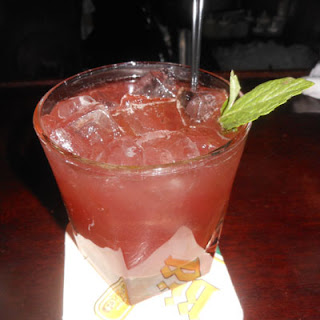
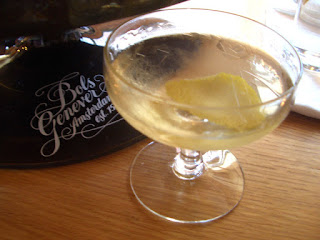
Showing posts sorted by relevance for query in 2 deep. Sort by date Show all posts

Friday, December 16, 2011

in 2 deep

1 1/2 oz Reposado Tequila (Espolón)
3/4 oz Ginger Liqueur (King's Ginger)
1/2 oz Punt e Mes
1 barspoon Fernet Branca (1/8 oz)
2 dash Orange Bitters

Stir with ice and strain into a cocktail glass. Garnish with an orange twist.

The other drink we had two Wednesdays ago was the In 2 Deep from Left Coast Libations. The recipe was created by Kevin Diedrich who used to be the bar manager at the Burrit Room in San Francisco before moving on to Jasper's Corner Tap. We had not made this drink previously since our sample nips of Domaine de Canton were running low; however, I was quite impressed by the King's Ginger at the No. 3 Gin launch (perhaps even more so than the gin itself) -- impressed enough to buy a bottle. While that was the first time I tasted it neat, I was first introduced to the Scotch-based liqueur at Tales of the Cocktail this year via Jackson Cannon's Flip Royal. At a little over forty dollars a bottle, the King's Ginger is pricier than Domaine de Canton, but it packs more ginger punch and less syrupy sweetness.
The orange twist in the In 2 Deep dominated the nose at first until the oils dissipated and the tequila began to take over. The sip was a slightly sweet grape flavor that led into the Punt e Mes' bitter and the tequila's agave notes at the beginning of the swallow. Toward the end of the swallow, the tequila morphed into ginger, and lingering Fernet and orange flavors rounded out the drink on the aftertaste.

Wednesday, February 27, 2013

white lion (variation)

2 oz Añejo Rum
1/2 oz Housemade Falernum
1/2 oz Grenadine
1/2 oz Lime Juice

Shake with ice and strain into a rocks glass filled with crushed ice. Garnish with mint and 2-3 dash of house aromatic bitters (sub Angostura), and add a straw.

Two Wednesdays ago, we traveled over to Allston to Deep Ellum for dinner. For a drink, I asked bartender Jen Salucci about the White Lion since the ingredient list was not the same as the one in Jerry Thomas from 1862:
White Lion
• 1 tsp Sugar
• Juice of 1/2 Lime (include rind in mixing glass)
• 1 wineglass Santa Cruz Rum (2 oz)
• 1 tsp Curaçao
• 1 tsp Raspberry Syrup
Mix well, chill with shaved ice, and garnish with berries in season.
Jen explained that it started out with bar own Max Toste trying to craft a Tiki-like drink for the winter to utilize the housemade falernum they had just created. As Max tinkered, he realized that his recipe was close to one that already existed -- the White Lion from Stan Jones' 1977 Complete Barguide:
White Lion
• 1 tsp Sugar
• 1 oz Lemon Juice
• 1 1/2 oz Rum
• 1/4 oz Grenadine or Falernum
• 2 dash Bitters
Shake with ice and strain into a cocktail glass. Variation: serve in a Highball glass with crushed ice and soda water. Orange curaçao may be added.
Max decided to use the name to continue the lineage of variations, even if this one was unintentionally created as such. Since I had this drink at Deep Ellum, I revisited the Jerry Thomas recipe and will write about it in the next week or two.
white lion deep ellum max toste
The aromatic bitters' allspice and clove notes joined that of the mint on the nose. A lime and pomegranate sip led into a clovey rum swallow. Definitely different in flavor than the original raspberry syrup version and closer to the Stan Jones one; however, the presentation was more akin to the Thomas instructions.

Thursday, February 14, 2013

calamity jane

1 1/2 oz Beefeater Gin
3/4 oz Amaro Abano
1/2 oz Lemon Juice
1/2 oz Ginger Syrup

Shake with 2 orange slices and ice. Double strain into a cocktail glass.

One of the drinks that my partner-in-crime, Katie Emmerson from the Hawthorne, created was a tribute to Calamity Jane. That night in service, I used the mnemonic of Calamity Gin to remember which recipe the name referred to. For an amaro, she opted for Luxardo's Abano, but the ingredient that got the most praise was the ginger syrup which was freshly juiced ginger with sugar. People figured that the "ginger" in the ingredient list was a more subtle ginger liqueur, although that would work in a pinch here. My favorite part of the recipe was the inclusion of two orange slices in the shake that reminded me of Sam Ross' Too Soon?. While I only got to straw taste the drink and thus have no written tasting notes, people seemed to enjoy this libation tremendously that night. Instead, I can offer my notes from the Facebook event page:
Another of the drinks on Monday the 11th is named after Martha Jane Canary, or more specifically after her nickname Calamity Jane. Back in the day, women were not allowed to do certain jobs; therefore, Martha began to dress in men's clothing and built up a reputation as a hard drinker (see the event photo of her) who could out swear, out spit, and out shoot any man. She became a solider to explore the Black Hills and during an Indian ambush, she gained the name Calamity Jane when she rescued her injured captain and brought him to safety.

Her colorful life included nursing the victims of a smallpox outbreak in Deadwood, but it was joked that those that she cured would end up with other diseases as a crack about Calamity working a brothel or two amongst her many other professions. After her time saving stage coaches, swimming across rivers to deliver communications, and the like, she became a part of Buffalo Bill's Wild West Show -- at first as a sharp shooter and horse rider, but later as a storyteller. This lasted for a bit with the stories getting bigger each time until she was fired for her frequent drunkenness and the antics that followed.

She led a good life and for that we should toast her! And she got her dying wish -- to be buried next to Wild Bill Hickok, a man she was infatuated with but would not return her affection. The drink named after her is spicy, rich, and complex and Calamity Jane wouldn't want it any other way.
Besides the ginger syrup, Katie also prepared a pineapple syrup for pineapple as many darker amari pair quite well with it. She was running low on time, and I recommended a choose-your-own (or bartender's choice) amaro Fix. For a recipe, she based it off of the Fernet Fix and figured out that Averna was one of her favorites in this combination. The biggest fan perhaps was Deep Ellum's Max Toste who ordered this drink a few times with a different amaro each drink. For a name, she wanted something trampy -- someone from the Wild West who got around (given the open nature of the recipe). For a name, Katie opted for Kitty Leroy who was performing in dance halls and saloons by age 14. By age 15, she was married for a brief time; the marriage failed for she was promiscuous and too wild. Later, she became a card dealer and often dressed in men's clothes. After becoming a skilled gambler and then a saloon owner, she was on to her third husband. The two of them got into an argument and she attacked him; when he would not fight back and strike a lady, she returned dressed in men's clothing and attacked again. This time with a gun, and she shot him dead. Actually, he was not her husband then and not quite dead yet, but they got married in the few days left in his life after the incident. A little bit of prostitution, gambling, and another two husbands before one of them shot her dead. To make this promiscuous drink:
Kitty Leroy
• 2 oz Amaro
• 3/4 oz Pineapple Syrup
• 1/2 oz Lemon Juice
Shake with ice and strain into a rocks glass. Fill with crushed ice, add a straw, and garnish with berries in season.

Wednesday, June 19, 2019

metropole

1/2 jigger Brandy (1 1/2 oz Courvoisier VS Cognac)
1/2 jigger French Vermouth (1 1/2 oz Noilly Prat Dry)
2 dash Gum Syrup (2 tsp Simple)
2 dash Peychaud's Bitters
1 dash Orange Bitters (Regan's)

Stir with ice, strain into a cocktail glass, and garnish with a cherry.

While looking through my old LiveJournal for the Fluffy Ruffles, I spotted the Metropole that I made in April 2008 shortly after having read about the drink in David Wondrich's Imbibe! book as well as on Chuck Taggart's blog. There, I made the somewhat newer 2:1 recipe that Wondrich preferred, but here, I found the older recipe in George Kappeler's 1895 Modern American Drinks as the equal parts drink. Wondrich wrote about this version in his Esquire Magazine column where he described the Metropole as, "If drinks were old movie stars, this one would be James Mason. Dark, handsome, suave, a little dry, but deep down a swine. Which is entirely appropriate, considering where it originated." The drink was created at the Metropole Hotel sometime between its opening in 1876 and the book's publication in 1895. Located near what became Times Square, the hotel's street-level Café Metropole served all night and gained a seedy reputation (hence, Wondrich's "swine" comment) until its demise in 1912 (only a week after one of the regulars got gunned down in front of the café). Kappeler also included the Metropolitan Cocktail which is pretty much the same there save for the bitters being two dashes of Angostura instead of the Peychaud's and orange bitters duo (and not the more modern Metropolitan that is the Cosmo riff with Kurant instead of Citron vodka, of course). The original Metropolitan published in O.H. Byron's 1884 Modern Bartender’s Guide preceded the Metropole and called for sweet vermouth instead of dry vermouth plus syrup, so perhaps the café purloined that and switched the vermouth type, bitters, and name slightly.
I opted for a little more simple syrup than specified which strayed from Wondrich's description of it being "a little dry," for I envisioned this to be a Cognac Sazerac minus the absinthe. In the glass, the Metropole presented a Cognac nose that preceded a semi-sweet and slightly fruity sip. Next, the swallow was a pleasing brandy and cherry anise combination.

Sunday, November 27, 2011

knickroni

1/2 oz Campari
1/2 oz Sweet Vermouth (Vya)
1 Egg, separated
1/2 oz Gin (Aviation)
1 dash Regan's Orange Bitters

Stir Campari and sweet vermouth with a spoon in a 2 oz sherry glass to mix. Layer an unbroken egg yolk on top. Layer gin on top of that. Beat egg whites until they are stiff (whisk or cobbler shaker with a balled up Hawthorne spring) and cover gin layer with egg whites. Garnish with a dash of orange bitters. Drink in a ceremonial 4 step process as laid out below by Leo Engel in 1878:
1. Pass the glass under the Nostrils and Inhale the Flavour –- Pause.
2. Hold the glass perpendicularly, close under your mouth, open it wide, and suck the froth by drawing a Deep Breath. -- Pause again.
3. Point the lips and take one-third of the liquid contents remaining in the glass without touching the yolk. -- Pause once more.
4. Straighten the body, throw the head backward, swallow the contents remaining in the glass all at once, at the same time breaking the yolk in your mouth.
Two Thursdays ago, the theme for Mixoloseum's Drink Night was "red and yellow" in honor of the leaves changing color as we get further into Autumn. Therefore, the use of red and/or yellow cocktail ingredients was encouraged. The idea for this drink came midway through the night in a discussion of how egg yolks were another yellow ingredient besides the obvious Yellow Chartreuse, Galliano, Strega, and Lillet. To figure out a red ingredient, I thought of Campari and somehow that triggered an old thought about how to modernize the Knickebein, a layered drink created in 1878 by Leo Engel that features an unbroken egg yolk in the middle. When we made a Knickebein for a Mixology Monday back almost 3 years ago, we lacked the crème de noyau to craft Engel's, so we opted for the one in Boothby's 1907 World's Drinks and How To Mix Them. The kümmel in Boothby's Knickebein was not so appealing despite the liqueur working well in other drinks. Therefore, the concept of modifying a favorite liqueur-laden drink and dividing it up into Pousse-café format led me to crossing a Negroni with a Knickebein especially since Campari and sweet vermouth fulfilled the red part of the colored drink night theme.
The Knickroni began with a pleasant orange aroma from the Regan's Bitters; I replaced the original Knickebein's aromatic bitters with orange ones to represent the Negroni's orange twist garnish. The first part of the drink contained the gin flavor smoothed by the egg white meringue. Next were the sweet vermouth and the sharper Campari notes; these flavors were greatly softened once the egg yolk was burst on the tongue.

Overall, the Knickroni offered up a more desirable flavor base than the other Knickebein combinations I have read in old drink books, so I chalk that up as a success. Another success was reading a post by Matt Hamlin in the A Jigger of Blog; Matt saw the tweet about the drink and commented that "There is some serious WTFery going on here."

Tuesday, April 14, 2015

colleen bawn knickebein

A few weeks ago, Gary Regan posted on Facebook about a challenge to convert cocktails into Pousse-cafés. He wrote, "Dhevandrea Hikaru, a bartender in Indonesia, contacted me recently about Pousse-cafés, and we had a nice back and forth about what they were, how they're made, etc. She asked if PCs could be made from classic drink such as the Grasshopper or the White Russian, and that got me to thinking: 'What an absolutely brilliant idea!' Seems as though those drinks would be sort of easy to layer: heavy cream, Kahlua, vodka for the White Russian, and heavy cream, green mint, white cacao for the Grasshopper, right? I haven't experimented but I think that would probably be the correct order. So I'm issuing a challenge to bartenders out there: make a Pousse-café using a classic cocktail recipe. I'll put the best of the best into my next 101 Best New Cocktails book and app. Thanks for the idea, Dhevandrea! Perhaps you'd like to submit a recipe yourself?"
I originally thought about doing a Bijou because the gem imagery of gin, sweet vermouth, and Green Chartreuse as distinct layers representing the diamond, ruby and emerald would be more stunning than the ingredients all stirred together. Then, I got into a discussion with David Wondrich about Knickebeins -- layered drinks that contain unbroken egg yolk as well as egg white froth. I had previously converted a Negroni into a Knickebein in the Knickroni, but that was adding an egg to the regular ingredients. What if I were to do it to a Flip that already had a whole egg in it? I quickly honed in on the Colleen Bawn that Jessica had at No. 9 Park in the link and I was introduced around that same time by Misty Kalkofen at Green Street. That link also provides a bit of history of this gem found in Edward Spencer's The Flowing Bowl from 1903. With rye, Benedictine, and Yellow Chartreuse in the Flip, it can do no wrong. Until, perhaps it is separated molecularly as such:
Build in a 2 oz sherry glass from the bottom up. Carefully layer each component on top of the next:
• 1/2 oz Benedictine
• 1/2 oz Yellow Chartreuse
• 1 unbroken Egg Yolk
• 1/2 oz Rye Whiskey
• Beaten Egg White Meringue
• Freshly grated Nutmeg and Cinnamon as a garnish.
Note: Benedictine and Yellow Chartreuse have nearly the same densities, so layering the two might not be as crisp or as possible as other liqueurs and liquors pairings.
Of course, building this piece of art might seem complicated until you realize that the Knickebein envisioned by Leo Engel in 1878 by way of his American and Other Drinks book has a very regimented quaffing protocol:
1. Pass the glass under the Nostrils and Inhale the Flavour –- Pause.
2. Hold the glass perpendicularly, close under your mouth, open it wide, and suck the froth by drawing a Deep Breath. -- Pause again.
3. Point the lips and take one-third of the liquid contents remaining in the glass without touching the yolk. -- Pause once more.
4. Straighten the body, throw the head backward, swallow the contents remaining in the glass all at once, at the same time breaking the yolk in your mouth.
And what better time to do it than 3am after getting home after your shift around two weeks ago? Once prepared, the Colleen Bawn Knickebein presented a sweet cinnamon spice aroma over lower nutmeg notes on the nose. On the second stage, the heat of the rye was soothed by the egg white, and the later two stages presented an herbal bounty that was eased by the protein bomb from the yolk at the end. While Knickebeins are best done as a group bonding (a/k/a hazing) ceremony rather than a solo shift drink, the life of a writer sometimes takes over especially in terms of good judgment.

Update: One done in the wild (a/k/a the Loyal Nine Bar) on 1/10/16:

Tuesday, April 21, 2009

ramos gin fizz

2 oz Old Tom Gin
1/2 Lemon (1 oz Lemon Juice)
1/2 Lime (1/2 oz Lime Juice)
1 tsp Vanilla Extract
2-3 dash Orange Flower Water
1 Egg White
1 1/2 oz Heavy Cream (Used Soy Milk)
1 tsp Superfine Sugar
2-4 oz Club Soda

Shake with ice for 5 minutes and strain into a highball glass. Top off with club soda and garnish with a lemon slice.

After getting back from my paintball tournament on Sunday and catching up on the interwebs, my ears perked up when I heard the sound of ice bouncing around a cocktail shaker three rooms away. The sound kept going longer than I expected a normal shake to go. And then it dawned on me -- Andrea was using the Hayman's Old Tom Gin we had bought the day before in a Ramos Gin Fizz. The Ramos is a drink that requires so much shaking that the Ramos' saloons hired shaker boys to take over this task from the bartenders for upwards of 15 minutes (according to legend and lore). After walking into the kitchen, just as in the later eras where bartenders would pass off the drink to the next bartender in succession to shake, I took my turn at the Boston shaker. I could easily see how the 5 minutes that we shook it for could seem like 15 especially if we were doing more than one of these.
The recipe Andrea was using came from Mittie Hellmich's book which is only slightly different from the ones in Famous New Orleans Drinks & How to Mix'em and Imbibe!. We had never made them at home before and only once had them out when Eric Seed was in town showcasing his new Old Tom Gin and other products and Max at Deep Ellum made a Ramos and a few other drinks.

The Ramos Gin Fizz had a great orange blossom and lemon juice aroma to it. The citrus combined with the sweet creamy gin flavors was an amazing experience to drink. Andrea thought that it was not as decadent as the one Max made us due to using soy milk (all we lactards usually have in the house) instead of using cream. Andrea has also been pondering how to make one of these for our vegan friends especially after some pretentious cocktail snobs told her it could not be done -- period. Given that we have made French 75's and other champagne cocktails with beer amongst other wacky experimentation in drink not to mention in food, we shrugged off their disparaging comments. Besides the soy milk for cream substitution, in place of the egg she thought some blenderized avocado might work or perhaps a vegan egg replacer like Ener-G. Well, it's a project for another day.

Saturday, January 17, 2009

knickebein

The theme for this month's Mixology Monday (MxMo XXXV) is "Broaden Your Horizons" as chosen by A Mixed Dram blog. The options were to either "Try a new base spirit. Never mixed with Tequila? Give it a try. If you’ve never made a beer cocktail or a wine cocktail, why not give it a shot? What about something really exotic?" or "Use a technique you’ve never used before. Ever been itching to give molecular mixology a shot? Now’s your chance. Ever been eager to infuse vodka or spice rum, or toss fruit and spices in something else? Here’s your excuse."

For this theme, I started thinking of things I either have not done yet or have shied away from. When I mentioned to Andrea that two concepts that I was thinking about were Pousse-cafes (layered cocktails, something I have never tried) and egg drinks (something that I am only recently learning to appreciate while out at bars), she got that look in her eye and dared me to do both. I instantly knew what she was talking about –- the Knickebein. We once saw it being made by John Gertsen at No. 9 Park for 3 guests sitting at the corner of the bar and one, of course, for himself.

The drink is attributed to Leo Engel in his 1878 book American and Other Drinks. His concoction was equal parts Curaçoa, Noyeau, and Maraschino (mixed) filling a port-wine glass two thirds of the way up. On top of that, he layered an unbroken egg yolk, and topped it with whipped egg whites sprinkled with drops of Angostura bitters. The one Gertsen made was similar –- he used only Maraschino on the bottom layer and I remembered that he had a layer of liquor between the meringue and the egg yolk. This extra layer is described in the recipe on the Bols website where they use Cognac or Kirsch.

The recipe I went with was a modified one from William Boothby's The World's Drinks and How To Mix Them. Boothby wrote about the Knickebein in the 1907 edition (the 1934 edition is much more abbreviated), "This famous Teutonic beverage is little known in America, and few bartenders have ever acquired the art of compounding one. It is an after-dinner drink, and in order to be fully appreciated, it must be partaken of according to the following directions, as four different sensations are experienced by the drinker. Therefore, the duty of the presiding mixologist is to thoroughly explain to the uninitiated the modus operandi, etc.:"

While Boothby gives similar directions as Engel, these are the exact ones from Leo including his italics for emphasis:
1. Pass the glass under the Nostrils and Inhale the Flavour –- Pause.
2. Hold the glass perpendicularly, close under your mouth, open it wide, and suck the froth by drawing a Deep Breath. -- Pause again.
3. Point the lips and take one-third of the liquid contents remaining in the glass without touching the yolk. -- Pause once more.
4. Straighten the body, throw the head backward, swallow the contents remaining in the glass all at once, at the same time breaking the yolk in your mouth.
The Engel recipe was too sweet sounding for me, so I modified the Boothby recipe slightly. I used a base layer of equal parts (1/2 oz) of Yellow Chartreuse, Kümmel (Helbing), and Benedictine, poured into a 4 oz Vodka glass. Next, an egg yolk was slid on top of that layer using a spoon. Floated on top using the back of the same spoon was 3/4 oz of Courvoisier VSOP Cognac (this step was my modification). And lastly, the whipped egg whites were added and flavored with a few drops of Angostura bitters.
One for me and one for Andrea. There should have been one more but our friend Michael (who is always up for these challenges and wrote, "That sounds so cool! It sounds like it would make me stronger!") had tickets to the Symphony that night.

Reflecting on the stages: (1) The smell was surprisingly fresh and spiced; not eggy in any way. (2) The meringue was clean tasting with the Angostura giving it an intriguing flavor. (3) The egg whites seemed to coat the mouth to reduce the burn of the Cognac. (4) Time for the show: the liqueurs were pleasant save for the Kümmel that added too strong of a sharp caraway or cumin taste and unbalanced the mixture (note: leave it out next time or sub in Maraschino, Cointreau, or perhaps Fernet-Branca for that third). As the egg yolk slid into my mouth, a wave of fear entered my body. The yolk easily burst on my tongue with a little pressure and the contents mixed with the last bits of the liqueur layer. At that point, my realization was that it was not all that gross; in fact, it had a richness that soothed the harsh taste of the Kümmel[1].

I would like to thank The Scribe from A Mixed Dram for pushing me to broaden my horizons and see that raw eggs are not that scary and layered drinks can be worth the extra effort! I may even be tempted to try the Knickebein again. Cheers!
Here I am with my body straightened and my head thrown backwards. I think this photo was taken just after the yolk hit my tongue (which was not at the end of the shot...)

[1] Kümmel can be rather delightful when used in well-balanced cocktails such as Weeper’s Joy from Imbibe!.
Weeper's Joy
• 1 oz Kümmel
• 1 oz Sweet Vermouth
• 1 oz Absinthe
• 2 dash Curacao
• 1/2 tsp Gomme Syrup
Stir with ice and strain into a cocktail glass.

Saturday, July 10, 2010

the door 74

1 1/2 oz Laird's Applejack
3/8 oz Grenadine
1/2 oz Lemon Juice
1/2 oz Martini & Rossi Dry Vermouth
1 dash Orange Flower Water
1 dash Peychaud's Bitters

Shake with ice and strain into a cocktail coupe. Twist an orange peel over the top and drop in.

On Monday night, we headed down to Allston to get dinner at Grasshopper, and afterward, we went down the block to Deep Ellum for a few drinks. At the bar that night was Ted Gallagher who now works at Deep Ellum on his nights off from Craigie on Main. The drink I selected was the Door 74 which was described to me as a cross between a Scofflaw and a Jack Rose. I did not learn the history of the drink's name until I later got a chance to speak with Max Toste, one of the co-owners of Deep Ellum. The drink was named after a speakeasy in Amsterdam that Max had a chance to visit a few months ago. Max was in Holland representing Deep Ellum as the bar was nominated along with Drink for an award; moreover, he was there giving a talk about his bar's beer and cocktail program. It turned out that the awards ceremony in May was the same week that the volcano in Iceland locked down all air traffic in that part of Europe, so Max was stuck in Amsterdam. Luckily, he met the bartenders at Door 74 who were able to play host to the stuck traveler. A similar drink appeared on the Door 74 menu under a different name, and Max renamed it as a homage to their hospitality.
The Door 74 started with a nose filled with orange aromas from the twist and flower water. The sip was semi-sweet and fruit filled from the apple, lemon, and pomegranate-containing ingredients; this sweetness was dried out on the swallow that contained the vermouth and orange flower water flavors. Indeed, it was rather interesting that the orange flower water came across more as a taste than as an aroma.

Wednesday, July 30, 2025

feet first in the deep end

1 oz Evan Williams Bonded Bourbon
1/2 oz Moderately Aged Rum (Doorly's 12 Year)
1/2 oz Light Aged/Filtered Rum (Privateer Tres Aromatique)
3/8 oz Tempus Fugit Crème de Banane
1/8 oz Amaro Abano
1 dash Angostura Bitters

Stir with ice, strain into a double old fashioned with a large ice cube, and garnish with oils from both a lemon twist and an orange twist.
Feet First in the Deep End Lost Lake Chicago Tiki Old Fashioned
Continuing on with my revisiting my well worn in Tiki books, I grabbed my copy of Minimalist Tiki book by Matt Pietrek and Carrie Smith. There, I encountered the Feet First in the Deep End by Shelby Allison and Erin Hayes at Lost Lake in Chicago that I had previously skipped over for I did not have Amaro Abano until 2022 yet had exhausted the other recipes a few years after it was published in 2015. In the glass the Feet First in the Deep End welcomed the senses with orange, lemon, caramel, and rum aromas. Next, caramel notes on the sip flowed into Bourbon, rum, banana, clove, and allspice flavors on the swallow.

Wednesday, June 1, 2011

white witch

Juice 1/2 Lime (1/2 oz)
1/2 oz White Crème de Cacao (Marie Brizard)
1/2 oz Cointreau
1 oz White Jamaican Rum (J.Wray & Nephew)

Add to Sling glass with ice and stir. Fill with soda water (~2 oz). Decorate with a spent lime shell and mint sprigs dusted with bar sugar. I skipped the sugar dusting, used crushed ice instead of cubes, and added a straw.

After the Theresa #4, I was still in a highball mood, and I spotted a drink, the White Witch, that would make use of the new bottle of Marie Brizard crème de cacao that was replacing a less glorious brand. I found the recipe in our 1972 edition of Trader Vic's Bartender's Guide but not in the 1948 version; the book provides little information about the drink save for that it was probably created some time in that 24 year span. Given that the drink calls for Jamaican rum, perhaps the White Witch refers to Annie Palmer who married the owner of the Rose Hall Plantation in Jamaica in 1820. This husband and Annie's next two husbands died suspiciously and it was hypothesized that Annie brought about their demise. Stories of her deep involvement in voodoo, romantic involvements with her slaves (before murdering them too), and the like suggested that she was indeed a psychopath to be feared. Perhaps the drink would make a good nerve calmer after a spooky séance or a thirst quencher after playing a round of golf on the Rose Hall estate (now a Ritz-Carlton golf resort). With neither of those two options open at that moment, I just figured that the drink would be tasty for crème de cacao pairs up well with Cointreau in the Prospector Cocktail and works well with with citrus in the Mady and Twentieth Century.
The mint garnish contributed greatly to the aroma and, along with the spent lime shell, helped to break up the stark absence of color. On the sip, the lime and soda water provided a crispness that was also flavored by the orange notes from the Cointreau. Meanwhile on the swallow, the funky notes from the overproof Jamaican rum were chased by a lingering chocolate note from the liqueur. Overall, the White Witch was dangerously easy to drink and the flavor combinations did indeed play well together.

Tuesday, February 16, 2016

queen of the lava beds

The theme for this month's Mixology Monday (MxMo CVI) was picked by Joel DiPippa of the Southern Ash blog. The theme he chose was "Spring Break," and he elaborated on the concept with his description of, "As we look past the frost in the air for the arrival of Spring, I wanted to challenge you with the theme of Spring Break!.. The best part of Spring Break is that it means so many things to so many different people, so I have some high expectations this month. Yes, Tiki-heads, I am looking at you. I want all of you to dig deep, steeled by last month's MxMo, and find your spring break drink! What sort of drinks do you enjoy when you start to break out of your winter shell? Do you crave a return to gin and tonics? Is there a drink that calls to you as the weather warms and the sun creeps through the sky longer and longer? Perhaps there is a drink that you fondly recall from your days of being a callow youth on Spring Break that led you down this primrose cocktail path?.. This is the month to share those warm weather finds!"
While wondering what to do for this Mixology Monday, the drink came to me by a need for a Valentine's Day drink for the Loyal Nine holiday menu. I wanted to do a Tiki drink for two that would help people not only romantically share a beverage but help to escape Winter itself. Actually, there were two special Tiki item menus as the cold weather the night before on the 13th depleted a whole week's worth of Hot Buttered Rum batter, and I decided to supplement the two servings left with the 1941 Hot Zombie for the chilly weather expected for the 14th. For the drink for two idea, I discovered that the biggest glass set we had was a 16 ounce "coupe/goblet" glass. The idea of trying my hand at a blender drink to fill this glass seemed promising, and luckily, the kitchen was kind enough to lend me one for the evening. My trial run the night before provided an interesting drink that I will publish in a few days, and I tweaked the recipe here to split the three rum blend to a mix of white rum and pisco and to swap out the Don's Spices #2 (equal parts vanilla syrup and allspice dram) for falernum. I debated between two names, and I decided that the earlier version would get the more Polynesian-inspired one, and this one would be dubbed "Queen of the Lava Beds." While that certainly sounds Hawaiian in its own right, the name is in reference to Lou Graham, a late 19th century madam that ran a successful bordello in the skid row (a/k/a lava beds) region of Seattle that I discovered through Boothby's Madame Lou cocktail.
Queen of the Lava Beds
• 2 oz Privateer Silver Rum
• 2 oz Barsol Pisco
• 1 oz Velvet Falernum
• 1 oz Honey Syrup (1:1)
• 1 oz Lime Juice
• 1 oz Pineapple Juice
• 2 light dashes Angostura Bitters
• 2 dash (~20-25 drops total) St. George Absinthe
Blend with 3/4 cup (6 oz) crushed ice for 5-10 seconds, pour into a 16 oz glass (or Tiki mug), and top with crushed ice (around 1/4 cup). Add a pair of straws, and garnish with a floated spent half lime shell partially filled with Hamilton's 151 Proof Demerara Rum that was ignited. This drink serves 2 and can easily be scaled down for solo drinking as well as up for three-or-more-somes.
It was pretty amazing the looks that were garnered as the drink was paraded across the dining room as well as the excitement on the faces of the recipient pairs. Indeed, one drink sold the next just from that flaming display (especially if it was at the two-top next to them). Part of the drink idea could be traced back to the Chappaquiddick where honey syrup and falernum were prominently matched together in a Daiquiri format. That duo has appeared in other drinks including the more recent Heaven is the Place as well as older ones like the Puka Punch. The pineapple juice also triggered the idea of pisco, and the San Francisco treat of Pisco Punch was solidified by Madame Lou's connection to San Francisco which is where she frequently visited and later died and where her tribute cocktail was first published.

So thank you to Joel for getting us all to escape the winter doldrums by thinking about warmer days and instilling an escapist mentality. And thanks to all of the other Monday Mixologists who bought their plane tickets, packed their precious tools, glassware, and ingredients, and set off to participate in this event!

Thursday, January 9, 2014

window to the flor

1 1/2 oz Lustau Don Nuño Oloroso Sherry
1 1/2 oz Lillet Blanc (Cocchi Americano)
1/4 oz Pierre Ferrand Dry Curaçao
2 dash Regan's Orange Bitters

Stir with ice and strain into a cocktail glass.

After the Bird's Eye View, I decided to make a drink that I had spotted in the collection of most recent Vinos de Jerez cocktail competition finalists. That one was the Windows to the Flor by Kevin Diedrich of Jasper's Corner Tap & Kitchen in San Francisco. Its resemblance to the classic Bamboo Cocktail lured me in besides having enjoyed Kevin's In 2 Deep from Left Coast Libations in the past.
The oloroso sherry added a nice raisiny aroma to the caramel and orange nose. The sherry also donated a grape note to the brandied citrus sip and a nutty raisin flavor to the orange peel-laden swallow. Definitely a different beast from the Bamboo, but just as light and delightful.

Thursday, August 20, 2009

improved holland gin cocktail

3 oz Bols Genever Gin
2 barspoon Maraschino Liqueur
1 1/2 barspoon Rich Simple Syrup (2:1)
1/2 barspoon Absinthe
2 dash Angostura Bitters

Stir with ice and strain into a cocktail glass. Twist lemon rind over the glass, rim edge, and drop in.
Yesterday, Andrea and I went to the Bols Genever Gin release party held at Drink here in Boston. Besides presentations by the Bols master distiller with the original 1820 recipe book in hand and by other Bols folk who spoke specifically about their product, we were privileged to hear from David Wondrich (author of Imbibe!) about how Genever played a major role in classic cocktails.

Gin was originally created in Holland as Genever, a malty liquor infused with juniper berries. During this time, the Dutch harbors received a wide variety of botanicals and grains which filtered their way into their liquors and liqueurs. The Dutch gin used barley and rye from the Baltics and they malted the grains to produce a product akin to a juniper whiskey. The English ripped off the concept of gin but made a product that was less grain flavored by using unmalted barley and miscellaneous grains. The spirit was highly rectified through distillations and filtrations to be less like a flavored whiskey and more like a flavored vodka. In the United States during the early and mid nineteenth century, English gin was not that prevalent relative to Holland gin. Much of the spirit was coming through New York which was heavily settled by the Dutch. As a result, many of the recipes from that era such as Jerry Thomas' required the proper gin of the day, namely Genever, to achieve the proper end result although some could work with the English-styled spirit as well. According to import records, the Dutch vs. English gin balance began to equilibrate around 1894 and flipped at the end of the century with 1899 seeing more bottles of British gin in bars and liquor shops than the Dutch variety.

Tasting the Bols Genever straight, it was indeed malty and very unlike English gin such as Bombay or Plymouth. The liquor is a combination of malt wine, grain neutral spirits, and a botanical infusion. Besides juniper berries, the Bols product is flavored with hops, angelica, licorice, and a secret ingredient that provides a tingling on the tongue at the end of the swallow. Max Toste of Deep Ellum guessed that it could be wormwood since he has noted similar tasting effects with his bitters infusions.

The Improved Holland Gin Cocktail was one cocktail they served to demonstrate their product. The absinthe and maraschino notes played well together like they do in the Lawhill Cocktail. Instead of the Lawhill's rye whiskey, the Improved Holland Gin Cocktail had a lighter but still malty base which demonstrated how Genever could serve as a good intermediary between English gin and whiskey. Wondrich's comment about the drink was, "rich, fragrant, and delightful... [like] a New York Sazerac!"

Sunday, December 13, 2009

red rot cocktail

The theme for this month's Mixology Monday (MxMo XLIV) is "money drinks" as chosen by Kevin Langmack of the Beers in the Shower blog. Kevin defined his concept as, "I feel a "Money" drink is something you can put in front of anyone, regardless of tastes or distastes about the spirits involved. Come up with a drink or a list based on spirits about drinks that would appeal to anyone." After giving the theme a little thought, I realized that I often look to our bottle of St. Germain elderflower liqueur when looking for a crowd pleaser. Some of the St. Germain recipes that I have had good luck with are Jamie Boudreau's La Bicyclette and L'Amour En Fuite and John Gertsen's Means of Preservation, and I believe that I have never failed with these recipes. One other recipe we have had decent luck with, the Red Rot Cocktail, was created here in Boston for a Roaring Twenties event that we read about.

The Red Rot Cocktail was created for that event at the Boston Athenaeum, one of America's oldest private libraries. The name was apropos as red rot is a type of deterioration of tanned leather that occurs when the tannins (often found in books from the latter half of the 19th century) degrade to a fine red powder, and the non-potable red rot cocktail is a chemical mixture used to treat leather bindings for retarding the decay. The potable format was created by Lauren Clark of DrinkBoston and Misty Kalkofen of Drink and hopefully none of it spilled on any century old book bindings. The drink's description was written by Lauren in Charles H. Baker-ese and I have included an easier to follow recipe below it including the gin choice we used:
Red Rot Cocktail, which Rather Resembles the Noxious Liquid Medicine for Moldy Red Leather-bound Books but Nonetheless Pleases the Palate

To one jigger of London dry gin add one half ounce each of St. Germain elderflower liqueur, Cherry Heering and fresh lemon juice, and two goodly dashes of Peychaud's bitters. Shake vigorously with ice and turn into a champagne saucer.

• 1 1/2 oz Dry Gin (Berkshire Mountain Distillers' Ephemeral)
• 1/2 oz St. Germain
• 1/2 oz Cherry Heering
• 1/2 oz Lemon Juice
• 2 dash Peychaud's Bitters
Shake with ice and strain into a coupe glass.
I opted for our bottle Ephemeral gin as it is a lighter, less junipery style; the Ephemeral might still appeal to people who claim not to care for gin while being complex enough to keep gin drinkers intrigued. Another fine gin choice would be Plymouth which is rather mildly flavored and is the one that Lauren used in this video on How2Heroes. The red part of the name derives from two components, the Cherry Heering liqueur and the Peychaud's bitters which impart a decently deep hue to the cocktail. The drink starts with cherry and lemon fruit aromas on the nose, and the sip yields a pleasing but not incredibly challenging level of spice. The gin is not as pronounced as it can be in many drinks, but is apparent on the swallow, and the drink falls safely in the middle of the sweetness spectrum. Furthermore, the Red Rot Cocktail's color is rather pretty but not too much so to scare off a guy. Perhaps the drink's name might not appeal to everyone, but the drink's taste sure has a good fighting chance to do so.
Cheers to Kevin for hosting this Mixology Monday and to the rest of the participants for their entries!

Thursday, June 18, 2020

between the devil and the deep blue sea

1 1/2 oz Overproof Jamaican White Rum (Wray & Nephew)
1/2 oz Apricot Liqueur (Rothman & Winter)
1/2 oz Swedish Punsch (Kronan)
1/2 oz Lime Juice

Shake with ice, strain into a cocktail coupe, and garnish with a lime wheel.

Two Thursdays ago, I stumbled upon the Coronian with apricot and Swedish punsch in the Café Royal Cocktail Book . Since I had already made that one, I took my desire for a Daiquiri and merged it with my inspiration from the Coronian in the direction and form of the Periodista. Instead of orange liqueur in the Periodista, I opted for Swedish punsch that I first discovered worked rather well with the punsch in the Havana Cocktail (see the Swedish Punsch Cheat Sheet for more pairings) and for overproof Jamaican rum as the base spirit. As a name, I called this one the Between the Devil and the Deep Blue Sea after a book on the most unruly of Caribbean ports, old Port Royal in Jamaica.
The Between the Devil and the Deep Blue Sea met the nose with a bright lime aroma over rum funk, orchard fruit, and dark notes from the Swedish punsch. Next, a lime, caramel, and orange sip sailed into funky rum, apricot, and tea flavors on the swallow.

Thursday, December 31, 2020

:: fred's top 10 cocktail moments of 2020 ::

In 2010, I was asked what my favorite cocktail that year was, and I decided not only to start a list of my favorite drinks, but I decided to list the top moments of the previous 12 months. So to continue with the tradition (despite 2020 being what it was), here is the 11th annual installment:

1. I became a whiskey guardian.
Last year, I hinted that I had a new gig as a part time brand ambassador, but I did not give any details past it being a whiskey distillery and they found me. A year later, I can reveal that it is Angel's Envy, and I have been enjoying the position. The beginning of the year had me doing lots of activities in bars and restaurants (including hosting a killer post-Speed Rack after party at Silvertone), and we pivoted the program to reach out to liquor stores to do promotions, events, and videos as well as to home consumers through virtual events. I planned on doing this alongside bartending part time; however, just as I finished off my 7th year behind the stick, the pandemic knocked out that means of work. I have not returned due to the lack of positions, diminished earning potential, increased stress, and health concerns. Perhaps in 2021, I will find myself bartending again, but until that point, I will be focusing on American whiskeys.
2. Got more involved in the bartender's guild.
This year I continued on with my roll as secretary for the Boston chapter of the USBG. While it was not the most active year given safety concerns, we did have a few events in the beginning of the year and one in-person event once the quarantine began which was a kayaking on the Charles adventure. The rest were some cool virtual events such as our tour and tasting with Barr Hill. To assist with the pandemic issues themselves, I volunteered with the USBG charitable arm to help with the caseload. And finally, I joined the national educational committee and put in a number of hours to get education week off the ground; I also assembled the wrap-up slide show from the various chapters' social medias. I did get featured twice -- once in a chapter leader spotlight and the other was actually my cat Embury (photo of him below) as part of animal shelter appreciation month.

3. Learned how to shoot and edit videos.
The brand work really helped bolster my confidence speaking in front of groups, but it was the addition of video work that rounded off this skill set. The virtual age of quarantine extended my job description to include Zoom tastings, video shoots, and video editing to my repertoir. I began an Instagram-TV series of whiskey cocktails created here in Boston (13 episodes to date) with me providing backstory on the recipe, the bartender, and/or bar while making the drink. Also in that link is a video of me making whiskey-glazed maple walnut scones, so baking videos as well! I also did videos with stores such as the Boston Shaker and Ball Square Fine Wines. Moreover, I gave a few virtual talks and tastings, and the one at Julio's Liquors was recorded (that had an in-person aspect with 10 spectators behind plexiglass stations that were spread out in a large room).
4. I wrote some essays.
For my post-Speed Rack after party, the featured Angel's Envy menu item was not some fancy cocktail but a boilermaker where we donated money to a breast cancer charity that spoke to me, namely the Ellie Fund. Afterward, I wrote up a tribute to said beer-shot duo. When the lock down began, I penned an essay for the USBG site about how life's path is rarely a straight line; it was in the first week of things so forgive any optimism or naïveté. There was also an essay that should have been merely a mention in the "got press" section in this list, but the article's author trimmed my quote to fit his right wing agenda; therefore, I won't link to that article but instead to my treatise on hospitality versus activism that followed. Finally, during quarantine, I noticed that I began dipping into my collectors bottles -- whether old, rare, or meaningful to only me -- and I wondered if others were doing the same. I put the question out there but did not get many responses, so I wrote later wrote up what the pandemic and spirits collecting taught me about life.

5. Got press.
Despite the limitations, I did get a bit of press this year. The coolest one came out this past month where a recipe that I created at Russell House Tavern almost 6 years ago (that never made a menu and might not have been served to a guest) got noticed and picked up by Epicurious in this article with the recipe published separately here. I also had a recipe published in Distiller using Benedictine with a bonus quote about Drambuie. When the lockdown came on, I was quoted in the Weekly Dig about how the service industry was handling things. And finally, some of my recommendations found their way into Uproxx and related sites for late season IPAs, Fall beers, Scotches for Bourbon drinkers, Canadian whisky, tequila, Scotches (original question was favorite Highland), and triple IPAs.
6. I read a bit.
I started the year off with a solid pace but somewhere around June or July, I began to falter. In the end, I read 19 books with 16 in the beginning of the year and 3 over the second half. Some of my favorites were Charles Bukowski's On Drinking, Bernie Lubbers' Bourbon Whiskey: Our Native Spirit, Bob Holmes' Flavor, Rafe Bartholomew's Two and Two: McSorley's, My Dad, and Me, Hector Garcia's The Book of Ichigo Ichie: The Art of Making the Most of Every Moment, Lulu Miller's Why Fish Don't Exist: A Story of Loss, Love, and the Hidden Order of Life, Lew Bryson's Whiskey Master Class, and Eric Alperin's Unvarnished.

7. I created some drinks!
Given that I did not work behind a bar or go out for cocktails for most of the year, I was a bit more productive at my home bar than usual. With Tiki drinks, I crafted the Shipwrecked, Who Killed Mr. Moonlight?, and the Doomscroller as my top three. For Sours, the Saidoka and Between the Devil and the Deep Blue Sea were probably my better two. And lastly, I did several bitter drinks with honorable mention going to The Elephant in the Room, Horror Hotel, Caveat Emptor, and The Kid with the Replaceable Head.
8. Visited brewery taprooms.
We tried to play it as safe as we could, and we found that brewery taprooms were good options (especially with recommendations of which ones were up on their protocols). Technically, beer gardens since all of them were outside. We finally got brave and ventured out starting in August to Lookout Farms which had a website-based ordering system and tables spaced out 15 feet apart in one of their fields. Some of the new ones that we made it to were Medusa's beer garden (down the street from the brewery), Faces Brewing Co., Cold Harbor Brewery, Backbeat Brewing Company, Timberyard Brewing Company, and Spicket River Brewery. We did not make it out to as many as previous years; with the need to buy food at each first round, we also limited our adventures to a single brewery instead of hitting 2-4 per adventure. Otherwise, much of my local beer appreciation happened at home either in my kitchen or in warmer months on our unit's deck on the second floor. That deck was a great escape where we watched the sun set and the bats flit around.

9. Traveled slightly.
Before the pandemic, I made it to New York City twice. There, I got to have beers at McSorley's (pictured above) where my dad drank in the late 60s when he went to nearby Cooper Union. There were cocktail adventures to Amor y Amargo, Pouring Ribbons, and Holiday Cocktail Lounge. I also made it to Louisville once for Angel's Envy training, and I got to visit some old and some new spots there. Unfortunately, my April trips to Louisville for the Angel's Envy national meeting for Whiskey Guardians and to Pittsburg for the USBG Northeast regional meeting got canceled. After that, I think the only time that I left Massachusetts was cutting through Rhode Island to get to another part of Massachusetts to visit a beer garden.

10. Really, you expect 10 good answers of what I got done during a pandemic?
The last one has historically been the hardest to answer. No, I was not energized enough to write a third cocktail book. Instead, we lived somewhat frugally and made use of our kitchen for most of our meals. We found a love of our deck to hang out on and even gussied it up with cafe string lights. Virtual drinking parties were also a thing with two major rituals springing up. One was Sazerac Sundays (pictured above) which lasted for several weeks, and the other one was Daiquiri Time Out which was every Monday and Friday for a little over two months. These were quite valuable as a way of socializing and not feeling alone, but soon Zoom fatigue set in, and the events trailed off. Who knows what next year will bring, but cheers and thanks for reading along this year!
Monday, January 11, 2010

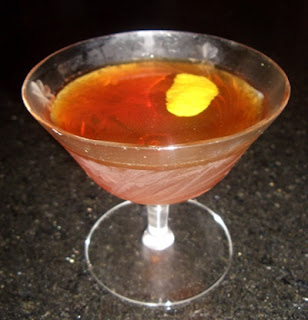
dauphin

1 oz Swedish Punsch (homemade)
3/4 oz Grapefruit Juice
2 dash Fraise Syrup (1 tsp homemade Raspberry Syrup)
1 dash Orange Bitters (Angostura Orange)

Shake with ice and strain into a cocktail glass.

This past week, I finally gave up hope that Eric Seed or other would start importing Swedish Punsch any time soon and decided to make my own. Part was giving up hope, and part was to quiet Andrea's pleadings. Swedish Punsch (sometimes called Caloric Punsch) is a traditional liqueur in Sweden made from Batavia Arrack (a rum-like spirit from Indonesia, not the anise-flavored Arak from the Middle East), sugar, and flavorings. These flavorings can include citrus peels, brewed tea, and spices, and the various additives work to soften the spicy and smoky Batavia Arrack into something more manageable to most people's palates. In fact, it can be rather drinkable on its own.

The Swedish Punsch recipe I followed was mainly Erik Ellestad's with a little of Deep Ellum's (which appeared in the January/February 2009 Imbibe magazine). Ellestad cites his recipe's influences as Jerry Thomas' Arrack Punch and United Service Punch. Essentially, the recipe was a one-quarter scale of Ellestad's with the rum and tea choices being Appleton V/X and Oolong, respectively. Deep Ellum's recipe had a greater amount of cardamom and included nutmeg; therefore, I increased the cardamom amount five fold and grated some nutmeg (here 1/2 tsp, or 2 tsp to the full scale recipe). The scaled down version made around 850 mL (a bottle and a touch more).

For a recipe idea to use the Punsch, I remember Erik mentioning that the Diki Diki was one of his favorites. The drink appears in Ted Haigh's Vintage Spirits and Forgotten Cocktails and is mainly Calvados with a small amount of Swedish Punsch and grapefruit juice. In order to showcase the Punsch more, I flipped through the Mixing at Elite Bars: 1903-1933 which is a rather good source of Swedish Punsch recipes. The Dauphin, besides being about half Swedish Punsch, stood out for it used the same pairing of Punsch and grapefruit juice so the flavor combination must be something special.

Indeed, the spice and lemon rind flavors in the Punsch paired up well with the grapefruit. Specifically, it seemed like the cardamom was the magical element in the mix to make the pairing shine. The sip started with a sweet raspberry and citrus fruit flavor and ended with a dry tea swallow. Moreover, the rum notes stood out at the end of the sip as well. I think for a next Swedish Punsch recipe, I will try to find something a bit drier for the Dauphin's balance was on the sweet side.

Monday, November 20, 2017

the same deep water as you

1 1/2 oz Plantation Dark Rum
1/2 oz Del Maguey Mezcal Vida
3/4 oz Tamarind-Cinnamon Syrup (*)
3/4 oz Lime Juice
1 dash Angostura Bitters

Shake with ice, strain into a Collins glass, fill with crushed ice, add a straw, and garnish with a mint sprig (later, it was a mint sprig + a paper umbrella).
(*) In a pinch, substitute 3/4 oz cinnamon syrup and 1 tsp tamarind concentrate such as Tamicon from an Indian spice store, otherwise follow the directions below.
(*) To make this syrup, break up 4 cinnamon sticks and add to 10 oz water in a pot. Bring to a boil and simmer covered 10 minutes. Add 10 oz sugar and 4 oz tamarind concentrate, stir while bringing back to a boil, cover, turn off heat, and let steep for 2 hours or more before straining.
In thinking about other ingredients to bring to the Cocktail Lab at Earl's Prudential two Mondays ago, I thought about tamarind syrup and recalled how well it paired with rum, cinnamon, and lime in the Final Countdown. Veering from that drink's Jet Pilot format, I dropped the grapefruit juice to make it more of a Test Pilot in structure and brought in a smoky mezcal akin to the Mr. Howell Daiquiri utilizing Scotch. I took the drink in a Tiki direction by serving it over pellet ice with a mint sprig (and later a paper umbrella) as garnish, and I kept with The Cure's Disintegration theme by dubbing this one The Same Deep Water as You.

Thursday, February 5, 2009

blood and sand (variation)

2 oz Dewar's Scotch
1/2 oz Cherry Heering
1/2 oz Martini & Rossi Sweet Vermouth
2 slices of Orange
1 Marasca Cherry (Luxardo)
1 dash Housemade Orange Bitters

Muddle cherry, orange slices and orange bitters in mixing glass. Add rest of ingredients and ice, shake, and strain into a cocktail glass. Garnish glass with orange wedge on rim and another Marasca cherry dropped in.

For my second drink at Deep Ellum, I told Max Toste that I was interested in the Blood and Sand unless there was something else he wanted to make me. He paused and then said that he wanted me to try his take on this classic drink, one named after the 1922 Rudolf Valentino as a bullfighter flick. The traditional recipe is:
Blood and Sand
1/4 Jigger Whisky
1/4 Jigger Italian Vermouth
1/4 Jigger Chery Brandy
1/4 Jigger Orange Juice
Shake well with ice, strain into chilled cocktail glass and serve. Recipe from Boothby's World Drinks and How to Mix Them (1934).
The most recent issue of Imbibe magazine (Jan/Feb) mentions this drink and that Ted Haigh suggests altering the equal parts recipe by reducing the sweet vermouth and Cherry Heering down to a 1:1:3/4:3/4 ratio to make the drink less sweet and more engaging. Max's approach was similar but more extreme. He skipped the orange juice entirely and replaced it with a muddled orange slice or two in addition to orange bitters. He scaled back the Cherry Heering and sweet vermouth and added back some of the sweetness with the muddled cherry. The end result was very Scotch forward and relatively dry (well, given the ingredients). There was a prominent and pleasant smokiness over the fruit and vermouth flavors. While I had never had a traditional version of the drink, Andrea had. She commented that she enjoyed Max's variation a lot more than the sickly sweet original.

Update: April 18, 2012 -- Max made us another Blood & Sand two weeks ago. Here is his current tweak on the recipe:
• 2 oz Blended Scotch
• 1/2 oz Cherry Heering
• 1/2 oz Sweet Vermouth
• 1/3 oz Maraschino Cherry Syrup
• 1 Orange Slice
• 3 dash House Orange Bitters
Muddle the orange slice. Add rest of ingredients and ice. Shake and double strain into a rocks glass.