Saturday, October 31, 2009

:: ice geeking ::

Preparing drinks can be facilitated by owning the proper tools. While a lot of people have spoken about the shakers, jiggers, and the like, very little has been written about ice tools. Ice plays a critical part in the drink making and enjoying experience, and its shape and size can effect everything from the preparation to the presentation. Here, I will talk about some of my more recent purchases in regards to processing small format ice and I will point you in the right direction if large format ice is your thing.

The ice tapper is the most frequently used tool in my arsenal; it is used to crack ice cubes into smaller pieces. Smaller pieces of ice have a greater surface area and thus cool drinks down quicker (given the same amount of ice). This can be advantageous during stirring and shaking many drinks. An exception to this is egg drinks where you want more froth which is best generated with large cubes; however, I have seen bartenders use a mix of cubes and cracked ice to promote both cooling and frothing. Surprisingly, it does not take a lot of force to break ice (although for more fine crushing, it does). With square cubes (made in Tovolo Perfect Cube silicone ice cube trays), it takes about 3 taps. The trick is not to tap the same side multiple times in a row, but to turn the cube to a new side each time. Each tap sets up cleavage planes that lead to the cube ending up anywhere from 3-12 pieces depending on your force, the tool, and the ice. While harder taps do work well, it does end up scattering ice fragments across your kitchen. In the photo are three of our crackers. The bottom one is a new one we bought at the Boston Shaker and, despite seeming rather light, is rather effective. The middle one is a vintage one we found in an antiques store in Somerville, NJ. Besides the cool Bakelite handle, the heavy ball and spring combination can generate a good amount of ice cracking power with very little hand movement. The top one is another vintage piece, a simple barspoon. Yes, the back side of the barspoon you already own will crack ice quite well. It does not have the springiness in the shaft that the other crackers do, but it will work quite well.

Ice tappers can only do so much. For a glass full of chipped ice for Tiki drinks or Juleps, tappers would become tedious besides the pieces being often larger than desired. One of the more useful tools which spares you the horrible noise of the electric blender is the manual ice crusher. Pictured above is an older Art Deco Ice-O-Mat reproduction I bought on eBay. Metrokane makes a few styles of ice crushers (the Boston Shaker sells one) and there are often vintage (especially wall-mounted) ones in antiques stores. While ours is stylish, it has a low ice capacity (2-3 at a time) and only produces one size of ice. The newer ones can hold more cubes in the hopper and will do two sizes depending on which way you crank the handle (as well as often have a vacuum to attach it to the counter).
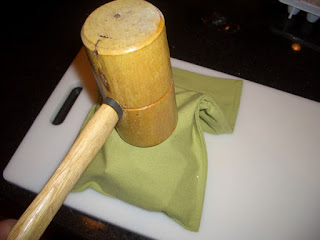
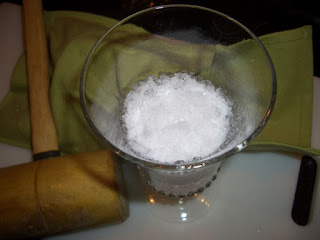
For even finer ice, a very satisfying tool is the Lewis bag. The Lewis bag is nothing but a tough canvas bag that you load the ice into, fold over the opening, and then smash the ice with a mallet or meat tenderizer. The bag pictured above is a hand-stitched one we bought at the Boston Shaker which is rather well made (besides coming in a variety of colors). We also have a canvas bank bag (seen below the ice tapper and Ice-O-Mat above) which works well but is not as thick, well-seamed, or attractive as the handmade ones, but was a lot cheaper and come in a variety of sizes. And for the DiYers out there, follow bartender Josie Packard's lead and sew your own! The one she did for Drink uses thick canvas that is triple-stitched via a sewing machine (according to the bartenders there, it is more likely to give out in the center than through the stitching when being used). For a striking implement, I got a pair of his and hers factory seconds mallets off of eBay. I was tempted by some of the vintage ones but got frustrated with the bidding wars and went with something off of the buy-it-now list. The end result is finely crushed ice (although larger sized pieces will be in the mix depending on how thoroughly you smash away) which was perfect in our Sherry Cobbler.
This list of ice processing tools is by no means complete; for example, I have seen ice crushed via wood muddler in a mixing glass. And there are plenty of ice geeks who want to go even more old school and render large format ice down into the proper size and shapes of their choosing. Drink in Boston, for example, purchases 50 pound ice and uses a variety of shavers (think wood planes for ice), cleavers, and ice picks. The shavers seem to work the best in terms of generating the finest ice without electricity albeit with a bit of time and effort. For some of the best ice picks I have ever seen, go visit Cocktail Kingdom and look at their Japanese ice picks. The rest can be found in various antiques stores (although I have no clue how long John Gertsen of Drink searched for his bar's tools).

Thursday, October 29, 2009

marco-antonio

1/3 Juice of a Grapefruit (2 oz)
1 tsp Maraschino Liqueur (Luxardo)
2 oz Gin (Beefeater 24)
1 tsp Grenadine (Homemade)
1/2 Egg White

Shake 10 seconds without and 30 seconds with ice. Strain into a cocktail glass.

Last night, I was thinking about the Josephine Baker and decided to flip through the pdf of the 1935 La Florida Cocktail Book from The Florida Bar in Havana, Cuba. One recipe that appealed to me was the Marco-Antonio perhaps due to Marco (technically Marconi after the Marconi Wireless) pestering me at the time by continuously jumping up on my computer desk for attention. The recipe reminded me a bit of the Hawaiian which I remembered as a gin drink (although we made it as the dark rum version). The Marco-Antonio's measurement for the juice made me wonder what volume of liquid would be in a 1935 grapefruit. I ended up choosing an equal parts ratio to make the drink neither too boozy nor too juicy, besides figuring that a vintage grapefruit was probably the juice equivalent of a navel orange of today (cerca 6 oz). Also, a similar recipe on CocktailDB supported the equal parts concept:
Edith Day Cocktail
• 1 1/2 oz Grapefruit Juice
• 1 1/2 oz Gin
• 1 Egg White
• 1/2 tsp Sugar
Shake with ice and strain over a glass filled with crushed ice.
For a gin, I chose Beefeater 24 which has some rather strong grapefruit notes although many of the gin flavors were lost or subdued in the egg-juice mix. The grapefruit carried over in the nose and the drink was rather sweet tasting. The gin notes did appear briefly on the sip after the fruit wave, and the Maraschino popped out at the end of the swallow. The egg white provided a good head on the drink and some smoothness to the drink, all while not seeming like an egg drink (at least the way they do with straight spirits). If we had chosen to use a third of a modern grapefruit, the drink would have been larger than most of our cocktail glasses and would have probably made for a good highball drink instead. Perhaps some tonic water or champagne could add some extra zip in that format. As for zip in this format, the Maraschino did add some complexity although some cocktail bitters such as Peychaud's or orange, whether added in the mix or added dropwise to the egg white froth surface, might have been a nice touch.

Wednesday, October 28, 2009

bless up

1 1/2 oz Appleton Estate Reserve Rum
3/4 oz Carpano Antica Sweet Vermouth
3/4 oz Aperol
2 barspoon Averna
1 barspoon Creme de Cacao

Stir with ice and strain into a cocktail glass. Garnish with an orange twist.
Last night, Andrea and I attended an Appleton Rum event at Eastern Standard co-hosted by Contemporary Cocktail's Willy Shine, John Lermayer, and Eastern Standard's Jackson Cannon. We met John at Tales of the Cocktail a few months ago and he is here in Boston preparing the Woodward, the bar at the Ames Hotel in the Financial District, for its opening in mid-November. Two of the Woodward's bartenders were in attendance, and the one that I spoke to had a great interest in making bitters (although sadly, he would not reveal what drinks were going to be on the menu). While Willie was at Tales this year, neither Andrea nor I met him, but we were amused to hear that he was born and grew up in Union Square, Somerville, close to where the Boston Shaker store currently is located.

Four drinks were on the menu last night; all were featuring Appleton Estate's Reserve Rum which is a blend of 20 different rums. While we did not have a chance to taste the spirit straight, there was a nice degree of spice detectable from the rum in the various drinks. My favorite drink of the night was the Bless Up which Willie Shine made for me. The Bless Up started with an orange oil nose which led into a rather rich and complex drink. Chocolate notes from the Creme de Cacao and Carpano Antica vermouth were complemented by the spiciness of the rum and Averna amaro and by the sweet fruit notes of the Aperol. The drink was very similar to the Dub Treo which they were also serving last night.
Dub Treo
• 1 1/2 oz Appleton Estate Reserve Rum
• 3/4 oz Carpano Antica Sweet Vermouth
• 3/4 oz Aperol
• 1 dash Fee's Whiskey Barrel Bitters
Stir with ice and strain into a cocktail glass. Flame an orange twist over the top and drop in.
The Dub Treo was described as a rum Negroni-sort of drink which reminded me a bit ingredient-wise of a drink that Eastern Standard's Hugh Fiore made me last year using Gosling's Family Reserve Rum. The Dub Treo, while less complex than the Bless Up, featured some delightful cinnamon notes from the bitters and vermouth which worked well with the spice flavors in the rum. Indeed, there was some beauty in its subtlety relative to the Bless Up.
Above is Eastern Standard's Kit Paschal about to flame an orange peel over my Dub Treo. Earlier, Kit relayed a story to us about how he ran all over town gathering up two cases-worth of Ting, a Jamaican grapefruit-flavored soda, a few bottles at a time. The Ting ended up in a highball beverage, the Appleton Ting.
Appleton Ting
• 2 oz Appleton Estate Reserve Rum
• 1/2 oz Agave Nectar-Lime Juice Mix (1:1)
Build over ice in a highball glass. Fill with Ting and garnish with an orange twist.
The Appleton Ting was our entry drink and it was a good showcase for the rum flavor due to the lighter ingredients. John Lermayer, who made us the drink, described it as a Jamaica's answer to the Dark & Stormy.

Tuesday, October 27, 2009

pearl white

1 1/2 oz Bombay Dry Gin
1/2 oz Lillet Blanc
1/2 oz Lemon Juice
1/2 oz Simple Syrup
2 sprig Mint

Shake with ice. Double strain (to remove mint bits) into a cocktail glass. Garnish with a lemon twist.
For my second drink at Green Street on Sunday night, I stuck with the gin theme and picked out the Pearl White off of the long cocktail list (shown in the photo above). While I could not find a source for this recipe, it appears to be very similar to a classic Southside with an addition of Lillet. The mint and lemon contributed greatly to the Pearl White's aroma. Moreover, the mint carried over into the taste to augment the gin sour's flavor. Indeed, the gin and Lillet were detectable in the beginning of the sip before being chased by the citrus and mint notes.

masquerade

2 oz Plymouth Gin
1/2 oz Lime Juice
1/2 oz Simple Syrup
2 drop Kübler Absinthe
1 Egg White

Shake once without ice and once with. Strain into a wine glass.

On Sunday evening after returning from our weekend adventure, Andrea and I stopped into Green Street before finally making our way home. We found seats at the far end of the bar and sat down in front of ex-Alchemist Lounge bartender Derric Crothers who took our drink orders. Off of the 6 page menu I chose the Masquerade. I later was able to trace the recipe back to Harman Burney Burke's 1936 book, Burke's Complete Cocktails And Drinking Recipes, through the help of the internet for the book is not yet in my collection. Burke's recipe appears to be a bit drier than Green Street's but otherwise very similar:
Gin, 1 Jigger
Gum Syrup, 1 Teaspoonful
Absinthe, 1 Dash
Add the White of 1 Egg
Juice of 1 Lime
Ice. 35 Shakes. Strain and serve.
I am not so sure that gum syrup would be noticeable over simple syrup when used with egg whites, since egg whites impart a different order of magnitude for mouthfeel. In the Green Street version, even with two drops, the drink had a good absinthe nose. The Masquerade's flavor was dominated by a dry lime taste with hints of the gin botanicals. The egg served to mellow out the drink quite a bit, although as the drink warmed up, the citrus and gin came more to the forefront.

Monday, October 26, 2009

nineteen

The theme for this month’s Mixology Monday (MxMo XLIII) is "Vermouth" as chosen by Vidiot of the Cocktailians blog. The concept was "to present a delectable vermouth cocktail for us all to drool over. Sweet/Italian or dry/French vermouth are fair game of course, as are quinquina, aperitif wines like Pineau des Charentes, or for that matter any fortified, aromatized wine such as Lillet or Dubonnet."

For this theme, I wanted to focus on a recipe that featured mainly vermouth. Such drinks are a lot lighter than spirit-based cocktails and often work better when confronted with an empty stomach. Recipes that popped into my head, such as Half Sinner-Half Saint, Fig Leaf, Chrysantemum, and Bamboo, all fit the bill except that I had already written about them. To start my search for a new recipe, I opened up my copy of Patrick Duffy's The Official Mixer's Manual (1975 edition) for it has a section dedicated to aperitif wine-centric recipes. There I found the recipe for the Nineteen which was consists of more than half dry vermouth, and after reading the rest of the ingredients, I was intrigued. Seeking back for an older recipe, the same proportions as Duffy's appear in the the 1930 Savoy Cocktail Book, while variations appear in Boothby, Stan Jones, and Esquire.
Nineteen
• 2/3 Dry Vermouth (2 oz Dolin)
• 1/6 Dry Gin (1/2 oz Aviation)
• 1/6 Kirsch (1/2 oz Trimbach)
• 1 barspoon Absinthe (1/8 oz Kübler)
• 4 dash Simple Syrup (1/4 oz)
Stir with ice and strain into a cocktail glass.
Indeed, the two-thirds part vermouth made the Nineteen rather light and easy to drink. On the sip, the first sensation at the tip of the tongue was a sweet fruit note from the kirsch and simple syrup with perhaps augmented by citrus peel flavors from the vermouth. Next came the absinthe followed by a combination of the winy-ness of the vermouth plus botanical notes from the gin. The drink did prove to be an outstanding aperitif cocktail and prepared our palates well for the dinner that was about to be served.
Cheers to Vidiot for hosting and to the rest of the Mixology Monday crew for participating!

Friday, October 23, 2009

big star

1 oz Gin (Beefeater)
1 oz Lillet Blanc
1/2 oz Grapefruit Juice
1/2 oz Galliano
1/4 oz Simple Syrup
1 dash Angostura Bitters

Shake with ice and strain into a cocktail glass. Garnish with a star anise.

For last night's Thursday Drink Night (every Thursday from 7pm E.S.T. onward) on Mixoloseum, the theme was "Not Absinthe". All aniseseed- or star anise-based spirits save for absinthe were fair game including aquavit, arak, anisette, pastis, Becherovka, ouzo, and Sambuca. I got creative and chose one that was not in the announcement's list -- Galliano, a complex herbal liqueur flavored with anise, star anise, vanilla, and other botanicals. The thought of star anise for some reason made me think of the influential 70's band Big Star which became not only the soundtrack for drink creation but the name of the cocktail as well.
The first sip of the Big Star was a bit sharp in a Campari sort of way; however, that sharpness faded rapidly after the first sip. After that brief acclimation stage, the drink was a very herbal and complex citrus cocktail. The anise notes seemed to appear earlier in the drink and the vanilla notes surfaced more towards the end of the glass.

As a side note, I cannot hear about or drink Galliano without thinking of this amazing paranoid delusional phone call that a late night WFMU DJ received. The description of "over the course of four and a quarter paranoid minutes the caller pressed his case for why the Galliano bottle is an instrument of pure evil and should be removed from the market permanently" only scratches the surface of the story. Reminds me of the joys of doing late night college radio back in the day. Remember, the bottle should just pick up and pour a drink. Enjoy!

:: administrata ::

First off, feel free to add our newly created Twitter feed to find out what and where we're drinking at the moment or what cool spirit, bar tool, or antique glassware we just spotted or scored in 140 characters or less:

http://twitter.com/cocktailvirgin

And second, the F.T.C. is making bloggers disclose samples and the like. It's true: we do get invited on occasion to free special events (such as the Bols Genever release party) as press and do receive free samples of bargoods to try out. These free-bees do not buy a good review although we are more likely to write about our positive experiences with the cocktails that result from them. This blog is what the 4 Cocktail Virgin/Sluts drink while at home or out as a way of recording for posterity the recipes we have enjoyed. We do realize that we have an effect on people's consumerisms, and we respect that and only discuss products and drinks that make us happy. Spirits that get used can often be substituted; bars do this all the time, so if you are playing the home game, do not fret about making due with what is in stock. Indeed, part of specificity is to maintain an accurate record of events and not to promote individual products per se.

dutch courage

2 oz Anchor Steam Genevieve
1/2 oz Bauchant Orange Liqueur
1 heaping barspoon Sugar (white)
1 dash Angostura Bitters
1 dash Angostura Orange Bitters

Stir with ice, and pour ice and all into a rocks glass. Twist orange peel over the top and drop in.
On Monday night after my 10th anniversary of DJing at Ceremony nightclub, Andrea and I walked to Kenmore Square to get dinner and drinks. Josh Taylor and Hugh Fiore were manning the bar that night (first time I had seen Josh be dressed like a bartender instead of a barback who makes great drinks when need be). Josh talked us through the new drinks on the menu including the new "Old Fashioned" section which appeared last Friday. The one that I picked was the Dutch Courage which was listed in Jackson Cannon-ese as using "Fritz's Genever". Fritz's spirit turned out to be the Genever-style gin made by Fritz Maytag of Anchor Distilling, so perhaps the drink could be renamed Dutch-style Courage to avoid trouble from the A.O.C.? The drink had a wonderful orange nose and a rather malty flavor. Moreover, the notes from the bitters and the juniper appeared at the end of the swallow. While I am not usually a fan of drinks served on the rocks, this cocktail benefited from it. The Bauchant is a subtle orange liqueur that was overwhelmed by the Genevieve; however, as the ice melted, the bite of the gin decreased and the orange flavors became more apparent.