Tuesday, January 8, 2013

averna stout flip

2 oz Averna
1 oz Stout (Mayflower Oatmeal)
2 dash Angostura Bitters
1 Whole Egg

Shake once without ice and once with ice. Strain into a wine glass and garnish with freshly grated nutmeg.  The dry shake will also help to de-gas the beer.

After returning home from Trina's Starlite Lounge on Christmas Eve, we were in the mood for a nightcap. The drink that I had in mind was Jacob Grier's Averna Stout Flip that he had posted about earlier in the week on his blog. Jacob recommended a smooth stout with a rich mouthfeel such as St. Peter's Cream Stout, Samuel Smith's Oatmeal Stout, or Young's Double Chocolate Stout. Luckily, I still had a bottle of oatmeal stout in the house to make this delight.
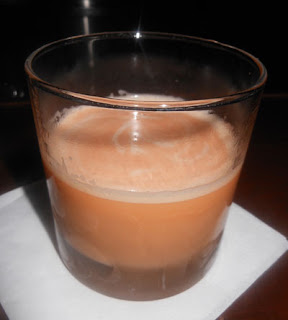
The nutmeg's spice contributed to the roasted malt aroma from the stout. A creamy caramel and roast-laden sip led into a coffee-like swallow filled with herbal notes from the Averna, the beer's hops, and the Angostura Bitters.

expatriot

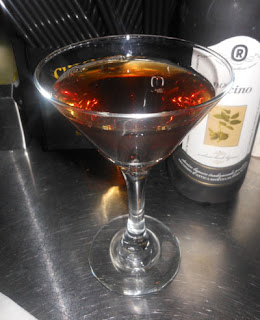
1 1/2 oz Cutty Sark Blended Scotch
3/4 oz Carpano Antica Sweet Vermouth
3/4 oz Nocino Walnut Liqueur
1 dash Fee's Black Walnut Bitters

Stir with ice and strain into a cocktail glass.

On Christmas Eve, we headed over to Punjabi Dhaba to have our traditional December 24th Indian food before Trina's Starlite Lounge opened at 9pm. Another good reason to get food there was that Trina's was only opening the bar and not the kitchen that night. We and others were indeed glad that co-owner Jay Bellao had volunteered to unlock the doors and step behind the bar.
trina's starlite lounge somerville
For a drink, I asked Jay for the Expatriot which was a walnutty variation of a Rob Roy or Bobby Burns that reminded me a little of Brick & Mortar's Sentimental Gentleman. The Expatriot differed from the Sentimental Gentleman from the start for its aroma had the richness from Carpano Antica besides the walnut liqueur. The sip was filled with grape, a hint of malt, and a dark note from the walnut. Finally, the Scotch began the swallow that ended with the walnut's tannic bitterness.

Monday, January 7, 2013

battle of new orleans

1 1/2 oz Bourbon (Four Roses)
2 dash Absinthe (1/4 oz Kübler)
1 dash Anisette (1 barspoon Raki)
3 dash Peychaud's Bitters
1 dash Orange Bitters (Regan's)

Stir with ice and strain into a cocktail glass. Twist a lemon peel over the top.

Friday two weeks ago, I decided to pick another cocktail off of the new version of the Anvil's 100 Drink List. The one that called out to me was the Battle of New Orleans. For an early recipe source, I looked to the web, and a search brought me to a post Paul Clarke wrote that mentioned Crosby Gaige's Cocktail Guide and Ladies' Companion where I had seen it before. I had viewed the drink as a Bourbon Sazerac of sorts with some additional flavors from the anisette and orange bitters and had previously skipped over it; however, Paul warned, "If you sip one of these, hoping for a Sazerac experience, you'll be disappointed. Just savor it on its own, for what it is, though, and you'll find it a pretty agreeable companion." Indeed, while many absinthes have anise notes in their herbal complexity, the anisette brings this to another level with a more singular addition to the flavor balance.
battle of new orleans bourbon cocktail
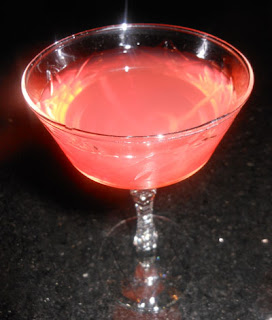
The combination of the absinthe and Raki's louching donated a hazy glow to the Peychaud's red-hued drink. On the nose, the lemon oil melded well with the anise aromas. Next, a malty sip led into the rest of the Bourbon flavors on the swallow along with anise and other herbal elements from the absinthe and bitters on the finish. The Bourbon itself made this a mellow Sazerac of sorts -- it lacked the sharpness of a rye one but certainly not the smoothness of a Cognac one. I am still unsure whether the drink would have been better by halving the Raki (perhaps more potent than anisette proper), but it did give a different herbal tonality to the drink than just absinthe alone.

queen of sheba

1 1/2 drink Brandy (1 1/2 oz Foret)
2 dash Sherry (1/4 oz Lustau East India Solera)
1 dash Port (1 barspoon Taylor Fladgate Ruby)
1 dash Sweet Vermouth (1 barspoon Cocchi)
2 dash Maraschino (1/4 oz Luxardo)
1 dash Curaçao (1 barspoon Pierre Ferrand)
2 barspoon Sugar (1 barspoon)
2 Egg Yolks (1 Yolk)

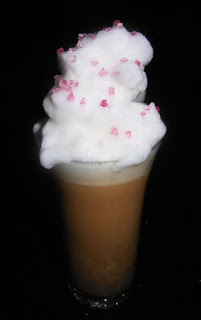
Shake with ice and strain into two (here 1) long thin glass. Crown each glass with an egg's white beated stiff. Sprinkle colored sugar (sugar infused with beet) on top. Note: the original was for two drinks and I scaled it down to one.

After the Joliet, I was in the mood for another drink so I peered into William Schmidt's The Flowing Bowl for something unusual. The late 19th century gem I selected was the Queen of Sheba which reminded me of a Knickebein with the liqueur, egg yolk, and spirit layers mixed together into a Flip. With that lack of separation, the style is a lot more casual and there is less weight put on the presence egg yolk. The Queen that the recipe refers to is a 10th century BC ruler of Ethiopia, and back then that empire would have included a vast stretch of land extending through the Middle East and into Armenia.  She was a contemporary of King Solomon and paid him a visit in Jerusalem.
william schmidt the flowing bowl
Once assembled, I regretted not having green colored sugar in addition to the red to give the drink a Christmas feel appropriate for the week it was made. Besides decorative, the egg white crown did function to dampen the ingredients' aroma. Once past the meringue layer, the sip was a creamy grape flavor. Finally, the swallow began with the brandy and ended with the liqueurs' orange and Maraschino notes.

Friday, January 4, 2013

joliet

2/3 Rye (1 1/2 oz Ryan & Wood)
1/3 Dry Vermouth (3/4 oz Noilly Prat)
1 dash Sherry (1/2 oz Lustau Pedro Ximenez)
1 dash Maraschino (1/4 oz Luxardo)
1 dash Angostura Bitters

Stir with ice and strain into a cocktail glass. I added a cherry to the recipe.

Thursday two weeks ago, I was flipping through Pioneers of Mixing at Elite Bars: 1903-1933 for a cocktail. In the whiskey chapter, I spotted the Joliet that seemed like an interesting Brooklyn-Red Hook-Manhattan sort of drink. I opted for a sweet sherry to balance the dry vermouth and for a smaller portion of Maraschino so as to keep its flavor in check.
gold rimmed cocktail glass
The Joliet started with a rye and Maraschino aroma that later gained raisiny notes from the sherry as it warmed up. The fullness and grape from the Pedro Ximénez joined the whiskey's malt on the sip. The whiskey continued on into the swallow along with the sherry's raisin flavor, and the drink finished with Maraschino and the spice of the Angostura Bitters. Overall, the Joliet was sharper than a Manhattan most likely from a quarter of it being dry vermouth.

[blue point]

1 1/2 oz Elijah Craig 12 Year Bourbon
1/2 oz El Maestro Oloroso Sherry
1/2 oz Punt e Mes
1/2 oz Yellow Chartreuse
2 dash Jerry Thomas Decanter Bitters

Stir with ice and strain into a rocks glass. Twist a grapefruit peel over the top.

For my second drink at the Blue Room, bartender Matthew Schrage suggested a Bourbon drink that sounded much like a Green Point with oloroso sherry in it. For a temporary name, I have dubbed it the Blue Point as a combination of the Blue Room and Green Point. Although there is no Blue Point in Manhattan or any of the other boroughs, there is a Blue Point in New York on the south side of Long Island.
blue room kendall square cambridge
The cocktail began with grapefruit oil over a grape and herbal aroma that gave way to a dry malt and grape sip. The swallow then offered the Bourbon flavors, Punt e Mes bitter notes, and the sherry's nuttiness which coupled well with the bitters' clove and the Yellow Chartreuse's herbal notes.

Thursday, January 3, 2013

nebbia di garda

1 1/2 oz Meletti Amaro
3/4 oz S. Maria Al Monte Amaro
1/2 oz Lemon Juice
1/2 oz Simple Syrup

Build in a Highball glass and fill with crushed ice. Garnish with a sprig of mint and freshly grated nutmeg, and add a straw.

Two weeks ago on a Wednesday, I paid a visit to bartender Matthew Schrage at the Blue Room. For a first cocktail, Matthew suggested an amaro-forward drink he called Nebbia di Garda. When I inquired about the name, he explained that it meant the "fog of Lake Garda," and that alpine lake in northern Italy is near where S. Maria al Monte Amaro is made.
blue room kendall square cocktails
The mint and nutmeg garnishes contributed greatly to the Nebbia di Garda's nose. A caramel and lemon sip containing a mint-like note was followed by a violet flower and herbal menthol swallow. For a cold Winter's eve, the drink did have a lot of welcomed Springtime elements to it.

[rusty cadillac]

1 1/2 oz Barbancourt 8 Year Rum
1/2 oz Galliano
1/2 oz Crème de Cacao
1/2 oz Angostura Bitters
1 Whole Egg

Shake once without ice and once with ice. Strain into a rocks glass and garnish with drops of Angostura Bitters.

A few Tuesdays ago, we ended up at No. 9 Park for cocktails when Ryan Lotz was bartending. For a drink idea, Ryan proposed a Flip that he had started working on while at the Hawthorne. Since I have enjoyed many of Ryan's Flips from his days at Lineage, I gave it the thumbs up. Since the drink lacked a name, Andrea noted the Galliano and crème de cacao that are in the Golden Cadillac and suggested the Rusty Cadillac after the overriding color of the Angostura Bitters.
no. 9 park cocktails
The Flip offered allspice and cherry aromas from the Angostura Bitters. A creamy sip led into a rum, vanilla, and nutty-chocolate swallow. Finally, the drink ended with a lingering spice finish that contained mint-like and clove elements. In addition, as the drink warmed up, the Galliano's star anise became more noticeable on the swallow.

Wednesday, January 2, 2013

:: fred's picks for the top cocktails of 2012 (in) ::

And for a third year running, I will complete my trilogy of year end wrap up posts by picking out the best recipes we tried at our home bar this year. While I did create a few recipes this year, I will tack a few of my favorite ones at the end and keep this list solely to recipes created by bartenders, living and deceased, from around the world.

January: The best drink we had at home in January is Casey Robinson's El Nacional perhaps for how the Campari and Ramazzotti acted together. For runners up, Jacob Grier's Mexican Turnover and the Swedish Punsch and Pimm's Pimmeron from 1700 Cocktails for the Man Behind the Bar.
February: Cale Green's dark and herbal Daiquiri called the Dirt'n'Diesel gets the nod for February. Runners up are Sidecar-ish They Shall Inherit the Earth from Esquire's The Art of Mixing Drinks and Brian Miller's Benjamin Barker Daiquiri.

March: The month's winner is Palliative Potion for Pomona as a rum and Swedish Punsch Corpse Reviver from Crosby Gaige's Cocktail Guide and Ladies' Companion. Next in line are the Supreme from The How and When which conjured up a Tango #2 and Rum Frisco, and the Chelsea Sidecar-like Snake in the Grass from Café Royal Cocktail Book.
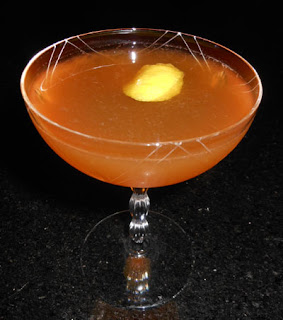
April: The tequila and sherry El Molino from PDT Cocktail Book was quite a delight in April. Runners up are the rye Hot Spring from Café Royal Cocktail Book and Clive's Classic Lounge's anti-Tiki Tar Pit that I discovered in a Diageo happy hour recipe book from Tales of the Cocktail in 2011.

May: May was a month of four equal parts drinks with or without absinthe. For a winner, I guess I'll go with Joaquin Simo's Naked and Famous. For runners up, Sam Ross' Sunflower and Jason Lograsso's Flower's of Distinction.
June: A Last Word-Jack Rose hybrid by Clover Club's Brad Farran, the Jack's Word, caught my attention for June. Erik Adkin's Pisco Ramos-like San Francisco Fizz and the lesser known Monte Carlo -- the Madeira-containing one from Pioneers of Mixing at Elite Bars: 1903-1933 -- get the nod for runners up.

July: July's pick is the reposado tequila, Punt e Mes, and strawberry-containing Resting Point from the P.D.T. Cocktail Book. For runners up, the Martinez-like L'Aurore from William Schmidt's The Flowing Bowl and the absinthe-laden Pontarlier Julep caught my attention.
August: Maksym Pazuniak's bitter and smoky Barefoot in the Dark is my pick. For runners up, the Periodista-like Superior from Boothby and Milk & Honey's Rome with a View are worthy potations.

September: The Pacer, a Bobby Burns-like drink with extra savory herbal notes from Yellow Chartreuse, deserves some extra attention. For runners up, I selected the Old Hall, a Martini crossed with a Gimlet, and P.D.T. Cocktail Book's Siesta.

October: Chris Hannah's Pomme en Croute in homage to the Crusta first made in New Orleans was rather good. The Harry Palmer is a good use of gentian liqueur in a whiskey drink and Bottoms Up's Of Thee I Sing, Baby is an interesting Periodista-like drink.
November: Despite my initial hesitation at the name, Fo Swizzle My Nizzle is a solid Cynar and gin Swizzle. For runners up, I looked to two variations: the Lion's Tail always seems like it should be a rum drink and the Hair of the Lion follows through; the Colonial is a good Pisco Punch riff.

December: The After Dark not only won the 2012 Vino de Jerez competition but also my vote for December's recipe. Strong runners up are the New Orlean's feel of the Cock 'n Bull Special and the Swedish Punsch-laden Stinger, the Tangier Night.
My favorite creations of 2012: I narrowed it down to five in no particular order. A Sainted Devil is a Fernet and tequila riff of a Blood and Sand. A Pegu Club crossed with a Scofflaw by way of some passion fruit syrup in the Tanglin Club. The classic feeling Black Friar. Finally, the rum and cacao The Cross and the Switchblade and the Batavia Arrack-driven Javanese Crusta.