Showing posts sorted by relevance for query Giuseppe Gonzalez. Sort by date Show all posts

Monday, July 2, 2018

:: balance in the bartending industry ::

The morning after the Herbs & Rye pop-up at Tiki by the Sea, bartenders Giuseppe Gonzalez and Nectaly Mendoza spoke to us during breakfast about how to live a healthier life as a bartender. Giuseppe began by asking Nectaly, "I've been bartending for 22 years, and you?" Nectaly replied with "3, that I remember." Both of these industry legends have given up drinking with Nectaly at 3 years sobriety and Giuseppe at 4. Each reached a breaking point as the partying was affecting their health. Both were overweight; Giuseppe had come down with Type I Diabetes and was on a kidney transplant list, and Nectaly faced his own health issues due to the drinking and drug abuse. Giuseppe also mentioned that he is a third generation bartender and how the job killed his father at age 38 from heroin and alcohol addiction.

Giuseppe continued on by explaining that the hard part was in learning to change his habits. He feared that he would lose all his friends in the process, and he wondered what it would be like to go to Tales of the Cocktail without that crutch. At Tales, when you walk into a seminar, you are handed a drink. It becomes part of your habit to drink, but there are ways of making it work. All of his best relationships have come from events like Tales, so there is value in going. And others like Jim Meehan and Julie Reiner have found ways of making it work.
Nectaly offered up that he does not preach sobriety. He commented how we see people both in their highest as well as their darkest moments, and the industry often does not provide guidance especially since we are not guiding ourselves. He suggested that each bartender ought to find out his or her true meaning and why they act a certain way. Bartenders these days are trying to be superstars on social media; trying to be people who they are not is not self-sustaining in the long run. Nectaly explained, "I chase myself in life" and how he stopped chasing awards. When he was chasing it, it felt like something fake; when he stopped, the awards givers and success began chasing him. In addition, "You've got to seek the happiness in yourself," and while drugs and alcohol got him into certain crowds, in the end it was just him.

Nectaly went sober when his career was on fire, and his establishment was winning awards. Yet, at Tales of the Cocktail that summer, it came to a close when he felt that he almost died due to the excess. On top of that, he quit because he was not happy. While Nectaly did not regret doing all the drugs and alcohol, he regretted how he felt.  He feels that the best version of himself is at 100% and that is a sober self. Nectaly later followed up by asking us what we were focusing on in life. Are we an artist (with talent) or a clown (the performer)? When Nectaly gets on the stage to work, he now tries to use his natural voice and reach his purist form without the need for juggling and makeup façades.

Guiseppe continued, "If you can't be happy without drinking, think about that," and he found that not drinking did not hurt his career. When you are behind the bar, you are the host and the M.C. You are making the party happen, and things can go awry if you are not vigilant which is made worse through drinking at work. As you drink, the night becomes more about you and less about your guests. Bartending is a job measured in small victories where the praise is about doing it well every day.

Giuseppe warned that "If you are looking at bartending for happiness, it is not going to happen. If you are looking for happiness, it is in connection." Nectaly supported this concept. While he blames the pressures in the industry for everything he did wrong, the industry was also the biggest support when he stepped back. People will fall in your life, and the goal is not to pick them up but to be there when they stand up. Make yourself accessible to help out, and rock bottom is the perfect foundation for that person to build themselves back up. Finally, Giuseppe wrapped things up by stating that if someone is in trouble and shoots you a text, call them. Do not text them if they are in trouble, but reach out and speak to them.

Monday, December 10, 2018

:: the need for a mentor ::

First published on the USBG National blog in July 2018; slightly adapted version here.

Throughout my bartending career I have frequently felt the need for a mentor. Usually this feeling is when I am approaching a crossroads or perhaps merely sensing the need for change and improvement, and a mentor seems like the easy out where someone will swoop down and tell me which direction to go. I have had many mentors throughout my bartending career, but none of them actually told me what path to take. Most of them were rather good at one or a few aspects of the trade and were willing to correct what they saw wrong, give advice when asked, or listen to my complaints and suggest ways of handling the problems. Countless times, these mentors did not even realize that they were teaching for I was observing their methods. Indeed, I have had mentors in how to welcome guests, how to patch up a bad moment and turn it into a good experience, how to deal with difficult coworkers and not be a dick; how to cut people off and kick people out with grace, etc. Many of the ones that I learned from excelled in only one or two things in my eyes, but they did that aspect of the job exceptionally well. Some I worked with (or for), but many that I learned from were my bartender and I their guest.

I recently watched an episode of Erick Castro's Bartender at Large series where he interviewed Giuseppe Gonzalez that hit on this topic. It was not even mentioned in the teaser description of the video, and I tuned into this one for I had met Giuseppe at my first Tales of the Cocktail in 2009 and bonded over the fact that we were both biology majors at the same university only a few years apart. I reconnected with him years later on Facebook after reading one of his long, opinionated rants and felt that I ought not miss more of what this man had to say.

As their banter drifted from bartenders who cannot think on their own for how to reinterpret drinks from the written recipe to taste better (or perhaps they shift the character of the drink too far to still be called the same thing), and Giuseppe got on the topic of mentoring. To wrap things up, Erick asked him for advice on how bartenders should create their own drink specs and riffs. In the last four minutes of the episode, Giuseppe griped that his workers complain to him after six months that they are not being mentored, and he explained that it is the [expletive] job. Giuseppe explained that Dale Degroff did not have a mentor – he just did it. True, Audrey Saunders was mentored by Dale, but she was independent and did both the research and the work herself as well. Giuseppe commands us to stop looking for mentorship. He suggests things: pick up a book, talk to peers, do the research, and grab bottles and experiment. Things come through work, repetition, and time. A bartender does not get that good from reading a book alone, but by holding down the job for years. Learn to listen and observe so as to do the job better over time.

At this point in my career, I am less looking for guidance in how to do the basics of the job, and more in which direction to take. While some bartenders have the advantage of well-connected bosses who set them up with the next leg of their career, most of us do not, and must rely on associates who relate needs and job openings, or perhaps utilize job boards for what is available. No one can answer the questions of what is the right next step for a person, but sometimes asking and looking around can show the opportunities and directions that exist. All too often, young bartenders hop from job to job without figuring out how to make themselves fit in better at the current spot. The continual hopping every few months inhibits the learning and growth that would likely make them better bartenders in the end. As Giuseppe proffers, hunker down and do the job and learn to do it better by repetition and adaptation.

This is not to say that one should not be on the look out for teachers, but it will often not be as formal as school (save for the first job, the first nights at a new position, or perhaps Barsmarts and similar classes). More likely, it will be from tinkering and figuring out things first hand or from observing someone doing something better and learning second hand and perhaps following up with asking questions or advice. Moreover, when the time comes, the favor should be repaid whether by offering sagacity or being willing to provide it. Becoming the bartender, bar manager, or owner with humility that people will seek out for guidance is definitely a solid end point in one's development.

Bartending in the 19th century was taught solely by apprenticeship. The 1860s saw the first bar books to come out, but it was not until Harry Johnson's 1888 bar manual that there were well laid out written instructions on how to do one's job better. These days, there are lots more books, articles, seminars, and videos to supplement the career growth that is earned the old fashioned way: on the job. One ought to utilize every avenue available; however, only some of the bartender's wisdom can be taught by a formal mentor. Determining the career path and when and where to move to still have to come from within to make sure that they are the right steps. The best that one can do is to try to take in as much knowledge from as many sources as possible and integrate them into how to improve at one's trade.

Friday, July 31, 2020

infante

2 oz Tequila (Lunazul Blanco)
1 oz Lime Juice (3/4 oz)
3/4 oz Orgeat

Shake with ice, strain into a double old fashioned glass with ice, and garnish with freshly grated nutmeg.

Two Fridays ago, I returned to Michael Madrusan and Zara Young's A Spot at the Bar book and selected the Infante attributed to Giuseppe Gonzalez. As a Tequila Daisy sweetened with orgeat, it reminded me of a streamlined Trader Vic's Pinky Gonzalez or perhaps my Silver Surfer. My later sleuthing determined that Giuseppe created this at Dutch Kills circa 2009, and the recipe in Sam Ross' app includes 3 drops of orange blossom water in the mix. Moreover, the drink name is another tribute to Pedro Infante, the singer-actor from the golden age of Mexican cinema, which Misty Kalkofen honored in her A Slow Dance with Pedro Infante.
The Infante greeted the nose with an earthy, nutty, and vegetal agave bouquet. Next, a creamy lime sip sang out before an agave melding into earthy almond swallow.

Monday, May 7, 2012

stormy mai tai

1 1/2 oz Angostura Bitters
3/4 oz Orgeat (Ferrara Orzata)
3/4 oz Curaçao (Senior Curaçao)
1 oz Lime Juice

Build on crushed ice in a rocks glass and swizzle to mix (shaking with ice and straining into rocks glass filled with crushed ice would be equally as effective). Float light rum (1/2 oz 10 Cane) and garnish with mint.

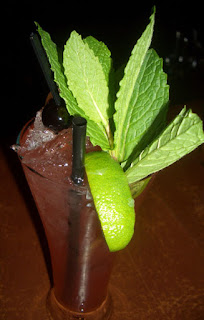
Every so often, our blog's analytics alerts me that the post on the Trinidad Sour receives traffic from a post Paul Clarke did about the recipe I wrote about. The original was created by Giuseppe Gonzalez when he was a bartender at Brooklyn's Clover Club, and it is a crafty inversion of a standard cocktail formula such that the bitters play a significant role with an ounce of Angostura Bitters. In the comments of Paul's post, Giuseppe left the recipe for an Angostura-heavy companion cocktail, the Stormy Mai Tai, that seemed rather curious and tempting. As an inverse bittered Mai Tai with the rum used as an accent and the bitters used as the base spirit (true, bitters do not appear in the regular Mai Tai), I saved this recipe until our mint patch had returned to full swing and I was up for a challenging drink. For the orgeat, instead of the subtle but very wholesome B.G. Reynolds syrup, I opted for a flavorful but extract-laden syrup from Ferrara since I figured that it needed to stand up to the robust flavors in the mix.
With this much Angostura Bitters in the drink, I was a little afraid to use a wood swizzle stick in fears that it would stain red and I substituted a metal bar spoon as a swizzle instead. The mint garnish contributed greatly to the drink's nose along with hints of the light rum that was lurking underneath the sprigs. The rum float dominated the flavor of the first few sips before the Angostura's cherry notes, the lime juice, and the Curaçao's orange entered into the sip. Finally, the Angostura's spice filled the swallow and were soothed by the orgeat's almond notes.

Thursday, March 12, 2009

trinidad sour

1 1/2 oz Angostura Bitters
1 1/2 oz Ferrara Orgeat
1 oz Lemon Juice
1/2 oz Rittenhouse Rye

Shake with ice and strain into a coupe glass. And yes, those are the correct volumes (Update: close, see below).
Trinidad Sour (via Giuseppe Gonzalez)
• 1 1/2 oz Angostura Bitters
• 1 oz Orgeat
• 3/4 oz Lemon Juice
• 1/2 oz Rye Whiskey<
Source: Liquor.com & Punch. The former has a lemon twist and the latter has no garnish.
For my second cocktail at Drink last night, the honorable Ben Sandrof came by to chat. We began speaking about how much bitters you could drink straight without getting sick and then how much you could put in a cocktail and still have it work. Excluding some of the sweeter bitters out there like Fee's or Stirrings, the most I have ever seen was in the Woodpecker, a drink I left off of our menu at the International Migratory Bird Day cocktail party where we served bird-inspired cocktails, due what seemed like an absurd recipe:
Woodpecker
• 2 oz Vodka
• 15 dashes Angostura (or Peychaud's) Bitters
Serve with 4 ice cubes or with crushed ice in a rocks glass.
Ben countered that he had two cocktails that he thought I might like to change or at least challenge my mind. The one I went with was a sour created by Giuseppe Gonzales of the Clover Club in Brooklyn and brought to Ben by way of Daniel Eun. Well not just a sour, but an inversion of a standard sour recipe such that the rye, which you would assume is the base spirit, becomes the flavor enhancer, and the bitters instead of being the accent become the drink's base. One of the pleasures of Ben's bartending is that while he can conjure up and serve perfectly regular drinks, he will gladly throw in a level of perversity if you are game, and accepting the perversity gauntlet often pays off grandly. For example, one of the most memorable drinks I had at No. 9 Park was a 1794 cocktail that Ben made for me with some xanthum gum-thickened Campari (almost a jelly) that yielded a cocktail with a rather fun and full mouthfeel to it. I figured that this would be a drink bold enough to match the Scotch Sazerac I had just finished.
I was in utter awe when the drink appeared in front of me. It was rather red with a thick froth on top. On the nose of the drink, there was a great deal of cinnamon, spice, and almond/orgeat aromatics. Upon the first sip, it was surprisingly very citrusy with more of a lime taste to it due to something in the bitters modifying the lemon's flavor. The ounce and a half of Angostura bitters a priori sounds like a disaster and my mind had a preconceived opinion of the flavor profile. However, it worked in a very delicious way, and not only that but the cherry wood in the Angostura's botanical mix brought out a great cherry-fruit flavor. Lauren Clark of DrinkBoston was at the ice bar behind me and Ben made her one as well. Lauren said she initially attributed the cherry flavor to her mind tricking her into thinking the drink was cherryish due to its incredible red color a la cherry juice. Over all, I was quite pleased with this drink both as an experience and as a drink itself. It was indeed an intense cocktail but very different type of intense from my Ardbeg Sazerac.

Thursday, February 19, 2026

barroom hero

1 oz Angostura Bitters
1 oz Fernet Branca
1/2 oz Rittenhouse Rye
1 oz Giffard Orgeat (homemade Orgeat)
1 1/4 oz Lime Juice
1 dash Peychaud's Bitters
2 spray Tahitian Vanilla (1 dash Savoy Society Orange Vanilla)

Shake with ice, strain into a coupe, and garnish with a flamed (unflamed) orange twist.
Two Wednesdays ago, I bought the four volume set of Kahuna Kevin's Tiki Cocktails books as PDFs from the author via Etsy. From the fourth volume, I was lured in by Kahuna Kevin's Barroom Hero that read like a hybrid of two of Giuseppe Gonzalez's drinks: the Trinidad Sour and the Magic Julep. Perhaps, Kevin named his drink after the Dropkick Murphys song, although the protagonist in that song only drank [high]balls and beer. Once shaken and strained, the Barroom Hero lurched to the nose with an orange, allspice, and minty aroma. Next, a creamy lime sip opened up into minty-menthol, almond, clove, and allspice flavors on the swallow. Given the ingredients and amounts here, Bartender Hero might be an appropriate name too for I have drank more Fernet and Angostura shots with my fellow bartenders than I have ever on my own.

Wednesday, December 7, 2016

malmsey flip

2 oz Blandy's 5 Year Malmsey Madeira
1/2 oz Maple Syrup
1/2 oz Angostura Bitters
1 Whole Egg

Shake once without and once with ice, strain into a large coupe glass, and garnish with freshly grated nutmeg.

After spotting Jacob Grier's PX Flip in the blog archives, I was curious if the same could be done with a sweet Madeira. Looking over the sugar content of the various fortified wines, I realized that Pedro Ximenez sherry has more than twice the sugar content of Malmsey Madeira (not to mention Madeira being balanced by a high acid content), so I figured that it needed to be sweetened somehow. For a first pass, I made this drink with demerara syrup and either Angostura or Peychaud's Bitters; the results were that demerara was not sweet enough and Angostura's Christmassy spice was superior here to Peychaud's absinthe-like feel. Instead of opting for a sweeter sugar syrup like simple, I selected maple syrup with the Fort Washington Flip in mind.
The Malsey Flip presented a nutmeg, clove, and maple bouquet to the nose. Next, the sip was a delightfully creamy grape and maple combination, and the swallow continued on with the maple flavors along with allspice, clove, and cinnamon notes.
Update: I discovered in November 2017 that the Livestock Tavern in Honolulu put this Flip on a short list of borrowed recipes along with ones from George Kappeler and Giuseppe Gonzalez!

Monday, December 31, 2018

:: fred's top 10 cocktail moments of 2018 ::

In 2010, I was asked what my favorite drink that year was, and I decided not only to start a list of my favorite drinks, but I decided to list the top moments of the previous 12 months. So to continue with the tradition, here is the 9th annual installment:

1. Favorite Drinking Moments.
I figured that I would start on the lighter side and think about my favorite moments in drinking -- not necessarily what was in the cup. The top one was closing up the bar at Our Fathers in Allston on New Years Eve and realizing that there was a small chance that I could catch a drink of my own on the way home. I messaged my old coworker Trevor who was at the Boathouse in Harvard Square which was just off my route home to see if there was a chance that I could reserve a beer, and I was granted the affirmative. The beer was Sierra Nevada's Celebration Ale 2017 which was good, but the enjoyment of a beer and an old friend to ring in New Year's Eve albeit in another timezone was a great feeling. A close runner up was at the Wild Turkey Behind the Barrel event this past September where Cards Against Humanity and shots of Wild Turkey were a magic combination. Again, what was in the cup did not hurt, but the camaraderie made the moment special.
2. Got Press!
2018 was definitely a year where I got my words and drinks out there. This included my Espresso Mexicano Cocktail and Maraschino-laden Take the Long Way Home in PunchDrink, an Egg Nog in WhiskeyWash, my Monkey Gland-Jet Pilot mashup on the PeguBlog's Tiki Month, Queen- and Madonna-tribute drinks on the AlcoholProfesssor, and a mocktail on HealthLine's detox article. I also had my thoughts recorded on my favorite gins of the year on Liquor.com, my Swedish punsch cheat sheet on HausAlpenz, and catering side hustle gigs on SevenFifty.

3. Still Writing!
This past June marked the 10th anniversary of my writing for the Cocktail Virgin blog and the 12th year of writing about drinks in general. Overall, I ended the year with a touch over 380 posts, so a little more than a post per day. I also had a number of essays published on the USBG National site this year, and I have started republishing the collection on this blog for wider access. Ten of the early essays appear in the Boston Cocktails: Drunk & Told Book as well. Perhaps the most accessed post on the blog this year was the Mystic Marvel. Were people looking for the wonderful combination of brandy, apple brandy, Drambuie, and lime? Probably not, for the obscure 1934 drink name coincides with a Marvel character Mystique, and the blog post is one of the top hits on Google searches! While recipes made up the bulk of my posting, my top three posts were about bartending in general and not drinks themselves. These included, the Art of the Cut Off that I first published on the USBG site, my notes from the Active Bystander - Making Bars Safe class, and Balance in the Bartending Industry that captured Nectaly Mendoza and Giuseppe Gonzalez's down to earth message at Tiki By the Sea. I am also rounding out four and a half years on Instagram where I put up drinks around 2 weeks before the posts hit the blog. Follow along if you dare.
4. Found Solace in Loss.
One of the toughest moments of 2018 for me was the sudden downswing of my drinking buddy Foamy the Cat. The vet was able to drain the fluid around his lungs to give me the great gift of another 2 1/2 weeks with him, but it was time. I ended up re-reading my words last year as I put down MixologyMonday to rest to contemplate death. I also had the chance to give my cat an Irish wake for I attended a single pot still Irish whiskey event later that day. A few days later, I went through my Untappd beer app photos and found some great memories through the years of my friend who was always willing to hangout regardless of the hour. Until we meet again Foamy!

5. Traveled a little.
It was not the biggest year for travel, but I still made it to two events thanks to my essay writing skill. In the Spring, I attended Tiki By the Sea in June where I learned about history, technique, hospitality, and self-health. I also attended Behind the Barrel at the Wild Turkey Distillery in September were I spent several days with 29 other bartender-campers and 3 awesome bartender-counselors soaking in the Bourbon lifestyle. History, family, philosophy, and food were all components here, plus a little skeet shooting to boot. I did get accepted to Portland Cocktail Week, but I sadly had to turn down that opportunity, so perhaps next year?
6. I read a lot this year: 60 books!
Normally, I read about 2 books a month for somewhere between 24-30 books per year, but I found myself reading more at home instead of going out as a ploy to save money and keep busy. And this was at a rate of 5-6 books per month for a year end total of 60! For best releases of the year that I read cover-to-cover, I would have to give it to Sother Teague's I'm Just Here For the Drinks and the Death & Co. crew's Cocktail Codex. For books not published this year that I adored, Gavin Weightman's The Frozen Water Trade about Frederic Tudor and friends bringing ice to the world, Helen Rothberg's The Perfect Mix: Everything I Know About Leadership I Learned as a Bartender which made me regret not bartending before going into a career-type job instead of the other way around, George Ade's The Old Time Saloon: Not Wet - Not Dry, Just History as an amazing piece of late Prohibition story telling about the pros and cons of the saloon and the Prohibition movement told with 1920s slang and plenty of color, Richard Erdoes' Saloons of the Old West with its colorful stories and how the saloon helped push the Temperance movement, Charles Maclean's Malt Whiskey as a great overview of history and styles, and Gregg Smith's Beer in America: The Early Years 1587-1840: Beer's Role in the Settling of America and the Birth of a Nation as an intriguing telling of American history from the beer perspective -- immigration, war, community, technology, and politics.

7. Still Bartending.
It was a year of change indeed on the job front. I helped open Our Fathers in Allston last November/December, and while I loved talking about gin and having access to 100 different labels, it was not paying the bills. Therefore, in March, I transitioned over to River Bar where I answered a call for help from my friend Geo who was the general manager. I spent the summer there, but after Geo and the other manager's departure, it soon became time to leave. I found work at Nahita when the beverage director contacted me. I have been working the main bar there as well as being the main bartender at the Fenix Speakeasy room in the back on Thursdays, Fridays, and Saturdays. One of my favorite photos of me this year was taken at Our Fathers. I had a couple who was overwhelmed by our 30+ gin drink menu, and to provide options, I mentioned that we had wine and beer ranging from IPAs to High Lifes. They got excited by the idea of High Life for one of their sisters was a beer snob. So I poured them an aperitif of a Highlife into a pair of Champagne flutes. Not only did it calm them down and allow them to slowly look over the menu as they sipped, it gave me joy since the 12 oz bottle perfectly filled two 6 oz flutes!
8. Created Some Drinks!
I'll just break up the 64 creations into superlatives:
• Best Name: The Sex Lives of Cannibals as a Jungle Bird-Mr. Bali Hai merge.
• Best Rescue of a Flabby Classic: I always found the Corpse Reviver #1 rather lame especially compared to #2. I took the same supercharge of the Vieux Carre that rescues the 1862 Saratoga to make the CR#1 into the Corpse Carre!
• Best Mashup: perhaps a tie between the Pegu Pilot and the Scorpion Ward which both take classics that fuse them to Tiki drinks.
• Winning Recipe: my Queen Anne's Revenge won the CocktailCourier competition and was sold by them as a kit this year. My Mai Tai Suissesse placed in the USBG Cocktail Classique sponsored by Lucid Absinthe, but alas, it was not a great time to travel to NYC to compete (for the honor of competing again).
• Best Drink Creation on the Fly: the Algiers Point one night at River Bar. A pair of cocktailians asked for something herbal like a Green Point, or perhaps something inspired by John Gertsen. So I thought, "Why not both?"
• Favorite Cocktail Conceived on a Walk Home: Up Jumped the Devil on National Artichoke Day.

9. Visited a lot of Brewery Tap Rooms!
Besides that, I also volunteered again to work the NERAX cask festival here in Boston. The tap rooms I visited in 2018 were: Winter Hill, Cambridge Brewing Co., Ragged Island, Proclamation, Abandoned Building, Drunken Rabbit, Democracy, Riverwalk, Barewolf, Sylvaticus, Mystic, Night Shift, Idle Hands, Turtle Swamp, Dorchester, Great North Aleworks, Long Blue Cat, Remnant, Castle Island, SoMe, Ground Effect, Medusa, True North, and Ipswich Ale.

10. The Tenth One is Always a Problem.
Despite a lot of transitions this year, it was a steady one in terms of productivity of drink creation, article and recipe posting, book reading, and the like. I have no clue what 2019 will bring for me other than seeing the bar world from the Bay Village in Boston through my job at Nahita. So let us raise a glass to 2018. Cheers and thanks for reading along this year!

Monday, January 6, 2020

coquito

56 oz Sweetened Condensed Milk (4 1/2 oz Goya)
48 oz Evaporated Milk (3 3/4 oz Stop & Shop)
24 oz Cream of Coconut (2 oz Goya)
4 tsp Vanilla Extract (3/10 tsp)
4 tsp Ground Cinnamon (3/10 tsp Freshly Grated)
1 tsp Ground Nutmeg (1/10 tsp Freshly Grated)
750 mL White, Añejo, or Spiced Rum (2 oz Don Q Extra Añejo)

Mix all but the rum in a pot, bring to a simmer while stirring, and then let cool. Stir in the rum and refrigerate. Serve over ice in a rocks glass and garnish with a cinnamon stick.
After I mentioned the buzz about Coquito, the Puerto Rican version of Egg Nog, Andrea was curious and went out shopping for the ingredients to mix up a batch. For a recipe, I wanted a more authentic voice (I believe that some of the web chatter was about Martha Stewart declaring that Coquito was "a take on a coffee drink made in Puerto Rico"), so I found one by Giuseppe Gonzalez, a well-respected bartender who grew up in Puerto Rico and has graced the posts on this blog several times. I scaled down his recipe that I sourced from Liquor.Com to make around a single serving. Once in the glass, this Egg Nog without eggs offered up luscious coconut, cinnamon, and caramelized milk aromas. Next, a thick and creamy sip led into a rum, coconut, cinnamon, and vanilla swallow. The coconut and dairy here provided plenty of sweetness and richness to make the eggs and sugar of the classic unnecessary.

Friday, February 19, 2021

east india swizzle

1 1/2 oz Cognac (Pierre Ferrand Ambre)
1 1/2 oz Pineapple Juice
1/2 oz Triple Sec(Pierre Ferrand Dry Curaçao)

Build in a Collins glass, fill with crushed ice, and swizzle to mix and chill. Fill with crushed ice and garnish with 2 dash Angostura Bitters, a cinnamon stick, and an orchid (omit).
Two Fridays ago, I was intrigued by the East India Swizzle that was published in Imbibe Magazine. This tropical riff on Harry Johnson's 1882 East India Cocktail was created by Giuseppe Gonzalez at PKNY in 2011, and it replaced the pineapple syrup with a decent proportion of pineapple juice. Once prepared, the East India Swizzle donated a cinnamon and clove aroma to the nose. Next, orange and pineapple on the sip led into Cognac and orange flavors on the swallow. Later, winter spice notes entered the equation as the Angostura Bitters garnish integrated into the drink.

Friday, August 3, 2018

prizefighter no. 2

1 1/2 oz Carpano Antica Sweet Vermouth (Cocchi)
3/4 oz Angostura Bitters
3/4 oz Orgeat
1/4 oz Lemon Juice
6-8 leaf Mint
3-4 wedge Lemon
1 pinch Salt

Muddle lemon, mint, and salt. Add the rest of the ingredients, shake with ice, double strain into a double old fashioned glass, fill with crushed ice, and garnish lavishly with mint.

Two Fridays ago, I continued on with another one of Nicholas Jarrett's Prizefighter series. Jarrett crafted eight variations through the years at the various bars he worked at including Clover Club, Dram, and The Cure. Previously, I have had the original and the seventh, and here I went with the second that he crafted at Brookyln's Clover Club. I was drawn to this recipe for it reminded me of another of Clover Club's drinks, namely Giuseppe Gonzalez's Trinidad Sour, given its heavy Angostura Bitters content along with orgeat and lemon juice.
The Prizefighter No. 2 broadcast a mint and allspice wave to the nose. Next, lemon and grape filled the sip, and the swallow gave forth grape, nutty, clove, and allspice flavors. Overall, the salt helped to mollify the bitterness to allow for a relatively gentle but still quirky Smash of sorts.

Friday, June 17, 2016

magic julep

1 oz Fernet Branca
1 oz Angostura Bitters
1 oz Simple Syrup
8-10 leaf Mint

Muddle mint leaves in simple syrup. Add the rest of the ingredients and crushed ice, stir, and add more crushed ice to form a cone on top of the drink. Garnish with mint sprigs.

Two Fridays ago, I plucked some mint from the garden to make a drink I spotted in Gaz Regan's 101 Best New Cocktails email called the Magic Julep. With an heavy dose of Angostura Bitters, Giuseppe Gonzalez's creation at Suffolk Arms reminded me of a bit of his other works including the Stormy Mai Tai, and the Fernet in the Julep reminded me of Ryan Lotz's Thin Mint Julep and Nick Jarrett's Prizefighter.
The Magic Julep's mint donated heavily in the aroma department. Next, the sip gave forth a sweet caramel combination, and the swallow was rather herbal with mint, gentian, and menthol notes. Despite the extreme ingredients in the mix, the Magic Julep was not overwhelming and rather easy to enjoy (relative to my palate, that is).

Thursday, June 4, 2026

job's lament

1 oz Fernet Branca (*)
1/2 oz Amaro di Angostura
1/2 oz Wild Turkey 101° Rye (Rittenhouse)
1/2 oz Demerara Syrup
4 drop Scrappy's Cardamom Bitters (1 dash Bitter Housewife)
1 grip Mint (8 leaf)

Muddle mint leaves in a Julep cup, add the rest of the ingredients and crushed ice, swizzle to mix and chill, top with crushed ice, and garnish with a mint bouquet.
(*) Originally created with Fernet Vallet but it became unavailable. The Yelp menu photo has it as Branca.
Two Thursdays prior, I ventured back to the online recipe flashcards from the Patterson House in Nashville and selected the Job's Lament especially since my mint was finally back up to speed. I was able to find a Yelp menu photo with the drink from February 2022, and it joins the other two laments on the blog, namely the Mayor's Lament and my Piglet's Lament (as a riff on Eeyore's Requiem). Overall, the recipe reminded me of Giuseppe Gonzalez's Magic Julep except with Amaro di Angostura and rye whiskey in place of Guiseppe's full ounce slug of Angostura Bitters. Once built, the Job's Lament proffered a mint aroma. Next, caramel from the two amari filled the sip, and the swallow rounded things up with minty, menthol, allspice, and clove flavors.

Tuesday, May 22, 2012

bittah walshie

2 oz Plymouth Gin
3/4 oz Angostura Bitters
1/2 oz Lime Juice
1/2 oz Orgeat
1/4 oz Curaçao

Shake with ice and strain into a cocktail coupe glass.

For my next drink at Stoddard's, I asked bartender Eric Cross for the Bittah Walshie. The cocktail was credited to Boston legend Ryan McGrale perhaps in honor of Stoddard's bar manager Jamie Walsh. With the heavy dose of Angostura Bitters along with lime juice, orgeat, and orange liqueur, the Bitter Walshie reminded me a little of Giuseppe Gonzalez's Stormy Mai Tai albeit with a less tropical feel.
The Bittah Walshie conjured an allspice and clove bouquet that led into a cherry, citrus, and almond sip. The swallow presented more of the Angostura Bitter's spices along with lime tartness and the gin's juniper notes.

Monday, January 2, 2017

:: fred's picks for the top cocktails of 2016 (in) ::

I will complete my seventh annual trilogy of year end wrap up posts by picking out the best recipes we tried at our home bar this year. Given my schedule of working nights, I find myself having the home bar as the only drinking option available, so I definitely have put a bit more focus on my closest and dearest bar with my posts. This list is dedicated to the best recipes created by bartenders, living, deceased, and unknown, from around the world all brought to me at my home bar (where luckily there is no last call).

January: There were two really good drinks that I made from Lost Lake in Chicago with their eponymous Lost Lake that came across like a Jungle Bird meets a Mary Pickford getting top nod for the month. Two soda water lightened drinks got my attention as well including the Vatican City from Mikki Kristola of L.A.'s The Varnish (that influenced by Italian Stallion) and Pioneers of Mixing at Elite Bars' West Indies Fizz.

February: I definitely enjoyed the brandy Diamondback riff, the Sidewinder, from Death & Co. Cocktail Book. Also of note were the Periodista-feeling Shipwreck Daiquiri from Tiki Drinks: Tropical Cocktails for the Modern Bar and the elegant pineapple-tinged Martini, the Madame Lou, from Boothby's 1934 World Drinks & How to Mix Them (which helped to name my Queen of the Lava Beds for V-Day at work that month).
March: My pick for March was Zac Overman's Angostura Colada from Fort Defiance that took the classic into funky rum and winter spice land. Runners up were two drinks that I have should have tried long before, namely Milk & Honey's Bensonhurst Manhattan riff and Don the Beachcomber's Three Dots and a Dash.

April: I really enjoyed the Daiquiri variation given my ingredient choices and recipe interpretation of the Westward from Pioneers of Mixing at Elite Bars. The split spirit-based Harvest Moon by Daniel Eun via The PDT Cocktail Book and the ginger-spiced Daiquiri, the Snow White, were definitely good recipes in April.

May: A lot of good choices, but the fact that I made All Jacked Up by Jordan Brower of Mayahuel twice by accident should be symbolic. I was also impressed by Bravo Zulu as Vincent Toscano's Bacardi Legacy recipe and Phil Ward's Baltasar & Blimunda from the Death & Co. Cocktail Book. While not necessarily a recipe runner up, my garnish from Trader Vic's Tortuga is the photo below.
June: Another tough month, but I still remember enjoying Frank Caiafra's Frida from the updated Waldorf Astoria Bar Book a lot especially with the raspberry-Chartreuse combination. Garret Richard's Yacht Rock from NYC's Slowly Shirley and Giuseppe Gonzalez's quirky Magic Julep were also rather tasty.

July: Even with a week away from the home bar due to Tales of the Cocktail, there were still a bounty of choices. Not only did I love Nick Detrich's Absent Stars from Cane & Table at my home bar, but I also make it for certain guests at work. Also noteworthy were a Tiki duo -- one old and one new -- of Trader Vic's tequila Ponche and Lost Lake's Fog Cutter variation.

August: I am rather pleased with my purchase of the Smuggler's Cove book and the Martin Cate's Shudders in a Whisper is a good reason why. Davey Jones' Locker by Brad Farran as a Daiquiri tinged by Don's Mix and Fernet was rather good, as was the classic that I should have written about sooner, namely the Applejack Rabbit from 1928's Here's How Again.
September: It was hard ordering these three, but I'll give the honors to a Crusta, namely rye-Cynar-mint Pie-O-My by Brynn Smith of L.A.'s Sotto. Continuing on with the mint was a delightful Brazilian number from Charles H. Baker Jr.'s The South American Gentleman's Companion with the Bee's Knees-White Lady mashup, the Bahia Busy Bee. The final slot was a toss up between two beasts of flavor with the nod going to Rafa Garcia Febles' Young Marble Giants tribute, Colossal Youth (the other was the Shattered Glasser, by the way).

October: I was really impressed by the recipes I made in Lou Bustamante's Complete Cocktail Manual, and I selected the Shark God of Molokai by Andrew Dolinsky of Cleveland Heath in St. Louis as October's pick. A brandy Brooklyn-Creole mashup from Pioneers of Mixing at Elite Bars called the Benediction was delightful as was the Luau from The PDT Cocktail Book.
November: Martin Cate's aquavit-driven Port of Göteborg was not one from his book but one published on Facebook, but it was worthy of mention. Secondly, the agave Midnight Bouquet from Meaghan Dorman of Manhattan's Raines and light but flavorful Pimm's-Tiki The Isle of Fawkes from Brian Maxwell of the Grass Skirt Tiki Room & the Side Bar both in a Columbus, Ohio, deserve note.

December: Somehow the combination of Scotch, raspberry, and lemon was magical in the Devery Crusta from Pioneers of Mixing at Elite Bars. Also of note were Sother Teague's room temperature Black Rock Chiller from The Cocktail Chronicles that astounds me at how well it works, and the Sherry Cobbler from the Canon Cocktail Book (if you can source Paxtxaran that is).

I do want to tip the hat to Sasha Petrashe: Regarding Cocktails and Brad Parson's Amaro book that had great drinks that sadly got nudged on certain months.

Saturday, July 14, 2018

jungle hotel bird

1 oz Cuban-Style White Rum (Angostura White Oak)
1/2 oz Dark or Aged Jamaican Rum (Smith & Cross)
1/2 oz Blackstrap Rum (Cruzan)
2 oz Pineapple Juice
1/2 oz Lime Juice
1/2 oz Apricot Liqueur (Rothman & Winter)
1/2 oz Campari

Shake with ice, strain into a Tiki mug, fill with crushed ice, and garnish with mint sprigs (chocolate mint).

When looking up the story of the Mojito in Beachbum Berry's Potions of the Caribbean, I spotted the Hotel Nacional and noticed how close it was to the Jungle Bird. The major differences were the rum, and the presence of simple syrup to balance the lime in the Campari-based one (but not in the apricot liqueur-based one). Since Campari and apricot have proven to be synergistic flavor pairings in drinks like the Intercept, I wondered how a mash up of the Cuban-derived Hotel Nacional and the Indonesian-born Jungle Bird would do. The Jungle Bird was also fresh on my mind since someone on Instagram had made my Yucatan Bird earlier that evening. For a name, I went with the concept of the charismatic talking parrot found in hotel lobbies across the tropics, and I dubbed this one the Jungle Hotel Bird.
In terms of rums, I went with a trio here, and I started by having half the drink being the white Cuban-style rum that would have been found in the Hotel Nacional. For the other half, I split the spirit between the dark Jamaican rum called for in the original Jungle Bird and the black strap rum that Giuseppe Gonzalez discovered to work superbly to tie together the flavors. Once prepared, the drink presented a chocolate mint aroma to the nose from my choice of garnish. Next, pineapple, lime, and caramel on the sip led into rums, pineapple, and bitter apricot notes on the swallow with a bitter molasses finish. Overall, the apricot worked well to round out the Campari, and the two functioned to make a slightly bitter orchard fruit flavor.

Wednesday, April 6, 2011

[campari swizzle]

2 oz Barbancourt Rum
1/2 oz Campari
1/2 oz Lime Juice
3/4 oz Demerara Syrup
1 dash Bittermens Tiki Bitters

Add ingredients to a tall glass, fill with ice, and swizzle until cold. Garnish with a mint sprig, a lime wedge, a cherry, and a straw.

On Friday night, Andrea and I went to Lineage in Brookline for dinner. For my first drink, bartender Ryan Lotz mentioned that he had been tinkering with two different Swizzle ideas; while the first was more of a traditional rum one, the second caught my attention for its Campari content. Although I have heard of Campari-laden Swizzles such as Giuseppe Gonzalez's Negroni Swizzle and Tiare's Bird Swizzle, I have not experienced one myself, so I gave Ryan the go ahead. Here, the mint sprig garnish's aroma overwhelmed that of the Campari, rum, and other ingredients. Flavorwise, the sip contained the lime with hints of the Campari poking through; next, the Campari showed its full potential on the swallow along with the rum. For what starts somewhat sharply on the sip ended rather smoothly on the swallow perhaps due to the Barbancourt Rum.

Thursday, March 9, 2023

duke of suffolk

1 1/4 oz Fords Gin
6 oz Hot Sweetened Black Tea Blend (*)

Build in a preheated 8 oz mug and float 3/4 oz whipped cream on top. Recipe for the sweetened tea aspect is from Thrillist; Daiquiris & Daisies uses a cold process black tea base for a syrup.
(*) 3 parts of a 50:50 mix of English Breakfast & Earl Grey Teas to 1 part simple syrup.
After helping to host a Westward Whiskey-USBG Boston event in the Financial District, I made my way over to Daiquiris & Daisies. There, bartender and co-owner Daren Swisher pointed out the special "Let It Snow" menu with a few bonus offerings. The Duke of Suffolk caught my eye for I was reminded of it recently as I had just listened to a Cocktail College podcast where host Tim McKirdy was talking to Erick Castro. Towards the end of the show, the topic came upon hot drinks, and Erick mentioned that he really loved the Duke of Suffolk that was created by Giuseppe Gonzalez at Suffolk Arms. Erick described how, "It's essentially the same build more or less as Irish whiskey except Earl Grey instead of coffee. Then gin instead of Irish Whiskey, but everything else was essentially the same. It's just an absolutely lovely drink... and I wish it was more popular." Given the weather outside, I was excited about the idea of a warm beverage. Here, the cream layer seemed to stifle aromas from escaping, but that layer added a glorious richness to the sip that was punctuated by piny juniper notes. Next, the swallow was all about the orange-y bergamot and black tea flavors.