Thursday, October 15, 2020

north of sunset

1 1/2 oz Gin (Beefeater)
1 oz Dry Vermouth (Noilly Prat)
1/4 oz Strega
1/4 oz Raspberry Syrup
1 bsp Maraschino (1/8 oz Luxardo)

Stir with ice, strain into a cocktail coupe, and garnish with a lemon twist.

Two Thursdays ago, I was thinking about the flavor combination in Chris Hannah's 'Round Midnight that was published in the 2009 Rogue Cocktails. I lifted the Strega, raspberry, and Maraschino trio, altered their ratios, and utilized it as a sweetener in a Dry Martini. The raspberry syrup made me think of the dry vermouth version of the Clover Club, and that set up the gin and dry vermouth base. For a name, I kept the Thelonius Monk theme of the Hannah's drink (I assume it was this since he is a big jazz fan) and named this one the North of Sunset especially given the splendid sunset I had witnessed an hour or two before (even though the song is about the boulevard in Los Angeles).
The North of Sunset played a lemon, red fruit, and juniper melody to the nose. Next, a semi-dry red berry and white wine sip transitioned to gin, star anise, nutty Maraschino, and vanilla flavors on the swallow.

Wednesday, October 14, 2020

cora middleton

1 1/2 oz Appleton Estate Extra Rum (Appleton Signature)
1/2 oz Bols Genever
3/4 oz Lemon Juice (1/2 oz)
1/2 oz Grenadine
1/2 Egg White (1 Egg White)

Shake once without ice and once with ice, strain into a cocktail coupe, and garnish with 5 drop orange bitters (Angostura Orange) and oil from an orange twist.

Two Wednesdays ago, I returned to Frank Caiafa's 2016 The Waldorf Astoria Bar Book and spotted the Cora Middleton. The 1935 Old Waldorf-Astoria Bar Book described the recipe as a "Clover Club made with Jamaican rum instead of gin" (the non-dry vermouth version). While that recipe called for lemon juice, Charles H. Baker Jr.'s Cora Middleton in The South American Gentleman's Companion was similar save for listing lime instead. Here, the modern Waldorf Astoria bartenders split the rum version from their older bar book with some Genever to bring it back a step or two toward the Clover Club; moreover, they found that grenadine worked better than raspberry syrup for their palates here. As a side note, a parallel rum drink exists in the literature named the September Morn.
This Cora Middleton proffered an orange aroma from the twist and bitters garnishes. Next, a creamy, malty, lemon, and berry sip danced into rum and Genever's botanicals on the swallow with a pomegranate finish.

Tuesday, October 13, 2020

rare stamps

1 1/2 oz Cocchi Americano
1 oz Ron del Barrilito Rum (Don Q Añejo)
1/2 oz Cardamaro

Stir with ice, strain into a cocktail coupe, and garnish with a lemon twist.
Two Tuesdays ago, I selected Sarah Baird's New Orleans Cocktails as a potential source for the evening's libation. There, I spotted the Rare Stamps created at the Ace Hotel, and I had previous skipped over this Rum Negroni of sorts when I lacked Cardamaro on my shelves. Once built, the Rare Stamps mailed a lemon oil aroma over orchard fruit notes of apricot and pear on the nose. Next, orange and peach elements on the sip opened up into rum and bitter tangerine flavors on the swallow. Overall, the combination reminded me a bit of the Sancti Spiritus albeit with a less aggressive rum note.

Monday, October 12, 2020

vagalume bowl

1 oz Aged Jamaican Rum (Coruba)
1 oz Cachaça (Cuca Fresca)
1 oz Apple Brandy (Morin Selection Calvados)
2 oz Grapefruit Juice
1 oz Lime Juice
1/2 oz Maple Syrup
1/2 oz Jagermeister

Whip shake with crushed ice, pour into a Tiki bowl, and fill with crushed ice. Garnish with a flaming lime shell (El Dorado 151 ignited).

Two Mondays ago, I began to think about Don the Beachcomber's 1970 Volcano Bowl that was delicious due to the maple syrup-grapefruit juice combination. I considered taking it in a Cleirmeil direction with Green Chartreuse, but I decided to introduce the cachaça-Jagermeister duo that worked elegantly in Sother Teague's Rough Seas. For a third spirit after the rum and cachaça, I pondered Cognac before opting for aged apple brandy to tie in better with the maple syrup. Since my maple syrup was from Vermont, the Firefly Festival held there every year with their large burn at the end came to mind as a parallel to a volcano. Given the Brazilian origin of cachaça, I went with the Portuguese word for firefly in the name: the Vagalume Bowl.
The Vagalume Bowl greeted the senses with maple, apple, and grapefruit aromas once the fire was extinguished. Next, maple's mouthfeel joined caramel, grapefruit, and lime notes on the sip, and the swallow rolled on with grassy, funky, apple, maple, and ginger spice flavors.

Sunday, October 11, 2020

roman punch

2 oz Cognac (1 oz Courvoisier VS + 1 oz Pierre Ferrand Ambre)
2 dash Jamaican Rum (1/4 oz Smith & Cross)
2 tsp Lemon Juice (1/2 oz)
1 tsp Curaçao (1/4 oz Pierre Ferrand)
1 tsp Raspberry Syrup (1/4 oz)
1 tsp Simple Syrup (1/4 oz)

Shake with ice, strain into a Highball glass, fill with cracked ice, and garnish with fruits in season (mint).

Two Sundays ago, I was flipping through Trader Vic's 1947 Bartender's Guide that seemed like a good use of the raspberry syrup that I had made somewhat recently. Trader Vic's version was Cognac driven with a Jamaican rum accent; however, the 1862 recipe in Jerry Thomas' book is two parts Jamaican rum to one part of Cognac (with pretty much everything else held the same save for dashes of port wine on top). Alas, I did not do the research at that time for I was a bit thirsty and looking to get on with the evening.
Trader Vic's Roman Punch met the nose with mint over Cognac, orange, and rum funk aromas. Next, lemon, orange, and red berry notes on the sip gave way to Cognac, funky rum, and raspberry flavors on the swallow.

Saturday, October 10, 2020

doyers street

1 1/2 oz Rittenhouse Bonded Rye
3/4 oz Dolin Dry Vermouth (Noilly Prat)
1/2 oz Bigallet China-China (Torani Amer)
1/4 oz St. Germain (St. Elder)
2 dash Angostura Bitters

Stir with ice and strain into a double old fashioned glass with a large ice cube.

Two Saturdays ago, I returned to Leo Robitschek's The NoMad Cocktail Book where I spotted his Doyers Street that read like a Brookyln Cocktail with elderflower liqueur and Angostura Bitters in place of the classic's Maraschino. Doyers Street is a short, historic street in Manhattan's Chinatown that has been deemed the bloodiest street in America. In its 200 foot length that includes a near 90 degree bend, the "Bloody Angle" was the scene of gang fights among its gambling houses, theaters, opium dens, pool halls, and prostitutes. This came later than the Irish gangs of the "Streets of New York" era in the 19th century, for it occurred between Chinese gangs in the first few decades of the 20th century. The violence using hatchets and guns was so great that records showed that it earned the title of the most violent intersection in the country.
The Doyers Street teased the nose with an elderflower, bitter orange, and clove bouquet. Next, caramel and orchard fruit on the sip slipped away into rye, bitter orange, floral, and allspice flavors on the swallow.

Friday, October 9, 2020

host body

1 1/4 oz Smith & Cross Rum
1 oz Lustau East India Solera Sherry
1/2 oz Amaro Nardini
1/2 oz Campari

Stir with ice, strain into a rocks glass with a large ice cube, and garnish with both grapefruit and orange twists.

Two Fridays ago, I was in the mood for an Amaro Nardini recipe, so I searched the Kindred Cocktails database for an answer. There, I was lured in by the Host Body crafted by Rafa Garcia Febles in 2014; its Smith & Cross, Nardini, and Campari reminded me of the Six Inch Gold Blade, so I was definitely intrigued.
The Host Body met the nose with a grapefruit and orange oil over caramel and rum funk aroma. Next, the sherry's grape mingled with the rum and amaro's caramel notes on the sip, and the swallow stepped in with funky rum, smoky, bitter orange, and earthy flavors.

Thursday, October 8, 2020

black manhattan

2 oz Bourbon (Angel's Envy)
1 oz Averna
1 dash Angostura Bitters (optional)
1 dash Orange Bitters (optional)

Stir with ice, strain into a cocktail glass, and garnish with a cherry. Given the citrus elements in Averna, an orange or lemon twist would not be out of place here as a garnish instead.
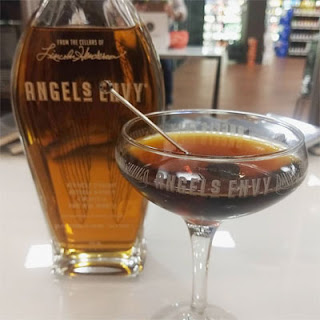
Yesterday, I did a video shoot at Redstone Liquors in Stoneham with my brand work for Angel's Envy where we demonstrated the making of a Black Manhattan. I then realized that I had never written up this drink on the blog for I had already put it in my online drink journal in 2007. The Black Manhattan was created by bartender Todd Smith at San Francisco's Bourbon and Branch two years prior in 2005 as a delightful riff on the Manhattan. The classic recipe had the sweet vermouth replaced with the Italian bittersweet liqueur Averna which donates rich and complex caramel, bitter orange, lemon, pomegranate, and Mediterranean herbs to the mix. The original recipe called for Bourbon although more modern ones utilize rye; in addition, various recipes include both Angostura and orange bitters, only one, or none at all. As I mention in the video, this drink is rather flexible for it works with a variety of amaro including Cynar, Amaro Montenegro, Amaro Nonino, and Ramazzotti. I love the variations (see the my Cynar F.L.A.N. recipe), but I always stick with Averna when I call it a Black Manhattan proper.

blue collar

2 oz Rye Whiskey (Rittenhouse Bonded)
1/2 oz Sweet Vermouth (Cocchi)
1/4 oz Amer Picon (Torani)
1/4 oz Maraschino Liqueur (Maraska)
2 dash Orange Bitters (Angostura Orange)

Stir with ice, strain into a cocktail glass, and garnish with a lemon twist.

In the recipe section of Eric Alperin's Unvarnished book, I was drawn in by the Blue Collar by Michael Madrusan. Michael created this riff on the Brooklyn by swapping in sweet vermouth and orange bitters for the classic's dry vermouth. Actually, the recipe is closer to the earliest known Brooklyn that appeared in Jacob Grohusko's 1908 Jack's Manual which called for sweet vermouth before the literature soon drifted to dry vermouth as the aromatized wine component.
Normally, I use a softer rye for my dry vermouth Brooklyns so that I can taste the liqueurs better; however, I went a bit more bold in flavor to cut into the vermouth's additional sweetness. Here, the Blue Collar offered up a lemon and malt nose that preceded a grape and malt sip. Next, the swallow showcased the rye that was colored by nutty cherry and bitter orange flavors.