Showing posts sorted by relevance for query sherry cobbler. Sort by date Show all posts

Monday, October 19, 2009

sherry cobbler

2 wineglass (4oz) Sherry (Lustau Dry Amontillado)
1 tbsp Sugar (Turbinado)
2-3 slice Orange

Shake with ice and allow the cubes to bruise the orange slices (or use a muddler before shaking). Strain into a tumbler filled with shaved ice, and decorate with berries of the season. Add straw.
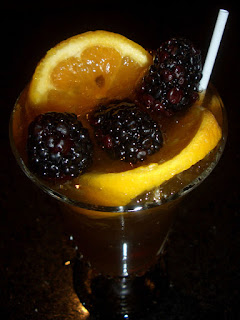
This weekend when we went out grocery shopping, I purchased some blackberries in order to make the Sherry Cobbler off of the Anvil's 100 Drink list. On Sunday night, after finding the recipe in Jerry Thomas' Bartender's Guide, I opened up Imbibe! to see what David Wondrich had to say about this beverage. Wondrich described the Sherry Cobbler as "Nothing but sherry, sugar, a lot of ice, and a bit of fruit (a slice or two of orange muddled in with the ice and a few berries on top), and a straw." He also stated that Thomas more likely used a dry, pale sherry like a Fino or Amontillado, although sweeter, darker sherries could be used if you reduce the sugar (he recommends 2 tsp sugar for dry sherries and 1 tsp for sweeter ones, opposed to the 3 tsp in Thomas' recipe). With that historical note, I opted for our new bottle of Amontillado and set to work. Also new toy-wise for this drink was the handmade Lewis Bag we got at the BostonShaker store and wood mallet (purchased elsewhere) to make the crushed ice (ice geeking post forthcoming). The drink itself was very sherry with orange notes adding some complexity. Perhaps we would have gotten more oils from the rinds had I muddled them instead of bruising them with ice cubes during the shake (note: I garnished with virgin orange slices, and strained away what was left of the shaken ones). Even without the muddling, the juice and pulp was mostly freed from the rind. The Sherry Cobbler was a bit quizzical in that it looks and feels like a summery drink except that it uses an autumnal or wintery spirit.

Wednesday, November 13, 2013

:: pirates, partisans, & grandmothers - the legacy and use of sherry ::

One of the other talks I went to at Thirst Boston on Sunday was Pirates, Partisans, & Grandmothers: The Legacy and Use of Sherry given by Jackson Cannon and Derek Brown. Jackson Cannon is well known here in Boston as the leader of the Kenmore bar trilogy -- Eastern Standard, Island Creek Oyster Bar, and Hawthorne -- as well as recently the second runner up in the 2012 Vinos de Jerez sherry cocktail competition. Washington D.C.'s Derek Brown opened up the Passenger and Columbia Room in 2009 and 6 months ago launched Mockingbird Hill that features 90 sherries. Derek explained that the focus for the talk was "How to unfuck sherry?", for many people believe that only old people drink sherry. He thought that it would be cool if they actually did, but it is not the case anymore. 

Sherry's history goes back to ancient times with 3000 years of history. The Phoenicians took vines throughout the ancient world, and the wines that came about were quite different but had some similarities especially with the modern sweeter styles of sherry. The Moors advanced sherry making by taking the new advancements of science, namely distillation, from North Africa into Spain. The fortification of wine proved to be advantageous especially during the Age of Exploration for regular wines would go bad on a ship's voyage while wines with additional proof would be stable for longer. Although Columbus took sherry on his voyages to the New World, it was Magellan who set the record by spending more money on sherry than on food and workers. Later, sherry solidified its place in Spanish viticulture by becoming the country's first Denominación de Origen.


Three main grape types predominate sherry production. The Palamino grape grows well on chalky soils similar to those found in Champagne and Cognac in France. The Palamino is technically three different and accounts for 97% of all plantings in Jerez. The other two are Pedro Ximénez and Muscatel which grow better on clay-based soils. PX is often raisinated, except for the dry sherry versions, from sun maturation before fermentation. Meanwhile, the Muscatel is not as sun-concentrated and displays earthy fruit notes; this grape produces wines closer to the ancient Phoenician style.


Derek broke down sherry into 3 'F' words. First, fortify. Sherry starts out as a still table wine that is fortified to around 15% ABV. Second, flor. The flor is a thick, white cap of yeast that protects the wine from being oxidized. Finally, fractionalized blending. Sherry often utilizes a solera system where a third of each barrel is taken away and replaced with newer wines. Statistically, some old sherry is still present in the solera.


There are four major styles of dry sherries. The Fino made from Palamino grapes maintains that protective layer of flor and keeps a non-oxidized flavor. The Manzanilla is more localized for it is a Fino produced in Sanlúcar. When the flor is not allowed to develop such as by killing it in the fortification step or by getting rid of it, it will oxidize and become an Oloroso. The Amontillado is another oxidized sherry that has the nose of an Oloroso and the finish of a Fino. A fifth dry sherry is the Palo Cortado that tastes like an Amontillado and an Oloroso, but it is a designation assigned by a committee as judged for the wine's flavor characteristics.


As for sweet sherries, the two major ones are Pedro Ximénez and Muscatel with both using sun-drenched raisinated processes and different fortification methods than the dry sherries. Cream is a mix of Oloroso and Pedro Ximénez sherries with Lustau's East India Solera being one of the more famous. Pale Cream, on the other hand, is grape syrup mixed with a Fino -- a style that erupted in the 1970s with Harveys Bristol Cream. A Medium designation was recently added, but Derek would love to see that one go away.


The popularity of sherry boomed with the Cobbler that was first mentioned by Washington Irving in 1809. While it is a simple drink, it requires crushed ice and its success rapidly followed Frederic Tudor's first ice shipments starting in 1806. Its success went hand-in-hand with the spread of ice appreciation in drinks. Back then, the Cobbler was mostly made with oxidized sherries that were slightly sweet. Derek mentioned that his favorite use of sherry was in the Adonis which is basically a Sherry Manhattan with sweet vermouth, orange and aromatic bitters.


Since sherry is exceedingly complex with over 300 volatile elements, it often pairs very well with food. Some classic combinations in Spain are Fino and ham, Manzanilla and oysters, and Amontillado and egg. Sherry has also recently worked well the bone and oyster luges phenomenon (pouring the wine over where the bone marrow or mollusk once was).


When asked if they could only have three bottles of sherry, Derek began by listing a Manzanilla from either La Gitana or La Cigarrera, an Amontillado such as Lustau's Los Arcos, and a Cream for sweetness such as Lustau East India Solera. Jackson commented that Lustau's E.I.S. has proven to be an indispensable cocktail ingredient and definitely agreed with Derek's list. He rounded out his list with an Oloroso such as from Alvear and a Palo Cortado such as Hidalgo's 30 Year Wellington.

Friday, April 29, 2011

sherry cobbler

2 1/2 oz Lustau Los Arcos Dry Amontillado Sherry
3/4 oz Rothman & Winter Apricot Liqueur
4 dash Smoking Ban Bitters (sub Angostura or other aromatic)

Build on crushed ice in a rocks glass, add a straw, and garnish with mint sprigs, strawberry slices, and an orange slice.

On Friday night, I headed over to Lineage to get dinner. For my first drink, bartender Ryan Lotz had an idea for a Cobbler which sounded great despite having had a Cobbler a few nights before. Wait, one cannot have too many Cobblers, and hopefully, this increased Cobbler presence in Boston is the new hot trend. The drink was a Sherry Cobbler that was a different take on the classic than the one that Cure made me last summer. In fact, with the dry sherry, liqueur, and mint sprigs, it reminded me a little of the Platonic Julep we had last year.
The Cobbler's strawberry and mint garnishes paid dividends in the aroma department. While the sip was mainly the sherry's grape notes, the swallow was a combination of the apricot liqueur and the Amontillado's delightful nuttiness. I was quite impressed by how both the sherry and apricot liqueur flavors were complemented by the strawberry's aroma. Overall, this light drink made for a great aperitif!

Tuesday, December 28, 2021

sherry cask cobbler

1 1/2 oz Patrón Sherry Cask Añejo Tequila (*)
1 1/2 oz Orange Juice
2 oz Pineapple Juice
1/2 oz Ginger Syrup

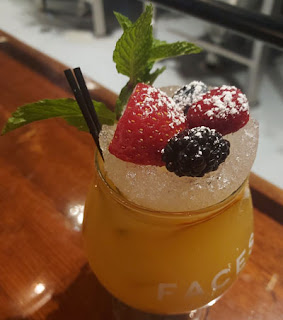
Briefly shake with ice, strain into a wine glass, and fill with crushed ice. Garnish with berries and mint (included a Tiki-style ice shell), dust with powdered sugar, and add a straw.
(*) An añejo tequila aged in Oloroso sherry casks. Perhaps an aged tequila and a 1/4 oz Oloroso or Amontillado sherry would work in a pinch.
The welcome cocktail at the Patrón event two Tuesdays ago at Faces Brewing Co. was this elegant Sherry Cask Cobbler. It featured their añejo tequila which is aged over 2 years in Oloroso sherry butts. Patrón's East coast ambassador Steph Teslar described how she fell in love with this expression when she first visited the Hacienda years ago, but alas, it was a limited offering. Years later, Patrón just relaunched this tequila on a larger scale, so it ought to be available in many markets. The nose of the spirit shared caramel, molasses, nut, apricot, and fig notes, and the flavor came through with dried pineapple, walnut, and baked pear. Sherry has been a cocktail ingredient dating back to the first cocktail book in 1862 by Jerry Thomas and even before that in Charles Dickens' 1844 novel Life and Adventures of Martin Chuzzlewit and Nathaniel Hawthorne's 1852 novel The Blithedale Romance. That early and popular drink was the Sherry Cobbler which is sherry, sugar, citrus (frequently orange), and crushed ice served in a tall glass, garnished with fresh berries, and a straw. Indeed, they followed suit by making a Cobbler from their sherry-aged tequila as their welcome drink at the event.

Friday, August 14, 2020

frozen sherry cobbler

3 oz Amontillado Sherry (Lustau)
1 oz Oleo Saccharum (Lemon & Orange Peel) (*)
1 oz Lemon Juice
1 cup Crushed Ice (8 oz)

Blend until smooth, pour into a 12 oz glass, and garnish with an orange slice and cherry (orange slice and mint sprig).
(*) Sugar steeped with lemon and orange peels for a 1-2+ hours and dissolved in hot water (equal volume to the amount of sugar added). Here, it was 3/4 oz sugar, peel 1/4 lemon, and peel 1/6 orange; after a 3 hour incubation with a few shakes in between, the sugar was dissolved in 3/4 oz boiling water. The 1 oz for the recipe was fine strained from this syrup and peel mix.
To beat the heat two weeks ago, I decided to make the Frozen Sherry Cobbler by Rob Kruger of Brooklyn's Extra Fancy that was published in Punch. While it recommended a commercial oleo saccharum, I decided to start a few hours early and made my own from lemon and orange peels and sugar (see instructions above). Once prepared, the Cobbler proffered orange and mint aromas from the garnishes over a nutty sherry note from the Amontillado. Next, grape and lemon on the sip slid into nutty sherry and a citrus brightness from the oleo saccharum on the swallow.

Sunday, December 25, 2016

canon's sherry cobbler

1 oz Oloroso Sherry (2 oz Lustau)
1/4 oz Patxaran (1/2 oz Atxa)
1/4 oz Maraschino Liqueur (1/2 oz Luxardo)
2 dash Angostura Bitters (4 light dash)

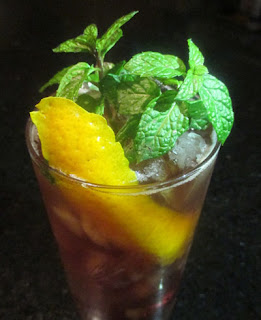
Shake with ice, strain into a Cobbler cup or wine glass, fill with crushed ice, and garnish with an orange slice, mint leaves, and seasonal berries (mint sprigs and an orange twist).
After my bar shift two Sundays ago, I reached for the Canon Cocktail Book. There, I spotted a delightful sounding Sherry Cobbler that seemed a bit on the small side especially for a nightcap. After doubling the recipe, Cobbler gave forth grape, mint, and orange aromas. The grape continued on into the sip where it mingled with hints of cherry and dark berry, and the swallow offered nutty, coffee, and cherry notes with a clove spice finish.

Tuesday, August 3, 2010

sherry cobbler

2 oz Lustau Pedro Ximenez "San Emilio" Sherry
1 barspoon Demerara Syrup
17 drop Bittermens Mole Bitters

Stir with ice and strain into a highball filled with fresh ice. Garnish with berries of the season.

Friday was spent learning more about French spirits. Our education at Tales started with Wednesday's "Bariana: The Golden Age of French Cocktails" and continued on with Friday's "Armagnac, France's First Brandy" and "How French Products Contribute to Cocktails." After these two sessions, we made our way over to the St. Charles Streetcar to go to the Bittermens Launch Party at Cure. Well, launch of their Tiki and Boston Bittahs and relaunch of their Mole and Grapefruit Bitters since shifting production from Germany to stateside in Somerville, MA.
Although Cure did not have a special menu for the event, the bartenders were up for making drinks with any of the four bitters. For my first drink, I asked what bartender Turk Dietrich what he could do with sherry and the mole bitters. While I was expecting the sherry to be used more as an accent, Turk surprised me by making sherry the major spirit and going old school with a Cobbler. I was also impressed at the attention to detail given in "ornament[ing] with berries in season" a la Jerry Thomas' recipe. The Pedro Ximénez sherry provided a very refreshing sweet fruit flavor and nuttiness to the Cobbler, and Andrea thought that it tasted "like liquid figs." I was rather impressed with how the fruit and nutty notes worked with the chocolate and spice in the bitters, as was Avery Glasser who quite enjoyed the pairing from the sip he had.

Thursday, July 29, 2010

spanish cobbler

2 oz Dry Sack Medium Sherry
3/4 oz Dos Maderas 5+3 Rum
1/2 oz Pineapple Syrup

Shake with ice, and strain into a rock glass filled with crushed ice. Garnish with raspberries.

On Wednesday at Tales of the Cocktail was the one day where we had very little interest in the talks since their focus was more hardcore industry rather than enthusiast. Therefore, we hit a decent number of tasting rooms. One of the best ones that day was the Dos Maderas rum room. This spirit blends rums from Barbados and Guyana and ages them first in whiskey then in sherry casks which impart a rather intriguing finish. They had both their 5+3 and their 5+5 products for tasting with the latter being more elegant due to an additional aging step in Pedro Ximénez sherry barrels.

Besides straight spirits tasting, they had Freddy Diaz and Julio Cabrera of Alambiq Mixology Consulting making a few exquisite cocktails featuring the rum. Well, the first one I had, the Spanish Cobbler, focused more on sherry with the Dos Maderas playing a strong second fiddle and bolstering the strength of the drink. The nose was filled with sherry and berries which made for a congruous fruit aroma. On the sip, the Cobbler was pretty dry, and the rum and the pineapple delightfully complemented the sherry.

One other drink I had there was this one:
El Quijote
• 1 oz Dos Maderas 5+3 Rum
• 1 oz Gran Duque d'Alba Brandy
• 1/4 oz Dry Sack Sherry
• 1/4 oz Simple Syrup
• 2 dash Angostura Cuban Cigar Bitters
Stir with ice and strain into a rocks glass filled with fresh ice. Garnish with a grapefruit twist.
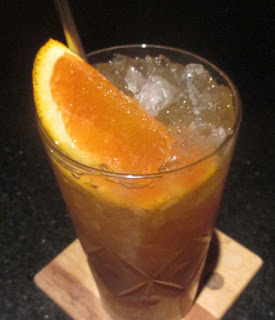
The El Quijote had a grapefruit aroma that led into a Spanish brandy and rum-flavored sip. Moreover, the cigar bitters donated some interesting flavors on the swallow. Most notable was the presentation of the bitters which was a long dropper bottle inserted into the wrapper of a cigar. Well, also notable was Dos Maderas' generosity by providing me with a fine cigar that really added to the experience of an outdoor event later that evening.

Monday, March 28, 2022

silk road cobbler

2 1/2 oz Dry Oxidized Sherry (Lustau Palo Cortado at work, Lustau Amontillado at home)
1/2+ (5/8) oz Apricot Liqueur (Rothman & Winter)
1/2- (3/8) oz Benedictine
1 thick slice Orange Wheel
2 dash Mole Bitters (Bitter Truth at work, Angostura Cocoa at home)
8 drop Absinthe (Kübler at work, St. George at home)

Muddle the orange slice, add the rest of the ingredients, and shake with ice. Strain into a Collins glass, fill with crushed ice, garnish with an orange slice, and add a straw.
Two Mondays ago at home, I decided to make a Cobbler that I had made three times on Saturday night. It began with a guest at Drink who wanted something both refreshing and on the lighter side of the ABV spectrum. I opted for a Sherry Cobbler using the flavors in the Silk Road Sour as guidance. I had previous used apricot liqueur in my Sherry Cobblers, but the Benedictine has a magic effect on it. I paid tribute to my flavor inspiration and dubbed this one the Silk Road Cobbler. In the glass, it yielded an orange and nutty grape bouquet. Next, a crisp grape, orange, and caramel sip lept into nutty, apricot, and herbal flavors on the swallow.

Thursday, April 14, 2016

e.c. cobbler

1 1/2 oz Blandy's 5 year Sercial Madeira
1/2 oz Averna
1/2 oz Cinnamon Syrup
1/2 oz Lemon Juice

Shake with ice and strain into a Collins glass. Fill with crushed ice, garnish with a lemon twist and grated nutmeg, and add a straw.
In turning over the menu at Loyal Nine for Spring, I wanted to change the stirred low proof offering to a second one with citrus. Since there has been an upswing of tickets for sherry and madeira Cobblers over the last few months thanks to one server's love of them, I decided to put a Cobbler on the menu. I, of course, opted for madeira since it along with rum and brandy are the trio of spirits popular during the Colonial era that our restaurant focuses on and despite the sherry Cobbler being the delicious default for the style. After hacking through some combinations, herbal Averna, spiced cinnamon syrup, and crisp lemon juice rounded out the dry madeira with perhaps some direction from my I Can't Dance last summer. For a name, I searched for shoe cobblers and producers in the restaurant's neighborhood but could only find information about the old Sears shoe factory between there and Central Square. The Cambridge Cobbler was sort of decided on -- until it appeared on the menu as the E.C. Cobbler for East Cambridge and the gang sign I like to flash with my hands when describing the Loyal Nine neighborhood.

Tuesday, April 1, 2014

endicott cobbler

1 1/2 oz Lustau Dry Amontillado Sherry
1 1/2 oz St. George Spiced Pear Liqueur
1 oz Averna
2 dash Peychaud's Bitters

Build in a Collins glass and gently stir. Fill with crushed ice and gently stir again. Add a straw and garnish with an orange twist.

For the new cocktail menu at Russell House Tavern, bar manager Sam Gabrielli commented that he liked the sherry drinks that I made for certain guests, and he requested that I come up with a Sherry Cobbler for the menu. After tinkering a bit, I became hung up on the equal parts dry amontillado-Cynar combination but could not figure out a third ingredient to round out the drink. One evening after my shift, I wandered down to Brick & Mortar and found a seat in front of Matthew Schrage. When I explained my conundrum, Schrage recommended St. George's Spiced Pear Liqueur and made a half scale version that rather worked. I fixed up the proportions and made a drink for Sam; Sam declared that while he liked the drink, it was a bit on the bitter side for a random guest to order it off the menu. Therefore, I swapped the amaro to Averna, brought the pear forward, and added Peychaud's Bitters to dry it out a touch. For a name, I stuck with the pear theme and paid tribute to the oldest living cultivated fruit tree in North America, the Endicott Pear Tree. The tree resides just north of here in Danvers, MA, and is still producing fruit after being planted 380-plus years ago.
The drink itself went live on the menu last night and was designed not only for flavor but ease and speed for assembly (although perhaps not as quick to build as the Scaffa for my night at the Blue Room). Once assembled, the twist added sweet orange accents to the drink's sweet fruit notes. A caramel and grape sip gave way to a pear, nutty, herbal, and lightly spiced swallow. While it is a touch on the sweeter side at first, it becomes less so with ice melt over time. Overall, I was impressed at how the high acidity of amontillado sherry functioned as a backbone here to build the rest of the drink around. Perhaps the Cobbler would be better in the Fall when pear flavors are more common, but Cobblers are perfect for the upcoming warmer weather.

Thursday, April 21, 2011

manischewitz cobbler & flip

With Passover upon us, I often hear questions about what can people drink since beer, whiskey, grain-based vodka and gin, and other ingredients are not allowed by lax standards and most things are not allowed by stricter ones. Some of my first alcohol memories came from drinking Manischewitz at Passover Seders. All I recall was not enjoying it despite it being sweetened and made from similar grapes as Welch's grape juice. Since then, Kosher for Passover wines have come a long way; however, none of them are as iconic as Manischewitz Concord Grape Wine. So how can this be improved? Or better yet, what would Jerry Thomas make for a Seder?

One of the Jerry Thomas recipes in the 1862 How to Mix Drinks; A Bon Vivant's Companion that I have not been able to make is the Catawba Cobbler. Catawba is a native grape hybrid that produces foxy and odorous wines that played a major role in the country's early wine production. By Jerry Thomas' early days, it was the most widely planted grape variety in the country; now, there are only a small number of wineries that sell this and few liquor stores actually will carry it. Instead of acquiring some in my next trip out to the Finger Lakes region of New York, I decided to use Manischewitz which is made from native grapes (51% Concord with no declaration of what the rest is). While it is not as odorous and unique as Catawba, any recipe that works for Catawba should do quite well with Manischewitz.
Catawba Manischewitz Cobbler
• 1 tsp Sugar
• 1 tbsp Water
• 2 wineglass Wine (4 oz Manishewitz Concord)
Dissolve sugar in water. To add flavor, I muddled the sugar with orange peel before adding the water. While a shaking with ice step was not specified, I added wine and ice, shaked, and strained. Strain into a tumbler filled with shaved ice (crushed ice). Add a straw and ornament with an orange slice and berries in season.
The ornamentation contributed greatly to the drink's aroma which was filled with strawberry and orange notes. The sip was a slightly orange-tinged fruit flavor that was followed by a funky native American grape swallow. While the starting ingredient here was not as tasty as the Pedro Ximénez in the Sherry Cobbler at Cure, the drink here was almost as enjoyable. Between the extra sugar and the melting ice, the Manischewitz was tamed considerably. Later versions of Catawba Cobblers that include orange juice or muddled/shaken orange slices would probably bring the drink some extra glory. While I wanted to stick with the recipe as Jerry gave it, I could not help but think that a dash or two of Angostura would work wonders here.
Since I still had a mostly full bottle of wine in front of me, I figured that I should attempt another recipe that could possibly work even better than the Cobbler -- a Flip! Along with orange juice, dairy, and honey, egg works wonders in taming rougher ingredients. While I could not find a Catawba Flip, I did have a recipe for a Claret one in Tom Bullock's The Ideal Bartender (although my hardcopy is entitled 173 Pre-Prohibition Cocktails: Potations So Good They Scandalized A President).
Claret Manischewitz Flip
• 2 heaping tsp Sugar (1 tsp)
• 1 1/2 jigger Wine (2 1/4 oz Manishewitz Concord)
• 1 Egg
Dissolve sugar in water (2 tsp). Add rest of ingredients and ice, shake, and strain into a punch glass. Garnish with freshly grated nutmeg.
Since Manischewitz is a sweetened wine opposed to a dry claret, I decreased the additional sugar in the recipe. Unlike in the Cobbler, the grape notes did enter into the aroma along with the nutmeg garnish. The egg provided a creamy sip and mellowed out the funky grape notes on the swallow. Strangely, the drink finished sweeter than it started on the sip. Over time, the nutmeg entered the flavor profile and provided some nice spice notes that complemented the wine's funkiness.
So there are two drinks that can easily be made completely Kosher for Passover even by the strictest laws. The pre-Prohibition bartenders often had to deal with poor quality wines and spirits, so their wisdom pays dividends in making Manischewitz into tasty libations. Their wisdom does not extend into what to do with Matzoh to make it more palatable though.

Monday, May 20, 2019

sherry cobbler

1 1/2 oz House Sherry Blend (*)
3/4 oz Orange Juice
3/4 oz Raspberry Syrup (**)

Build in a snifter glass, fill with crushed ice, and swizzle to mix and chill. Garnish with 5-6 dash Regan's Orange Bitters and an orange twist.
(*) 2 parts Oloroso, 2 parts Amontillado, 1 part Pedro Ximenez, and 1 part Manzanilla. To make the 1 1/2 oz à la minute: add 1/2 oz, 1/2 oz, 1/4 oz, and 1/4 oz, respectively.
(**) Not a full 1:1. Made with one part raspberry, one part water, one part sugar.
For my second drink at Green Street, I tried Jordan Runion's take on the classic Sherry Cobbler where he subbed in orange juice for the muddled orange slices and raspberry syrup for the sugar in Jerry Thomas' recipe. In this preparation, the double dose of orange from the twist and bitters hit the nose right off the bat. Next, orange, grape, and berry notes on the sip gently slid into raisiny and nutty grape blending into raspberry flavors on the swallow.

Saturday, May 7, 2016

dunmore cobbler

2 oz Amontillado Shery (Lustau)
1 oz Pineapple Syrup
1/2 oz Blended Scotch (Buchanan 12 Year)
1/2 oz Lemon Juice

Shake with ice, strain into a Collins glass, fill with crushed ice, and garnish with 3 dash Angostura Bitters and a pineapple wedge (omit).
Two Saturdays ago, I turned to the new issue of Imbibe Magazine (May/June 2016) and decided upon a Cobbler as the evening's libation. The Dunmore Cobbler created by Ryan Fitzgerald and Todd Smith of ABV in San Francisco took the classic Sherry Cobbler and switched the sweetener to pineapple syrup and accented things with a bit of Scotch whisky. Once assembled, the Dunmore Cobbler gave forth an allspice and clove bouquet to the nose. Next, grape, malt, and lemon on the sip transitioned into pineapple and nutty flavors on the swallow. And once the floated bitters garnish entered into the equation, the drink became spiced and drier.

Wednesday, December 4, 2013

winter cobbler

1 1/2 oz Scotch
1 oz Honey Ginger Syrup
1/2 oz Palo Cortado Sherry
1/2 oz Lemon Juice
2 dash House Aromatic Bitters

Shake with ice and strain into a Julep cup (or Highball glass). Pack with crushed ice, garnish with mint, and add a straw. Perhaps this was built in the Julep cup though, sans shake/strain step, since my notes do not specify.

A few Wednesdays ago, we ventured down to Deep Ellum for dinner. For a first drink, I asked bartender Jennifer Salucci for the Winter Cobbler that just appeared on the menu. I am always pleased when bars take old non-cocktail, non-highball styles like the Cobbler, Fix, and Zoom and give new life to them. Here, Deep Ellum made a seasonal Cobbler that read like a riff on the Penicillin Cocktail; this was not their first riff on the neo-classic for they had the agave-based Little Branch Cocktail on the menu three years ago.
The Winter Cobbler began with a mint aroma over a Scotch and sherry nose. Honey flavors sweetened the lemon and grape sip, and the swallow offered Scotch and raisiny notes with a growing ginger signature after successive gulps. Overall, I was quite impressed at how well Palo Cortado sherry paired here with Scotch and how much depth it added to the Penicillin Cocktail-like base.

Thursday, July 28, 2011

king vittorio's cobbler

2 oz Zucca Rabarbaro Amaro
3/4 oz Lemon Juice
3/4 oz Simple Syrup
1 Strawberry

Muddle strawberry. Add rest of the ingredients and ice. Shake and double strain into a rocks glass filled with crushed ice. Garnish with a slapped mint leaf and another strawberry.

For my second drink at Cure in New Orleans, I asked bartender Turk Dietrich for the King Vittorio's Cobbler created by Neal Bodenheimer. I was quite impressed when Turk replied by asking me if he had made me a Cobbler the last time I had been there. Keep in mind that was a little over a year ago, but apparently that Sherry Cobbler was delicious enough for both of us to remember. Besides my appreciation for the drink style, the combination of Zucca and strawberry was rather tempting. For a name connection, there is a bar in Milan that is called Caffè Miani and nicknamed Zucca. This cafe is located in the Galleria Vittorio Emanuele at the Piazza del Duomo. As for the "king" part, this expensive shopping arcade was named after King Vittorio Emanuele II who ruled over Italy for 17 years until his death in 1878. And yes, they do serve Zucca at the Zucca now.
Indeed, the strawberry paired quite well with the dark notes of the Zucca on the nose. Next, the sip was a sweet strawberry and lemon taste, and this was followed by a clean flavor from the rhubarb root and other botanicals in the Zucca. For such a simple drink, it had a lot of character and the Cobbler format was perfect for the presentation.

Friday, August 3, 2012

the bon-vivant

1 1/2 oz Lustau East India Solera Sherry
1/2 oz Cruzan Black Strap Rum
3/4 oz Lemon Juice
1/2 oz Cinnamon Syrup
2 big Blackberries

Muddle blackberries in a rocks glass. Add rest of ingredients and fill with crushed ice. Stir, garnish with 2 sprigs of mint and a blackberry, and add straws.

Monday after my DJ gig, we stopped into Eastern Standard for dinner. For a drink, I asked bartender Seth Freidus for the Bon-Vivant which was subtitled "in honor of the professor." That professor of course is Jerry Thomas, and this tribute was created by Kit Paschal in the style of a Sherry Cobbler.
The Bon-Vivant offered up a mint aroma that led into a sip containing sherry's grape and the muddle blackberry. Next, the sherry's nutty notes paired well with the rum's molasses flavor at the beginning of the swallow that ended with light cinnamon notes. Overall, the Lustau East India Sherry was a lot nuttier than I remember it being; Andrea surmised that it was the black strap rum that set the sherry in that direction.

Saturday, January 31, 2015

gin cobbler

1 1/2 oz Fords Gin
1 oz Lustau Amontillado Sherry
1/4 oz Grade B Maple Syrup
1/4 oz Allspice Dram

Build in a Highball glass (or Julep-like cup), fill with crushed ice, and add a straw. Float 1/4 oz Giffard Apricot Liqueur (*), garnish with a dried apricot, and spritz clove essence over the top (most likely something akin to the clove-infused rum used in the Model T at their sister establishment Backbar).
(*) This float sank, so perhaps mixing it in with the rest of the ingredients would work better.

For a second drink at Ames Street Deli, I asked bartender Rob Hoover for their Gin Cobbler as the combination of nutty sherry and apricot liqueur work rather well together. Moreover, sherry and maple syrup partner splendidly too such as in the Midtown and French Toast Flip.
Once built, the Gin Cobbler offered a clove-driven aroma. The grape and maple filled the sip, while the first few swallows were all about the apricot. One of the problems here was that the apricot float sank due to its high density, and it did not help that the liqueur was more flavored than say Rothman & Winter; see my note in the instructions about incorporating this flavor better. Midway through the drink, the swallow began to present juniper and allspice notes and darker flavors from the maple and sherry; finally, the clove spice reared itself as a flavor at the very end in a way that worked well in conjunction with the allspice dram.

Thursday, June 20, 2024

coley cobbler

2 1/4 oz Sweet Vermouth (Cocchi)
1/2 oz Fernet Branca
1/4 oz Demerara Syrup
2 Orange Wheels

Muddle the orange wheels, add the rest of the ingredients, shake with ice, and strain into a Collins glass. Fill with crushed ice, add a straw, and garnish with 2 orange half moons and around 1/8 oz juniper-forward gin (Beefeater) dripped over the top.
While in Denver reading Nicola Nice's The Cocktail Parlor: How Women Brought the Cocktail Home book in the section mentioning the Sherry Cobbler, I was inspired to riff on Ada Coleman's Hanky Panky and transform it into a Vermouth Cobbler. Sweet vermouth and Fernet were a duo that worked in my Diddlin' Dora back at the Blue Room in 2013, and I decided to make this riff an inverse Hanky Panky of sorts and include classic muddled orange wheels in the mix to smooth out the balance. Once I got home from the trip and made the recipe that I had put into my notes, I dubbed the result the Coley Cobbler after Ada's nickname at the Savoy bar, and it began with an orange and juniper bouquet. Next, grape, orange, and a hint of caramel on the sip opened up into vermouth melding into herbal-menthol flavors on the swallow.

Monday, August 3, 2015

meyer's cobbler

1 1/2 oz El Dorado 5 Year Rum
3/4 oz Hidalgo Amontillado Sherry
1/4 oz Lemon Juice
1/4 oz Rich 2:1 Demerara Syrup
1 dash Angostura Bitters
1 bsp Strawberry Preserves
1 slice Lemon
1 slice Orange

Whip shake with two ice cubes and double strain into a rocks glass filled with crushed ice. Garnish with a berries (here, blackberry and raspberry), orange slice, and mint. Add straws, and finish the drink by sifting powdered sugar over the garnishes.
Probably the most stunning visual cocktail of my New Orleans adventure -- with, of course, Beachbum Berry's Tiki libations in a separate class of their own -- was this Cobbler at Compère Lapin. The taste also lived up to the appearance as well. For dinner on Sunday, I stopped into Compère Lapin and asked bartender Ricky Gomez for this drink. Since the drink description said "rum," I asked which one expecting it to be Myer's (yes, mentally overlooking the spelling difference). Ricky declared that it was El Dorado 5 Year Rum, and when I inquired further about the name, he explained that the Cobbler drink shares a linguistic relationship to the Cobbler shoemaker, and that got him thinking about old-timey professions. Therefore, he paid tribute to Meyer the Hatter on St. Charles Street, a shop founded in 1894 that I passed by every day on my way to the Monteleone Hotel. Moreover, it is one of Boston legend John Gertsen's favorite New Orleans stops; when I bumped into him at the Bartender's Breakfast during his brief Tales sojourn, not only was he sporting a new hat, but he was carrying a Meyer's bag with more goodies (see photo below). Once prepared, the Meyer's Cobbler shared an orange and mint aroma that led into an orange and grape sip with a hint of caramel from the rum. The rich rum continued on into the swallow where it blended in with the nutty sherry, and finally the drink ended with a light strawberry note.

Figure 1: Portrait of a hat fiend.