Monday, February 7, 2011

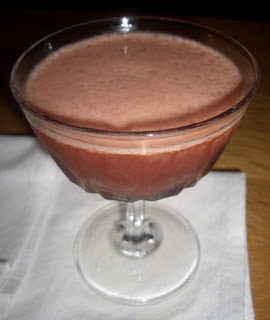
arawak

1 1/2 oz Jamaica Rum (Coruba)
1 1/2 oz Sweet Sherry (Lustau Pedro Ximenez San Emilio)
1 dash Angostura Bitters

Stir with ice and strain into a cocktail glass.

A few weeks ago, I was reminded of the Arawak Cocktail in a tweet by RumDood. So for the second drink last Monday night, I reached for our 1947 edition of Trader Vic's Bartender's Guide and opened it up to the rum section. The drink is a riff on the Pirate's Cocktail calling for Jamaican rum and swapping the vermouth for a sweet sherry. It seemed like the perfect after dinner drink to follow the Jamaica Jerk Seitan dish that Andrea had prepared.

The ingredients and name make an interesting and cohesive historical reference. The Arawak people were one of the indigenous peoples of the West Indies, and they were the natives that Christopher Columbus discovered in his 1492 voyage. With a bit of Caribbean rum and bitters mingling with a Spanish fortified wine, the parts are all there. Especially since Columbus' ship was well stocked with sherry on that voyage as Camper English's recent article in the L.A. Times describes.
For a rum, Andrea wanted to experiment with our recent acquisition of Coruba. My gut instinct was to grab the Smith & Cross and use its overproof roughness to cut into the sweet sherry; however, I was game for experimenting with the Coruba for we had not used it for much other than as an accent in certain drinks. Of our two sweet sherries, the Pedro Ximénez won out over Lustau's East India Solera.

The Arawak's nose was the dark aged rum aroma softened by the sherry. While the sip was sweet, smooth, and grapey, the swallow was full of dark and funky rum flavors, the raisininess of the sherry, and the spice of the Angostura. Moreover, I was impressed at how well the Coruba's caramel note matched the sherry's richness. Indeed, Andrea commented that the drink "taste[d] like a really delicious Coke or Dr. Pepper syrup."

Sunday, February 6, 2011

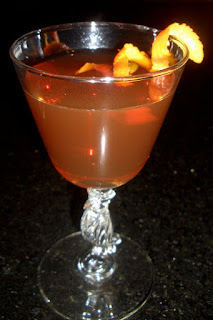
endeavor

1/3 Bourbon (1 oz Eagle Rare 10 Year)
1/3 Green Chartreuse (1 oz)
1/3 Lillet (1 oz Cocchi Americano)
1 dash Angostura Bitters

Stir with ice and strain into a cocktail glass. Garnish with an orange twist.

Last Monday, the Endeavor from the UKBG Approved Cocktails book caught my eye. With green Chartreuse, an aromatized wine, and a base spirit, the recipe reminded me of the gin-based Bijou (or Scott Holliday's rye-base Family Jewels variation) and the Irish whiskey-based Tipperary. Here, the spirit and wine ingredients were Bourbon and Lillet, respectively. What is curious is that these British bartenders published the recipe only 4 years after Prohibition had ended; the recipe calls for Seagram's, a Canadian company that purchased several American distilleries after Prohibition ended and began a few decades of making Bourbon in the States.
The Endeavor's aroma was a pairing of orange oil and green Chartreuse. On the tongue, the sip contained citrus notes from the Cocci Americano punctuated by an herbal tingle from the Chartreuse, while the swallow was a combination of the Bourbon, the spice of the Angostura Bitters, and the main brunt of the Chartreuse complexity. As a food pairing, Andrea discovered that the drink went rather well with a square of Newman's Own Organic Orange Dark Chocolate. Compared to a Bijou, the Green Chartreuse was more pronounced here; perhaps the Lillet did not mute the Chartreuse as well as sweet vermouth or perhaps the whiskey intensified its character.

Friday, February 4, 2011

1836

1 oz Siete Leguas Añejo Tequila
1 oz Campari
1 oz Carpano Antico Vermouth
2 dash Bittermens Mole Bitters

Stir with ice and strain into a rocks glass. Add ice cubes (4), a straw, and an orange twist.

On Sunday night, Andrea and I headed over to Craigie on Main for a nightcap. While Andrea was drawn to the mezcal-laden Degüello on the menu, I was more curious to find out what bartender John Mayer had been playing around with off the menu. John picked a companion piece to the Degüello called the 1836; both drinks were named after bits of history from John's home state of Texas. During the Texas Revolution, Santa Anna's troops were preparing to attack the Alamo and they opted for some psychological warfare. They repeated a bugle call, El Degüello meaning "slit throat," signifying that they were planning to leave no man alive. Even the ones hiding in the Alamo's basement.
Degüello
• 3/4 oz Scorpion Mezcal
• 3/4 oz Oloroso Sherry
• 3/4 oz Punt e Mes
• 1/2 oz Old Monk Rum
• 1/4 Demerara Syrup
• 1 dash Angostura Bitters
• 5 drop Angostura Orange Bitters
Stir with ice and strain into a rocks glass. Garnish with a flamed orange twist.
My 1836 was named after the year that Texas declared independence from Mexico. Essentially, it was a tequila take on the rye-based 1794 created by Dominic Venegas while at Range in San Francisco. When John made me the 1836, I was amused that it looked practically like the variation, the 1795, that bartender Ted Gallager made almost a year ago. With the change from the 1794's rye, John felt that the drink still needed some barrel-aged notes, so he picked an añejo tequila to round out the drink.
The 1836 began with an aroma of Campari, Carpano Antica, and orange oil. The taste was a semi-sweet grape sip that was chased by a drying wave of Campari and agave notes. Lastly, the chocolate notes from the mole bitters lingered as a pleasing aftertaste.

cafe royal special

1/4 Dry Gin (3/4 oz Darnley's View)
1/4 Lemon Juice (3/4 oz)
1/4 Dry Vermouth (3/4 oz Noilly Prat)
1/4 Sloe Gin (3/4 oz Plymouth)

Shake with ice and strain into a cocktail glass. I added a lemon twist.

On Saturday night, I was in the mood for a lighter style of cocktail when I spotted the Café Royal Special. The drink was created by the compiler of the Café Royal Cocktail Book, William Tarling, and with the split base of gin and sloe gin, it reminded me of a drier Improved Ping Pong. For a gin, I opted to try out the sample of Darnley's View Gin that we were sent. A quick taste of this Scottish gin gave a good balance of citrus, juniper, and coriander notes without anything being too sharp or overpowering. With this citrus notes, I felt that the gin would be a good match for this recipe. What I could glean off of their website is that they keep it simple with only 6 botanicals: juniper, coriander seed, lemon peel, elderflower, orris root, and angelica root.
The Café Royal Special started with a lemony aroma from the twist and the juice. The sloe gin came out as a berry flavor on the dry and tart sip, and this was followed by the dry vermouth and lemon notes on the swallow. Overall, the drink was surprisingly dry for a sloe gin recipe, although it did gain a bit of sweetness as it warmed up.

Thursday, February 3, 2011

dover

3/4 oz Berkshire Mountain Distillers' Ethereal Gin (orange label)
3/4 oz Lime Juice
3/4 oz Combier Orange Liqueur
3/4 oz Cocchi Americano

Shake with ice and strain into a rocks glass. Fill with ice and add straws and a lime wedge.

On Friday night, Andrea and I traveled over to Brookline to eat dinner at Lineage. One of the drinks bartender Ryan Lotz made me was the Dover from their cocktail menu. The Dover was created when a regular customer requested an alternative to her regular gin and tonic; since her nickname was Dover, Ryan decided to dub the drink this. Based off of a Corpse Reviver #2 sans absinthe (or perhaps a Hoop La!), the drink had a classic feel to it from the get-go.
The freshly cut lime wedge provided a pleasant aroma to the drink. On the sip, a semi-sweet citrus flavor was chased by a juniper-laden swallow that contained a bit of drying tartness to it. Moreover, as the ice melted, the drink got even more crisp and less sweet tasting. Overall, I could see it making a good transition for a gin and tonic drinker and as well as a good variation for the classic cocktail lover.

Wednesday, February 2, 2011

dead man's mule

1 oz Orgeat
1 oz Kübler Absinthe
1/2 oz St. Elizabeth's Allspice Dram
1/2 of a Lime (in wedges)

Muddle lime wedges in the bottom of a copper mug. Add rest of ingredients, fill with crushed ice, and top with ginger beer. Add straws.

For my final drink, bartender Joe Staropoli who was working at the ice bar mentioned to Tyler that I had considered the Dead Man's Mule last time I was at Drink. That time I passed it up in favor of The Old Man, the Monk, and the Sea, but this time I was game and it seemed like a good transition from the Johan Goes to Mexico. After Tyler made me the drink, Joe came by and relayed the drink's history. About two months ago, a dozen guys from Copenhagen showed up to the bar, and a pair of them requested this drink from him. Joe was a little taken aback by the request and with bar manager John Gertsen's assistance, they adapted the recipe given Drink's ingredients. Since the original calls for Goldschläger cinnamon schnapps, which Drink lacks, they replaced it with allspice dram and were rather pleased with the results.
The Dead Man's Mule greeted the nose with anise from the absinthe and ginger from the soda. The sip was the classic lime and orgeat pairing found in many Tiki drinks, while the swallow was absinthe, allspice, and ginger notes all residing in harmony with each other. While the drink was spicy, it was a lot less intense that I first expected given the ingredients and proportions.

johann goes to mexico

1 1/2 oz Mezcal Vida
1/2 oz Angostura Bitters
1/2 oz Lemon Juice
1/2 oz Demerara Syrup (1:1)

Shake with ice and strain into a cocktail glass.

Soon Andrea arrived at Drink from her class and it was time for another round. The cocktail bartender Josey Packard wanted to make me was a bitters-heavy mezcal drink called Johann Goes to Mexico. The Johann in question was the 19th century surgeon, Dr. Johann Siegert, who developed Angostura Bitters. Soon after Josey created this drink last year, a bartender from Upstairs on the Square requested if he could put it on their menu where it resided for the summer.
The Johann Goes to Mexico presented itself with an aroma of Angostura's cherry notes and mezcal's smoky sharpness. On the tongue, the bitters' cherry combined with the lemon in a slightly sweet sip. The swallow though was mainly about the smoke and agave flavors from the mezcal; moreover, the Angostura, mezcal, and lemon juice's crispness dried out the drink at the end. Indeed, it was a bit surprising that the Angostura was more up front than on the swallow where it usually resides.

Tuesday, February 1, 2011

saratoga brace up

1 tbsp Sugar (1/2 oz Demerara Syrup 1:1)
2 dash Angostura Bitters (1 dash)
4 dash Lemon or Lime Juice (1/2 oz Lemon)
2 dash Absinthe (2 dash Herbsaint)
1 Egg (1 Egg)
1 wineglass Brandy (2 oz Cognac)

Shake without ice and then with ice. Double strain into a highball glass, top with seltzer water, and add a straw.
Note: Ingredients on the left are from Jerry Thomas and the ingredients in parentheses on the right are the way Josey made this drink.

For my second beverage at Drink, I asked bartender Josey Packard what drinks she had been excited about making lately, and she replied that she has been enjoying the old school classics. When I stated that I was up for anything as long as I had not had it before, she first suggested a Golden Fizz (which she made me a while back) before settling upon the Saratoga Brace Up. Indeed, I was familiar with the recipe, but alas, I had never pulled the trigger on making one. Surprisingly, David Wondrich in Imbibe! said very little about this drink that first appeared in the 1887 edition of Jerry Thomas' book. He did compare it to another drink, the Scotch-based Morning Glory Fizz. Both of these Fizzes were probably palliatives prescribed after a night of drinking, and both contain egg (or egg white) and absinthe to settle the stomach issues that might be occurring then.
The Saratoga Brace Up had a rather subtle aroma that came across as a chocolaty or earthy note. The sip was lemony and was neither sweet nor tart but had a bit of crispness on the tongue from the soda's carbonation. Next, a light collection of Herbsaint and Angostura notes punctuated the Cognac on the swallow. Overall, the Saratoga Brace Up was easy to drink without being characterless; moreover, I could definitely see nursing one or two of these after a ribald night on the town and much more so than the smoky Morning Glory Fizz.

ti' punch fizz

2 oz La Favorite Rhum Agricole Blanc
1 oz Lime Juice
1 oz Demerara Simple Syrup (1:1)
1 1/2 oz Cream
2 dash Tiki Bitters
1 Egg White

Shake without ice and then extensively with ice (2 minutes). Add 1 oz of soda water to a highball glass and double strain the drink on top of that. Pour 1 oz of soda water into the shaker, swirl, and strain on top of drink. Add a spoon straw and a lime twist.

Last Wednesday, I went down to Drink in Fort Point when Andrea was in French class. For my first drink, bartender Tyler Wang wanted to make me a drink called the Ti' Punch Fizz that they had recently come up with. The Fizz was created by Drink's own Ezra Star (who apparently also invented the Bijou according to Wikipedia) by taking the classic Ti' Punch and giving it a Ramos Gin Fizz-style treatment.
The Fizz's aroma was initially dominated by the lime oils from the twist. Flavor-wise, the sip was a sweet creamy lime flavor, while the swallow was a smoothed out rhum agricole taste that finished clean and dry. The lime and rhum agricole were muted by the cream and egg white, and it was noteworthy how well these flavors complemented each other.