Wednesday, September 30, 2015

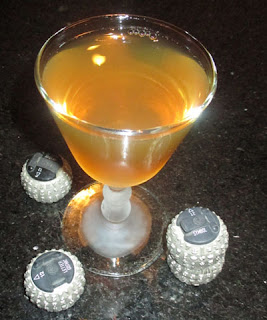
corpus christie

2/3 Scotch (1 oz Buchanan's 12 Year)
2 dash Sweet Vermouth (3/4 oz Dolin)
2 dash Bourbon (3/4 oz Fighting Cock 103)
1 dash Maraschino Liqueur (3/8 oz Luxardo)
1 dash Ojen Bitters (1/8 oz Butterfly Absinthe)

Stir with ice and strain into a cocktail glass.
After Yacht Rock Sunday two weekends ago, I returned home hankering for a nightcap. For ideas, I turned to Pioneers of Mixing at Elite Bars: 1903-1933 and spotted the Corpus Christie that appeared like an Improved Rob Roy-Manhattan hybrid. Once in the glass, the Corpus Christie shared absinthe's ethereal anise aromas crossed with Maraschino's fruity-nutty ones. On the sip, the grape and malt flavors were accented by cherry, and the swallow gave forth smoky whisky, nutty, and anise elements.

everybody wants to rule the world

3/4 oz Chinaco Blanco Tequila
3/4 oz Morin Selection Calvados
1/2 oz Kronan Swedish Punsch
1/2 oz Cinnamon Syrup
1/2 oz Lime Juice

Build in a Collins glass, fill with crushed ice, and swizzle to mix and chill. Top with crushed ice, garnish with an orange twist and freshly grated nutmeg, and add a straw.
For Yacht Rock Sunday's menu two weekends ago, I wanted to put a less summery and more autumnal Swizzle on the menu. I had been holding back on using apple brandy until the weather started to get colder, and I figured that it was about time to think again about Calvados. For the spice element in the Swizzle, I looked to Swedish Punsch and thought about how well it worked with apple brandy in the Cason and Murderer's Cocktails. Moreover, I considered how well tequila pairs both with Swedish Punsch in the Chutes and Ladders and with apple brandy in the Broken Crown, so I decided to split the spirits. To bolster the spice, I added cinnamon syrup which pairs well with both apple and agave flavors, and to counter the sweetness, a bit of lime juice. The combination felt a bit regal to me (or it wanted to feel regal), so I decided to pick out of the song title roster Tears for Fears' Everybody Wants to Rule the World.

Tuesday, September 29, 2015

broken wings

1 1/2 oz Encanto Pisco
1/2 oz Lillet Blanc
1/2 oz Rothman & Winter Apricot Liqueur
1/2 oz Lime Juice
12 drop St. George Absinthe

Shake with ice and strain into a cocktail glass. Garnish with an orange twist.
Another drink that I did for Yacht Rock Sundays two weekends ago revolved around one of my favorite classic apricot liqueur recipes, the Culross. Instead of rum, I switched the spirit to pisco to take it in a more floral and tropical direction. I had previously tinkered with the Culross for a Bols Genever event at the Franklin Southie with the Zeeland. There, one of the botanicals in Bols Genever is wormwood and it added a lot to the complexity of the drink; to mimic that, I added a very light touch of absinthe for some herbal complexity. For a name, I ended up pairing the recipe with the Mr. Mister song Broken Wings due to all of the high notes in the mix.

hungry eyes

1 1/2 oz Berkshire Mountain Distiller's Greylock Gin
1/2 oz Yellow Chartreuse
1/2 oz Green Tea Syrup (*)
1/2 oz Lemon Juice
1 dash Angostura Bitters

Shake with ice and strain into a cocktail glass containing 1 oz soda water. Garnish with 6-8 pre-swelled Thai basil seeds (also known as tukmaria and falooda). A lemon twist would work in a pinch.
(*) 1 part strong steep tea to 1 part sugar.
Two Yacht Rock Sundays ago at Loyal Nine, I was mulling over some less bitter herbal cocktail ideas when I decided on pairing green tea syrup with Yellow Chartreuse. Or perhaps I was looking for a recipe using Thai basil seeds that I had in the spice cabinet. Thai basil seeds are small black seeds that swell when placed into water over the course of around 5-10 minutes. I was originally introduced to the seeds in a drink at the Green Goddess, and I tinkered with them in the Frog Pond for they look like frog eggs given the white coating that they acquire. Back to the spirits aspect, I paired this with gin and lemon juice but the drink needed some bitters to give some lower notes to the tea and Yellow Chartreuse's high ones. The addition of Angostura Bitters brought the drink closer to a gin for brandy Champs-Élysées. Given how the Thai basil seeds dance with carbonation, I also lightened the drink with an ounce of soda akin to the Safety Dance. With the same wide coupe, the basil seeds got lost in the surface area, so I used a taller, narrower glass. For a name -- or perhaps the name was already in my mind for the basil seeds also look like eye balls -- I picked Eric Carmen's Hungry Eyes off of the yacht rock song playlist. Describing the origins of this drink though is like figuring out the chicken and the egg conundrum.
Thai basil seeds can be found in their dry format Indian spice stores under the name tukmaria or falooda, and are often found in a variety of Asian drinks already swelled (less useful). Swelling the seeds is easy in a small glass with a bit of tap water. I have experimented with flavoring the seeds with little luck. The swelling is linked to low solute rainwater and thus adding syrups and liqueurs inhibited things; moreover, even if it did work, the seeds might sink instead of float in the cocktail. I have not tried swelling the seeds and transferring them to a syrup or liqueur though. Warmer water may speed up the swelling time, but it did not seem to make the end diameter any greater.

Monday, September 28, 2015

terrible love

1 1/2 oz Del Maguey Chichicapa Mezcal (Montelobos)
3/4 oz Suze Gentian Liqueur (Salers)
1/2 oz St. Germain Elderflower Liqueur
1 dash Orange Bitters (Regan's)

Stir with ice and strain into a rocks glass with a large ice cube. Garnish with a grapefruit twist.
At the nightcap hour after my Saturday shift two weekends ago, I turned to the Death & Co. Cocktail Book for a recipe. There, Phil Ward's Terrible Love from 2013 called out to me for the combination of gentian and elderflower liqueurs worked rather well in The Root and the Flower and the Prieure de Sion. Once mixed, the Terrible Love shared a grapefruit and smoke bouquet. On the palate, the pear-like flavor from the St. Germain on the sip gave way to smoky agave and earthy gentian on the swallow with an orange and floral finish.

frenchman street cocktail

2 oz Louis Royer Force 53 VSOP Cognac (Foret VSOP)
1/2 oz Sweet Vermouth (Dolin)
1/2 oz Pierre Ferrand Dry Curaçao
1 barspoon White Crème de Cacao (Marie Brizard)
3 dash Peychaud's Bitters

Stir with ice and strain into a cocktail glass.

Two Fridays ago for my post-work nightcap, I turned to the grand prize winner of the "Show Me the Proof" Cognac competition that I mentioned in the Orientation. This one was the Frenchman Street Cocktail created by Timothy Miner of the Long Island Bar. This New Orleans-inspired cocktail did not only look delicious, but I was excited to try another of Tim's recipes after having enjoyed the Handbook for the Recently Deceased and the Sherry Duval.
The Frenchman Street Cocktail proffered a dark orange peel aroma. The vermouth's grape on the sip soon transitioned into brandy on the swallow. The finish though was an intriguing combination of chocolate-orange with a dry anise ending.

Sunday, September 27, 2015

hai karate

2 oz Gold Virgin Island Rum (1 3/4 oz Caliche, 1/4 oz Wray & Nephew)
1 oz Lime Juice
1 oz Pineapple Juice
1 oz Orange Juice
1 tsp Maple Syrup
1 dash Angostura Bitters

Shake with ice and pour into a tall glass. Garnish with a lime wedge and an orange slice both speared to a cocktail cherry (here, nasturtiums and mint).
Two Thursdays ago, I turned to Beachbum Berry's Remixed for a Tiki nightcap. The one that called out for my post-shift drink at home was one of Jeff Berry's originals, the Hai Karate that he created in 1999. With my mint and nasturium garnish, the Hai Karate offered a mint and peppery floral aroma. Tart lime and orange flavors on the sip flipped into rum blending into maple and pineapple on the swallow with a clove finish.

Saturday, September 26, 2015

a moment of silence

1 1/2 oz Rye Whiskey (Old Overholt)
1 oz Marie Brizard Apricot Liqueur
1/2 oz Averna
1/2 oz Angostura Bitters
1/4 oz Laird's Bonded Apple Brandy

Stir with ice and strain into a rocks glass with ice seasoned with Campari. Garnish with an orange twist.

Two Wednesday ago, I turned to Beta Cocktails for nightcap ideas. Of the untried ones, Maksym Pazuniak's A Moment of Silence definitely called out to me. The pairing of Averna and apricot liqueur was one elegantly showcased in the inelegantly named Averna Jimjam, and here instead of lemon juice, the drying effects of Angostura Bitters along with a spirit backbone of rye and apple brandy fulfill the role.
A Moment of Silence began with an apricot aroma that was brightened by the twist's orange oil. Next, a rich caramel and malt sip gave way to rye and apricot on the swallow. Finally, the end was rather complex for it finished very bitter followed by sweet and fruity notes.

Friday, September 25, 2015

:: charles joly on food pairing ::

On Tuesday, I attended the first installment of the Diageo World Class classes that are the educational series leading up to the competition. While I have no plans of competing in this event right now, I am always game for gleaning knowledge from experts. The first session of the day's three was led by Charles Joly who won World Class in 2014, and the title was "Ketel One Food Pairing."

Charles began by describing how he initially solely relied on his chef and trusted his palate and the way he could break things down. And even today, when he takes on a consultancy, the first thing he does is walking into the kitchen to see what the chef is playing with. Traditionally, most pairings have been food and wine, and people declared that cocktails were both too high in ABV and too flavorful. However, while sommeliers have fixed constraints by what the vintners put in a bottle, bartenders can endlessly alter recipes to better fit the food.
Charles next discussed the history of vodka and food pairings, and in doing so, made a good argument for its place on the menu. Vodka tasting can actually be rather challenging because the subtleties of flavor require a fresh palate as opposed to analyzing a set of Scotches; Charles described a lineup of vodkas to taste as "the thinking flight." Vodka has traditionally been paired with food for quite a long time especially in Eastern Europe and Russia. In many of these countries, there will always be at least hors d'oeuvres while drinking. Moreover, flavored vodkas go back hundreds of years -- perhaps from the beginning -- whether to hide off flavors in the distillate or to enhance the spirit with seasonal ingredients.

Charles then addressed the difference between taste and flavor. Taste is the standard five of sweet, sour, bitter, salt, and umami, while flavor is everything else including aroma and texture. Many of the the five tastes work to enhance or balance the others. With salt and umami, they balance bitterness and enhance sweetness; this is why a peanut butter and jelly sandwich works so well. With sweet, it balances sour, bitterness, and spice, and it enhances salt which is why salted caramel is so delicious. With sour, it works with spice and sweetness and enhances salt. Charles continued to describe how many bartenders add a pinch of salt (or dash of saline) in a Sour recipe and why the salted rim in a Margarita is so successful in brightening the flavors; note, this is not a perceivable amount of salt -- if you can taste the salt, it is too much. Finally, bitterness balances sweet and salt. Bitterness is what makes grapefruit a very different citrus fruit; for example, its addition in a Hemingway Daiquiri along with Maraschino is very different than just a Daiquiri with Maraschino.
In pairings, one possibility is to complement with a like mirroring a like whether in structure, flavor, texture, intensity, or bridging ingredients. The other possibility is to contrast where opposites attract whether in structure, flavor, or texture. With the drink, you do not want to beat up the chef's food; the goal is to complement but not overwhelm or muddy things up either. So keep it simple. Often the bartender does not have the opportunity to try out the foods and only has the menu description in hand. Moreover, the drink might be pairing with multiple dishes served during the same course or spanning two courses.

In terms of alcohol percentages, low alcohol is important since it helps with food; however, high ABV can cut through fat. A downside of boozy drinks is that it can enhance spice and make things too hot as well as get the guests too trashed to appreciate the later courses that the chef prepared. Indeed, smaller servings is a way to overcome these alcohol quantity concerns. When designing drinks, calculating the ABV is rather helpful. Consider a 30% dilution as a good standard; see the image below for an example of this calculation. In looking for inspiration, do not think of mirroring the exact ingredients that are in the dish; instead, look regionally and culturally to add elements found in that food's culture. Finally, subtlety is key in food pairings such as using only a light touch instead of a heavy hand with absinthe.
Charles offered a few examples along the way of food pairings and their effects before we got to tinker at the bar setups in the back of the room to create pairings with two dishes. During the vodka tasting section, pickled fish with all of its salt, vinegar, and umami worked excellent with Ketel One. Charles noted that the pickleback was nothing new for the Scandinavians had long utilized this phenomenon as the brine balances out the acid in the booze. Next, Ketel One Oranje when matched with Camembert accented the cheese's earthy, sweet, umami, and creamy notes. When presented with a steak with peppercorn sauce and dill, many will think about a Manhattan which is a more drastic pairing. A softer pairing can be achieved with a drink including lemon juice, a fruity Lambic beer, and some herbs; here, acid instead of tannin is utilized to cut the fat, and the Lambic beer is hinting towards a shrub. Finally, with a New York-style cheesecake topped with blueberry sauce, a Campari drink (vodka, Campari, and a barspoon Fernet) brought out the cheesiness, salt, umami from the cake and enhanced the fruit in the sauce. Charles would be hesitant to serve a Campari drink like this to a wider audience, but with a room of bartenders, he felt comfortable. Also, a drink such as this needs to be served well chilled, so a smaller portion besides cutting back on the alcohol consumption will help ensure that it does not get too warm and thus flabby or unbalanced.