Showing posts sorted by relevance for query knickebein. Sort by date Show all posts

Sunday, November 27, 2011

knickroni

1/2 oz Campari
1/2 oz Sweet Vermouth (Vya)
1 Egg, separated
1/2 oz Gin (Aviation)
1 dash Regan's Orange Bitters

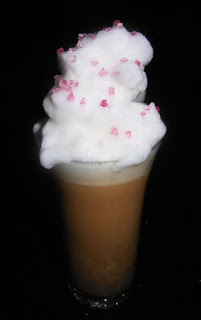
Stir Campari and sweet vermouth with a spoon in a 2 oz sherry glass to mix. Layer an unbroken egg yolk on top. Layer gin on top of that. Beat egg whites until they are stiff (whisk or cobbler shaker with a balled up Hawthorne spring) and cover gin layer with egg whites. Garnish with a dash of orange bitters. Drink in a ceremonial 4 step process as laid out below by Leo Engel in 1878:
1. Pass the glass under the Nostrils and Inhale the Flavour –- Pause.
2. Hold the glass perpendicularly, close under your mouth, open it wide, and suck the froth by drawing a Deep Breath. -- Pause again.
3. Point the lips and take one-third of the liquid contents remaining in the glass without touching the yolk. -- Pause once more.
4. Straighten the body, throw the head backward, swallow the contents remaining in the glass all at once, at the same time breaking the yolk in your mouth.
Two Thursdays ago, the theme for Mixoloseum's Drink Night was "red and yellow" in honor of the leaves changing color as we get further into Autumn. Therefore, the use of red and/or yellow cocktail ingredients was encouraged. The idea for this drink came midway through the night in a discussion of how egg yolks were another yellow ingredient besides the obvious Yellow Chartreuse, Galliano, Strega, and Lillet. To figure out a red ingredient, I thought of Campari and somehow that triggered an old thought about how to modernize the Knickebein, a layered drink created in 1878 by Leo Engel that features an unbroken egg yolk in the middle. When we made a Knickebein for a Mixology Monday back almost 3 years ago, we lacked the crème de noyau to craft Engel's, so we opted for the one in Boothby's 1907 World's Drinks and How To Mix Them. The kümmel in Boothby's Knickebein was not so appealing despite the liqueur working well in other drinks. Therefore, the concept of modifying a favorite liqueur-laden drink and dividing it up into Pousse-café format led me to crossing a Negroni with a Knickebein especially since Campari and sweet vermouth fulfilled the red part of the colored drink night theme.
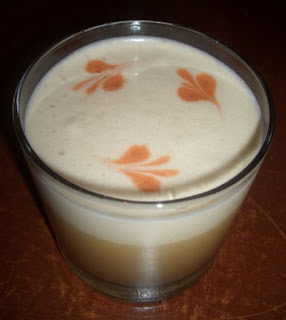
The Knickroni began with a pleasant orange aroma from the Regan's Bitters; I replaced the original Knickebein's aromatic bitters with orange ones to represent the Negroni's orange twist garnish. The first part of the drink contained the gin flavor smoothed by the egg white meringue. Next were the sweet vermouth and the sharper Campari notes; these flavors were greatly softened once the egg yolk was burst on the tongue.

Overall, the Knickroni offered up a more desirable flavor base than the other Knickebein combinations I have read in old drink books, so I chalk that up as a success. Another success was reading a post by Matt Hamlin in the A Jigger of Blog; Matt saw the tweet about the drink and commented that "There is some serious WTFery going on here."

Tuesday, April 14, 2015

colleen bawn knickebein

A few weeks ago, Gary Regan posted on Facebook about a challenge to convert cocktails into Pousse-cafés. He wrote, "Dhevandrea Hikaru, a bartender in Indonesia, contacted me recently about Pousse-cafés, and we had a nice back and forth about what they were, how they're made, etc. She asked if PCs could be made from classic drink such as the Grasshopper or the White Russian, and that got me to thinking: 'What an absolutely brilliant idea!' Seems as though those drinks would be sort of easy to layer: heavy cream, Kahlua, vodka for the White Russian, and heavy cream, green mint, white cacao for the Grasshopper, right? I haven't experimented but I think that would probably be the correct order. So I'm issuing a challenge to bartenders out there: make a Pousse-café using a classic cocktail recipe. I'll put the best of the best into my next 101 Best New Cocktails book and app. Thanks for the idea, Dhevandrea! Perhaps you'd like to submit a recipe yourself?"
I originally thought about doing a Bijou because the gem imagery of gin, sweet vermouth, and Green Chartreuse as distinct layers representing the diamond, ruby and emerald would be more stunning than the ingredients all stirred together. Then, I got into a discussion with David Wondrich about Knickebeins -- layered drinks that contain unbroken egg yolk as well as egg white froth. I had previously converted a Negroni into a Knickebein in the Knickroni, but that was adding an egg to the regular ingredients. What if I were to do it to a Flip that already had a whole egg in it? I quickly honed in on the Colleen Bawn that Jessica had at No. 9 Park in the link and I was introduced around that same time by Misty Kalkofen at Green Street. That link also provides a bit of history of this gem found in Edward Spencer's The Flowing Bowl from 1903. With rye, Benedictine, and Yellow Chartreuse in the Flip, it can do no wrong. Until, perhaps it is separated molecularly as such:
Build in a 2 oz sherry glass from the bottom up. Carefully layer each component on top of the next:
• 1/2 oz Benedictine
• 1/2 oz Yellow Chartreuse
• 1 unbroken Egg Yolk
• 1/2 oz Rye Whiskey
• Beaten Egg White Meringue
• Freshly grated Nutmeg and Cinnamon as a garnish.
Note: Benedictine and Yellow Chartreuse have nearly the same densities, so layering the two might not be as crisp or as possible as other liqueurs and liquors pairings.
Of course, building this piece of art might seem complicated until you realize that the Knickebein envisioned by Leo Engel in 1878 by way of his American and Other Drinks book has a very regimented quaffing protocol:
1. Pass the glass under the Nostrils and Inhale the Flavour –- Pause.
2. Hold the glass perpendicularly, close under your mouth, open it wide, and suck the froth by drawing a Deep Breath. -- Pause again.
3. Point the lips and take one-third of the liquid contents remaining in the glass without touching the yolk. -- Pause once more.
4. Straighten the body, throw the head backward, swallow the contents remaining in the glass all at once, at the same time breaking the yolk in your mouth.
And what better time to do it than 3am after getting home after your shift around two weeks ago? Once prepared, the Colleen Bawn Knickebein presented a sweet cinnamon spice aroma over lower nutmeg notes on the nose. On the second stage, the heat of the rye was soothed by the egg white, and the later two stages presented an herbal bounty that was eased by the protein bomb from the yolk at the end. While Knickebeins are best done as a group bonding (a/k/a hazing) ceremony rather than a solo shift drink, the life of a writer sometimes takes over especially in terms of good judgment.

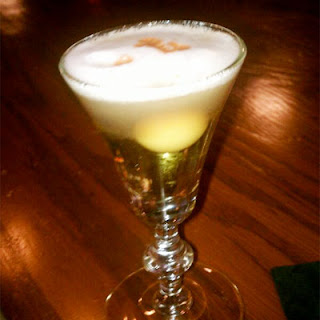
Update: One done in the wild (a/k/a the Loyal Nine Bar) on 1/10/16:

Saturday, January 17, 2009

knickebein

The theme for this month's Mixology Monday (MxMo XXXV) is "Broaden Your Horizons" as chosen by A Mixed Dram blog. The options were to either "Try a new base spirit. Never mixed with Tequila? Give it a try. If you’ve never made a beer cocktail or a wine cocktail, why not give it a shot? What about something really exotic?" or "Use a technique you’ve never used before. Ever been itching to give molecular mixology a shot? Now’s your chance. Ever been eager to infuse vodka or spice rum, or toss fruit and spices in something else? Here’s your excuse."

For this theme, I started thinking of things I either have not done yet or have shied away from. When I mentioned to Andrea that two concepts that I was thinking about were Pousse-cafes (layered cocktails, something I have never tried) and egg drinks (something that I am only recently learning to appreciate while out at bars), she got that look in her eye and dared me to do both. I instantly knew what she was talking about –- the Knickebein. We once saw it being made by John Gertsen at No. 9 Park for 3 guests sitting at the corner of the bar and one, of course, for himself.

The drink is attributed to Leo Engel in his 1878 book American and Other Drinks. His concoction was equal parts Curaçoa, Noyeau, and Maraschino (mixed) filling a port-wine glass two thirds of the way up. On top of that, he layered an unbroken egg yolk, and topped it with whipped egg whites sprinkled with drops of Angostura bitters. The one Gertsen made was similar –- he used only Maraschino on the bottom layer and I remembered that he had a layer of liquor between the meringue and the egg yolk. This extra layer is described in the recipe on the Bols website where they use Cognac or Kirsch.

The recipe I went with was a modified one from William Boothby's The World's Drinks and How To Mix Them. Boothby wrote about the Knickebein in the 1907 edition (the 1934 edition is much more abbreviated), "This famous Teutonic beverage is little known in America, and few bartenders have ever acquired the art of compounding one. It is an after-dinner drink, and in order to be fully appreciated, it must be partaken of according to the following directions, as four different sensations are experienced by the drinker. Therefore, the duty of the presiding mixologist is to thoroughly explain to the uninitiated the modus operandi, etc.:"

While Boothby gives similar directions as Engel, these are the exact ones from Leo including his italics for emphasis:
1. Pass the glass under the Nostrils and Inhale the Flavour –- Pause.
2. Hold the glass perpendicularly, close under your mouth, open it wide, and suck the froth by drawing a Deep Breath. -- Pause again.
3. Point the lips and take one-third of the liquid contents remaining in the glass without touching the yolk. -- Pause once more.
4. Straighten the body, throw the head backward, swallow the contents remaining in the glass all at once, at the same time breaking the yolk in your mouth.
The Engel recipe was too sweet sounding for me, so I modified the Boothby recipe slightly. I used a base layer of equal parts (1/2 oz) of Yellow Chartreuse, Kümmel (Helbing), and Benedictine, poured into a 4 oz Vodka glass. Next, an egg yolk was slid on top of that layer using a spoon. Floated on top using the back of the same spoon was 3/4 oz of Courvoisier VSOP Cognac (this step was my modification). And lastly, the whipped egg whites were added and flavored with a few drops of Angostura bitters.
One for me and one for Andrea. There should have been one more but our friend Michael (who is always up for these challenges and wrote, "That sounds so cool! It sounds like it would make me stronger!") had tickets to the Symphony that night.

Reflecting on the stages: (1) The smell was surprisingly fresh and spiced; not eggy in any way. (2) The meringue was clean tasting with the Angostura giving it an intriguing flavor. (3) The egg whites seemed to coat the mouth to reduce the burn of the Cognac. (4) Time for the show: the liqueurs were pleasant save for the Kümmel that added too strong of a sharp caraway or cumin taste and unbalanced the mixture (note: leave it out next time or sub in Maraschino, Cointreau, or perhaps Fernet-Branca for that third). As the egg yolk slid into my mouth, a wave of fear entered my body. The yolk easily burst on my tongue with a little pressure and the contents mixed with the last bits of the liqueur layer. At that point, my realization was that it was not all that gross; in fact, it had a richness that soothed the harsh taste of the Kümmel[1].

I would like to thank The Scribe from A Mixed Dram for pushing me to broaden my horizons and see that raw eggs are not that scary and layered drinks can be worth the extra effort! I may even be tempted to try the Knickebein again. Cheers!
Here I am with my body straightened and my head thrown backwards. I think this photo was taken just after the yolk hit my tongue (which was not at the end of the shot...)

[1] Kümmel can be rather delightful when used in well-balanced cocktails such as Weeper’s Joy from Imbibe!.
Weeper's Joy
• 1 oz Kümmel
• 1 oz Sweet Vermouth
• 1 oz Absinthe
• 2 dash Curacao
• 1/2 tsp Gomme Syrup
Stir with ice and strain into a cocktail glass.

Thursday, July 2, 2015

:: boston cocktail allstars - john gertsen ::

In continuing on in the series of bartenders, past and present, who have helped to shape the Boston cocktail scene, I feel that it would be a serious omission if I left out John Gertsen. In one part for what he has done for Boston and in another part for what he has done for me. I distinctly remember meeting Gertsen in August 2007 at a LUPEC Boston-sponsored Chartreuse event at Green Street in Cambridge. A man dressed up as a Carthusian monk was either introduced to me or started talking to me -- namely, John Gertsen in a costume. I later learned that there was not a costume that John would not don for a cocktail event (see the photo below of him as a Colonial fop for Boston Thirst). John gestured that we should sit down and we continued our conversation partially cloaked to the rest of the world by the robe-hood about cocktails, life, and how veering from what one went to higher education for was not a bad thing. From there, I soon made Tuesdays and Saturdays, John's nights on the No. 9 Park bar, part of my haunts. And shortly thereafter, I met his loyal followers who also flocked to the bar on those nights such as Monica and Tyrone.
Like the other posts, I will cover 5 drinks that span the bars that I knew the Allstar at. However, there are many classic cocktails that I associate with him. First, there is the Sazerac. John's enthusiasm made the ritual of building and serving the regular rye whiskey Sazerac a joy to behold, but he utilized it as a platform to make simple tweaks into new gems as I captured in having my first Gin Sazerac. It also felt special because you could sense the lineage in this drink as he spoke of the bartenders and their bars in New Orleans who made this drink a special one for him. The second is the Tom & Jerry. No, he did not create the Tom & Jerry, nor as Wondrich explains, neither did Jerry Thomas. But Gertsen helped to define the drink as the appropriate beverage to have when it snows in town. And perhaps only when it is snowing. People would later seek out his approval if he did not send it out on social media that it was Tom & Jerry weather. Indeed, No. 9 Park was one of the few bars to have a Tom & Jerry bowl set on display during the winter season. The third was the Knickebein -- that crazy layered pousse-café drink with an unbroken egg yolk in the middle and beaten stiff egg whites on top that is taken in a four step ceremony. No, he never served one to me, but my witnessing him serving it to one of his groupies to see how far he could take things, was enough to have me try it at home. And that transference of enthusiasm for the drink led to me recently being asked to write an article in the upcoming Oxford Companion to Spirits and Cocktails about the drink. With those three classics out of the way, here are 5 drinks or so crafted by John that help define how he helped to shape my view of Boston cocktails, and perhaps how he helped to shape the Boston drinking scene overall.

1. Flight of Heraldry: The Negroni, Contessa, and Patrician
One thing that John was involved in at No. 9 Park was making up cocktail flights. The first I remember was the Flight of Aviation that traced the drink through the decades as different ingredients became less available and as tastes changed. However, one that preceded it, the Negroni-inspired Flight of Heraldry, was one that he had a hand in creating and includes two drinks that are still made around town to this day. Perhaps tack on the Negroni as one of the other classics that John helped to inspire me to love (and I have to include Ben Sandrof in on this for serving me a Negroni made with xanthum gum-infused Campari for a richer mouthfeel). With the Negroni being so hot these days, it is good that John's contributions were captured in Gaz Regan's The Negroni book. And as a show of influence, my Negroni Knickebein appears in that book as well!
2. Helsingor
The Helsingor is a transitional cocktail of sorts. It was created once John opened up Drink, but was based off of a No. 9 Park cocktail the Copenhagen. I cannot recall who crafted the Copenhagen, but unlike No. 9 Park, Drink lacked the necessary Gamel Dansk. Therefore, John generated this Angostura-heavy riff back in 2009 for one of his old No. 9 regulars Tyrone. A half ounce of Angostura Bitters either does or does not seem like a lot of bitters now, but back then, it definitely was. True, the Trinidad Sour was kicking around as well as some classics from the literature. That level of absurdity carried on in drinks like the Mission of Burma, the inverse proportioned Pegu Club riff that John created for a Grand Marnier event. I am also thankful for John (technically, Jeff Grdinich) inviting Andrea and me to have a drink on that Grand Marnier event menu, namely the Lioness (of Brittany).

3. Means of Preservation
Of course, not everything memorable that John created at Drink was over the top, and the Means of Preservation is a fine example. Paul Clarke writing about the Ephemeral Cocktail back in 2009 inspired John to make his own riff. One of the key ingredients in both is celery bitters; however, they were not commercially available in Boston at that time. Luckily, I had been supplying Drink with my celery bitters since 2008 to make up that lack. In thanks, John let me "work" at Drink so I could compete at Tales of the Cocktail in 2009 in a bitters competition (I used the royal "we" a lot in describing on microphone how "we" used those celery bitters at Drink). Technically, I did bus our cocktail and water glasses once the night that he agreed to let me be a barback. And perhaps, I should have pushed back then to have actually get a job as a barback for real...
4. DoublePlusGood
In preparing for a guest shift at Los Angeles' Edison, John created a cross between a Mai Tai and a Pisco Sour by taking the former and adding an egg white and Angostura Bitters as a garnish. John always enjoyed describing how Mai Tai was called that for being the Tahitian translation of "out of this world," and he took that one step further with his 1984 Newspeak name for this riff. He also opted for a white rum to give this drink a purity of color (save for the two Angostura Bitters plus-signs as garnish).

5. Krakatoa
Nothing is as stunning as fire when it comes to garnishes or drink preparation. True, John helped to bring back the Blue Blazer, but I never took to the concept of hot, booze-depleted Scotch. The Krakatoa was a cooler drink that utilized a Fernet-colored Batavia Arrack Old Fashioned to extinguish flaming Green Chartreuse in the glass to generate something akin to a Don't Give Up the Ship or Toronto. John did similarly in expanding the 1895 Star Cocktail into the Super Nova.
Last August saw Boston saying goodbye to John as he left Drink for the West Coast via a Gertstravaganza celebration at the Hawthorne pictured above. Indeed, John also introduced me to Scott Holliday as he returned back from Canada in 2008 right before Scott took over Rendezvous' bar program, so that picture is quite fitting. The drink that Scott presented that night in John's honor was something the two of them created post-shift, late at night, when they were roommates, namely the Negrimlet -- a Negroni-Gimlet mash up. While John is in San Francisco, our paths will surely cross again. I did have the honor two months ago of having him and David Wondrich sitting at my bar at Loyal 9 (and I was working with Loyal Nine bar manager Bryn Tattan that night who John helped to train from barback into a full bartender) before they moved on to a table to have dinner. I think that was the first time I actually served him a drink, and it was an honor to switch sides of the game that night. And perhaps at Tales of the Cocktail in two weeks and at events in the future, I'll have another chance to raise a glass to this Boston Cocktail Allstar. Cheers, Mr. Gertsen!

Friday, December 4, 2020

fool's gold

1 oz Buffalo Trace Bourbon (Old Grand-Dad Bonded)
1 oz St. George Dry Rye Gin
3/4 oz Bittermens Amere Nouvelle (Torani Amer)
1/4 oz Giffard Banane du Bresil

Stir with ice, strain into a cocktail coupe, and garnish with a lime twist.

For a drink two Fridays ago, I returned to Brian Bartels' The United States of Cocktails. There, I spotted Jen Ackrill's Fool's Gold that fell somewhere between a Liberal and a Banana Boulevardier. Jen created this drink at the Top of Waikiki restaurant in Honolulu, and it appeared in Gaz Regan's 101 Best New Cocktails 2015 alongside my Colleen Bawn Knickebein (strangely, I submitted that recipe for a section on Pousse cafe-style drinks (it never garnered enough submissions to make a full section), and Gaz liked it more than the drink that I had submitted for the regular 101 cocktails section).
The Fool's Gold met the nose with Bourbon and banana aromas at first with orange notes coming through later. Next, the caramel from the Picon filled the sip; then, the swallow showcased Bourbon, juniper, and a bitter tropical note that came across almost like pineapple, and this was followed by a banana finish.

Wednesday, August 4, 2010

:: notes about eggs ::

On Sunday, after the New Amsterdam Next GINeration Cocktail Challenge, Andrea and I caught our last seminar at Tales of the Cocktail 2010, "The Eggpire Strikes Back," hosted by Timo Janse, Andrew Nicholls, and Henrik Hammer. The presentation covered everything from the historical and philosophical aspects of eggs to the practical ones suited to the bar. Eggs have been used in beverages and frozen desserts since 3000 B.C. and only recently have come under attack. Perhaps some of the fear of eggs has always existed, but these issues have become more to apparent in recent history. The presenters even spoke of the chemical egg white substitute called Mr. Frothy -- a few drops gave a foam, but when tasted neat, it had a horrible bitter flavor and an unattractive aroma. Before jumping into the more practical aspects, I need to pass on their recommendation to read On Food & Cooking by Harold McGee. My copy is coming via Amazon, so for now, I take their recommendation without question.

Do's and Don't Concerning Creamy Heads on Drinks:

• Fresh eggs work best.
• Refrigerate your eggs. Eggs age four times faster without refrigeration.
• Use only as needed and do not batch in advance.
• The more water, the more foam.
• Too much water, the less foam.
• The presence of acid increases the foam amount.
• It needs to be absolutely free of detergents.
• Pre-shaking with just the egg white helps to set up the foaming capabilities.
• Adding a balled up Hawthorne strainer coil can help to foam up the egg white in this pre-shake. Remove the coil before adding rest of ingredients and ice.

There was a bit about egg physiology and biochemistry that was quite interesting to me (I am a classically trained biologist), but to spare the details and get to the nitty-gritty of how this will effect your drinks, here are the pointers:

• Egg white serves to bind ingredients together, provides texture, donates an attractive layer of foam.
• Protein is bound up in knots in the egg white. Movement unwinds these knots and causes them to branch out. In this branching out process, one peptide chain will grab onto another and cause them to stick together. In this process, air can get trapped.
• It is possible to over do this "movement" step by over-agitating/over-shaking.
• Eggs can absorb flavors in the refrigerator. As an egg ages, it generates sulfur compounds, but the more complained about off-flavors are absorbed, especially those that come across as "wet dog" aromas.
• Use the egg's absorption of odors to your advantage. Store eggs in a sealed container with white or black truffles, lemon oil-soaked cloth, or other aromatics to give them a more pleasant smell instead.
• Store your eggs so that there is less movement. Fridge door (the traditional place refrigerator manufacturers put the egg drawer) are the worst since the constant opening and closing weakens the egg white.
• Egg white is filled with umami (the 5th taste after salty, sour, bitter, and sweet) and acts as a flavor enhancer.
• Different species of fowl provide different flavors. The diet of the bird will affect the flavor of the egg greatly. Yes, ostrich egg will work.
• To re-create historic egg yolk-containing pousse-cafés, like the Knickebein, quail egg is probably the most accurate today to replicate the chicken eggs of yore.

In terms of the health fears, it has been covered elsewhere in depth, but here are the highlights:

• Salmonella, if present, is exclusively on the outer shell.
• Frequency is one egg in every 20- to 40-thousand, or one egg per person every 84 years.
• It takes 3-5 weeks for this bacteria to develop so use fresh eggs.
• There is more risk if eggs are cracked and sit around before being used. This gives the bacteria time to grow in numbers (especially since the bacteria from the outside of the shell would come into contact with the energy-rich inside of the egg at this point). The danger is in the improper handling of food, not in the use of eggs per se.
• Salmonella targets the sick, pregnant, very elderly, and very young which are four groups who should not be drinking egg cocktails in the first place.
• Eggs have a lower incidence of Salmonella than lettuce (unsure if he meant bacteria in general or Salmonella specifically).
• 17.5% alcohol by volume kills Salmonella.

Tuesday, January 6, 2009

old cuban

1/2 oz Lime Juice
1 oz Simple Syrup
2 dashes Angostura Bitters
Mint Leaves
1 1/2 oz Barbancourt 8 15 Year Rum
2 oz Cristalino Sparkling Wine

Muddle mint leaves with simple syrup, bitters, and lime juice. Add rum and shake on ice. Double strain through a regular and a tea strainer into a coupe. Top with champagne and garnish with a spanked mint leaf. Note: this is what I observed; most recipes list it as 3/4 oz lime juice which it could have been, and I completely missed the addition of the bitters but I included them in the recipe.

After Drink, we took Sam's suggestion to eat down the road at Sel de la Terre especially after I had read that they had offered a vegetarian prix fix menu on New Year's Eve here. After dinner, we hopped on the subway to continue our night at Eastern Standard in quest of their cheese plate. We found a pair of seats in front of Kit Paschal's station. While Kit was tending to Andrea's order of "something with pastis" whereby Kit decided he wanted to make the original, rather complicated Zombie recipe [1], I looked over the menu for a drink I have not tried yet. I went with the Old Cuban.
The Old Cuban was rather pleasant -- a mojito given some extra sophistication with the bubbly. After this round of drinks and cheese, we were about to be off to the next destination when Kit presented a round of pousse-cafés with the check [2]. The Old Cuban's mint theme carried over with a layer of Fernet-Branca on top of crème de menthe with crushed ice and garnished with a mint leaf.

[1] Kit's excitement was on par with John Gertsen's level when he was making a round of a rather complicated pousse-cafés for my neighbors at No. 9's bar; the pousse-café contained maraschino liqueur, an unbroken egg yolk, [another booze layer], freshly whipped meringue, and cocoa powder. I probably missed a bitters and/or other layer. EDIT: it's called the Knickebein.
[2] I later learned the name of the drink as the Miracle Frappe from this chart.

Monday, January 7, 2013

queen of sheba

1 1/2 drink Brandy (1 1/2 oz Foret)
2 dash Sherry (1/4 oz Lustau East India Solera)
1 dash Port (1 barspoon Taylor Fladgate Ruby)
1 dash Sweet Vermouth (1 barspoon Cocchi)
2 dash Maraschino (1/4 oz Luxardo)
1 dash Curaçao (1 barspoon Pierre Ferrand)
2 barspoon Sugar (1 barspoon)
2 Egg Yolks (1 Yolk)

Shake with ice and strain into two (here 1) long thin glass. Crown each glass with an egg's white beated stiff. Sprinkle colored sugar (sugar infused with beet) on top. Note: the original was for two drinks and I scaled it down to one.

After the Joliet, I was in the mood for another drink so I peered into William Schmidt's The Flowing Bowl for something unusual. The late 19th century gem I selected was the Queen of Sheba which reminded me of a Knickebein with the liqueur, egg yolk, and spirit layers mixed together into a Flip. With that lack of separation, the style is a lot more casual and there is less weight put on the presence egg yolk. The Queen that the recipe refers to is a 10th century BC ruler of Ethiopia, and back then that empire would have included a vast stretch of land extending through the Middle East and into Armenia.  She was a contemporary of King Solomon and paid him a visit in Jerusalem.
william schmidt the flowing bowl
Once assembled, I regretted not having green colored sugar in addition to the red to give the drink a Christmas feel appropriate for the week it was made. Besides decorative, the egg white crown did function to dampen the ingredients' aroma. Once past the meringue layer, the sip was a creamy grape flavor. Finally, the swallow began with the brandy and ended with the liqueurs' orange and Maraschino notes.

Monday, January 2, 2012

:: fred's picks for the top cocktails of 2011 (in) ::

Just like last year, I will finish my trilogy of year end wrap ups by revisiting all of the recipes we tried at our home bar this year. While I did create a few recipes this year, I will tack some of my favorite ones at the end and keep this list solely to recipes created by bartenders, living and deceased, from around the world.
January: From the Secret Sherry Society's contest, Owen Thomson's Highland Games gets the nod for the best drink of the month. For runner's up, I picked the Teresa for its elegant and quirky balance and Jabriel Donohue's Pantorium for its Last Word-like style with one of the better names of the year (it is on the sweeter side though).

February: Mike Ryan's Shadyside Fizz from Beta Cocktails was intriguing enough to get my attention for February. For runners up, The Flowing Bowl's Iced Punch and Frank Cisneros' Farmers Armagnac had some classic stylings.

March: From the Big Bartenders Book, Jamie Boudrea's Novara delightfully paired Campari and passion fruit syrup against the crispness of lemon. For runners up, the Scotch and ginger Strange Acquaintance and the Bourbon and port Coffee Brown were definitely solid drinks in March.
April: Leo Engel's 1878 embittered Sidecar, the Alabazam, was a surprising favorite. Runners up were the strawberry and pastis Negroni, Sbagliato Grosso from Left Coast Libations, and the rather intense Nuclear Daiquri.

May: With split spirits and split liqueurs balanced by lemon, Café Royal's Lilac Domino was an impressive showing that coincided well with the Spring flowers. For runners up, there were the guava-laden Jerry Thomas Barbadoes Punch and the convergent evolution of the Rattlesnake Fizz from A Taste of Absinthe.

June: Easy to overlook in the 1972 Trader Vic, the White Witch with chocolate, orange, and funky rum notes made for a great Fizz. The silver and bronze medal were the dark rum and spice Horse Tonic and Phil Ward's tequila-based Brooklyn, the Rojo Bianco.
July: 1022 South's modern take on the Grasshopper, namely The Grasshoper Lies Heavy, and Martin Cate's pisco and rum Tiki drink, Lingua Franca were the joint winners for July.

August: The early 20th century sherry, vermouth, Fernet, and Chartreuse Meditation impressed me as something early 21th century. For runners up, I picked the tequila and herbal Under the Volcano from Beta Cocktails and Joaquin Simo's classically styled aperitif Flor de Jerez.

September: The embittered and dry Martinez-like Marliave's Cocktail from Louis Mixed Drinks from 1906 moved me. David Shenaut's quirky Learning to Tie and the split Old Tom, split grape mezcal drink, Nicholas Jarrett's Black Cat scored secondary honors.
October: Jim Romdall's Seersucker Fizz surprised me perhaps due to the Punt e Mes complexity and apricot liqueur notes. Phil Ward's flowery absinthe and tequila Amore Morado and the 1937 Bluebeard's Passion which taught me that blue drinks are not necessarily lame received notable mentions.

November: Chicago's Sable's Board of Directors was a surprisingly good lighter style herbal number. For runners up, I point to the Fernet Apple Jackrabbit, the Follow that Black Rabbit, and Jason Schiffer's autumnal Michigander.

December: William Schmidt's 19th century Martinez-like Angelus when made with Ransom's Old Tom Gin was exquisite. Both the tropical Manhattan, the Martinique, and Tim Lacy's beer-lightened Fizz, Felonious Monk had good showings as well.
Personal Creations:Looking back over the recipes I created in my home bar, I narrowed things down to my top 6 favorites (in chronological order). To see the others, click on the "*original" tag.

• The cachaça and Lillet version of the Cold Ruby Punch that appears in Jerry Thomas, the Cold Emerald Punch was designed for summer drinking.
• Merging the Bamboo aperitif with the Crusta, the Bamboo Crusta retained both drink styles' charms.
• With the Fix being one of my favorite old, nearly lost drink styles, the Barbados Fix with its Earl Grey tea syrup notes turned out well.
• With influence from the Nuclear Daiquiri, the Bikini Atoll takes the Mai Tai to a more intense level.
• Adding to the Manhattan variations, the Coney Island makes for a good chocolatey nightcap.
• Hybridizing the joys of the Negroni with the old school challenge of Leo Engel's Knickebein, the Knickroni is hard to forget.

Monday, July 4, 2016

:: top cocktail posts of the blog over the last 9 years ::


Nothing is more American beverage-wise than the cocktail. And what better way to celebrate the 4th of July than being retrospective on my nation of drinks data.

While looking over the analytics that Blogger provides, I realized that there was a discrepancy between what they reported as the top posts and what the raw data is. Therefore, I searched through the 34 pages of 100 drinks per page to find out what had the top number of clicks; I weeded out non-cocktail recipe posts and also drew an arbitrary line that yielded 26 posts. This data of course is just clicks from search engines or page links and not actual reads such as through the blog front page (or successive pages after that) or through RSS feeds. Without further ado, here the top ones:

26. The Means of Preservation is John Gertsen's riff on Teardrop Lounge's Ephemeral which elegantly put St. Germain into a stirred Martini format avec celery bitters. It still gets made enough at Drink to be referred to as merely the "MOP."
25. Tommy Noble was created at the B-Side Lounge by Dave Cagle before it spread to other bars with its gin, Pimm's, citrus, and Peychaud's simplicity. Named after a journeyman boxer from the early 1900s, my publishing the recipe was the first time Dave Cagle was in print (so he claimed when he saw an early proof of the Drink & Tell book). I asked Dave if he had a great interest in boxing history, and he replied that it was named after a line from a talking lizard video (Drinking from Cups) that they were watching and making reference to at the time circa 2006.
24. The Silent Order is No. 9 Park/Drink's Ben Sandrof's Chartreuse, citrus, and basil wonder that was intriguingly softened by including water as a jiggered ingredient to tame the 110 proof spirit.
23. Teresa is an incredibly quirky yet well-balanced drink by home bartender Rafael Ballesteros that Gary Regan chose to highlight in his The Joy of Mixology book.
22. The Paper Plane is one of three drinks by Manhattan legend Sam Ross to make this list. This drink balances bourbon and lemon with two amari in an elegant equal parts number.
21. The Knickebein is a bizarre layered drink with an unbroken egg yolk floating on top of the liqueur layer made even more bizarre by the 4 step protocol laid out by Leo Engel in 1878. I later modernized and reformulated the ingredients, and my enthusiasm for the drink scored me the honors to do the write-up for the forthcoming Oxford Companion to Spirits and Cocktails book.
20. Gregor de Gruyther's Nuclear Daiquiri was his most famous contribution to the cocktail world before his early demise. His upped the ante to the classic Daiquiri by specifying the rum as overproof and funky Wray & Nephew and switching the sweetener to Chartreuse and falernum; it later inspired me to morph the mix into a Mai Tai called the Bikini Atoll.
19. The Pink Squirrel? In the post, I made this creamy dessert from a powdered mix found in my parents' 1970s bar collection as well as with a homemade peach kernel ratafia. I need to revisit the Alexander-like recipe using Tempus Fugit's excellent crème de noyau.
18. Drink's Hibiscus White Rum Milk Punch based off of Jerry Thomas' 1862 California Milk Punch was one of the recipes that kickstarted the Boston phenomenon of offering clarified milk punches.
17. Eric Alperin's Chet Baker by way of Greg Rossi when he was trying to start up a program at Dalí is indeed a delightful Rum Manhattan.
16. Sam Ross's second drink, the Sunflower is a Corpse Reviver #2 riff with the Lillet swapped for elderflower! Works great for a regular of mine with bourbon, too.
15. Naked & Famous by Joaquin Simo while at Death & Co. is a mezcal drink that frequently gets recommended by a server at work (along with the Division Bell) for lovers of smoky agave drinks.
14. The Sinatra Smash by Las Vegas' Patricia Richards came to me by way of LUPEC Boston's blog after some of the members did an event with her. Whiskey, berries, and vanilla flavors surely do make for a winning combination!
13. The Swamp Water Fix was Ted Kilpatrick's way of updating the cult 1970s Chartreuse club hit, the Swamp Water, into something higher while at No. 9 Park.
12. Sam Ross' third drink is the tasty medicine called the Penicillin given the curing qualities of Scotch, ginger, and honey.
11. Pok Pok's Tamarind Whiskey Sour re-inforced how well tamarind's acid complements citrus drinks!
10. The Moroccan Old Fashioned is an excellent drink I had in Nashua, NH. It was created by now famous Boston bartender Sean Frederick just as he was getting his start behind the stick! The Berber syrup recipe he provided might be part of the post's draw.
9. The Cradle of Life created for PKNY's opening menu is not only a popular post but it contains the most pilfered photo I have ever taken (and launched countless successful DMCA takedown requests). Fire!
8. The Bohemian is one of the many examples of why Misty Kalkofen is the grand wizard of St. Germain drink creation. Gin, grapefruit, elderflower, and bitters proved to be a neo-classic.
7. My favorite Manhattan variations right after the Brooklyn is the Green Point (but with the bitters added, see comment at end of post) with Yellow not Green Chartreuse. Perhaps the Little Italy has been gaining ground lately too.
6. Dirt 'n' Diesel from Tavern Law in Seattle comes across like a deliciously dark and amaro-laden Corn 'n' Oil.
5. Ryan Lotz's Black Cadillac is a Flip that he concocted at Lineage. In addition to the whole egg, the robust flavors of Laphroaig, Smith & Cross, and stout beer make for an amazing nightcap!
4. The Shanghai Sling is a Chinese 5-spiced syrup variation of a Singapore Sling that I created back in 2009. Really intriguing that out of the 186 drinks marked "original" in the tags, this is the one that appears in the top 26...
3. Technically the above statement isn't fully true. The collection of 4 beer cocktails I did for Matt Rowley's "Hard Drinks for Hard Times"-themed Mixology Monday using Heineken Light left by a guest at one of our parties (here as a sub for sparkling wine) has some variations that I crafted.
2. Drink's 1919 paying tribute to the Great Molasses Flood that preceded Prohibition is one of the two year-named drinks. A split based rum and rye Manhattan or perhaps Vieux Carré/De La Louisiane is another Boston neo-classic.
1. The number one most clicked on post is another year based one that pays tribute to the Whiskey Rebellion, the 1794. Swapping a Boulevardier's Bourbon for rye and adding molé bitters for the win!

Overall, there is a great skew towards recipes posted between 2009 and 2012 where 23 of the 26 fall. 2009 was the only one post higher than 2011. Cheers!

Saturday, December 31, 2016

:: fred's top 10 cocktail moments of 2016 ::

In 2010, I was asked what my favorite drink that year was and I decided not only to start a list of my favorite drinks I had out on the town and in at the home bar, but I decided to list the top moments of the previous 12 months. So to continue with the tradition, here is the 7th installment:

1. Still bartending.
Nearly 4 years after my first night as a professional bartender, I am still following this career path. March 2017 will make two years at Loyal Nine where I have been the lead bartender since July 2015. There is not too much new to say, but I included this aspect in the previous 3 years of roundups, so why not once again? I am still keeping on focusing on providing good guest experiences as well as creating new recipes that I'll mention later down below.

2. Expanded my voice.
This year saw me teaching my first class (actually two that night) at the Boston Center for the Arts in May on the Margarita and tequila in general based on my travels to Mexico (see 3rd photo below). Moreover, I started writing a monthly column for the USBG national site as well as hopefully the first of many articles for Edible Boston starting with this one on Turkey Shore Distillery's Old Ipswich Rum. Finally, I was also asked to host Reddit's /r/cocktails' first Ask Me Anything in November.
3. Participated in Events.
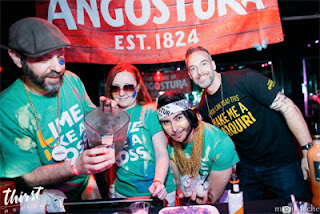
Perhaps one of the biggest bartending honors for me was having Loyal Nine being one of the 12 bars involved in Cocktail Magic, besides the 3 traveling bars, we were one of the 9 bars chosen from Boston. For Boston Thirst this year, I was also selected to head up a Blender Bender team where our sponsor was Angostura. We made good use of their portfolio with including their amaro, rum, and bitters in our drink, and we contributed to a great deal of brainfreeze that night (see photo above). Early in the year, I was a guest bartender for Wink & Nod's Tiki Monday nights bringing four of my recipes from different parts of my drink creating eras to the masses. And I am still the lead cat herder for Mixology Monday which just did its 114th online cocktail party of sorts.

4. Traveled.
I started my year off with being chosen for an USBG-sponsored trip to Mexico to tour the Patron distillery and experience a taste of Guadalajara. It was a bit of a whirlwind trip for I left to the airport after closing the bar on a Sunday night, flew out early Monday morning and returned Wednesday evening. I should say luckily returned since the airline wanted to send me to Houston since there was no plane to send me to Dallas (which would get me to Boston). I opted to wait for a plane to Dallas in hopes of making it home to open the bar on Thursday. Everything came through with about 30 minutes to spare, but I did miss my chance to visit bars in Dallas and Houston! I also went down to New Orleans for my 5th Tales of the Cocktail. I wrote up my best moments from that trip after attending 12 seminars, a bunch of parties, and a handful of bars. See the rest of the shenanigans and talk notes here. Soon, I will be traveling again in about two weeks to Louisville as I was selected to be a steward for the American Craft Spirits Association competition!
5. Got press!
 I got interviewed for the U.S. Bartender Guild site thanks to my column writing and other participation there, and Doug Winship wrote up my role in blogging as a means to show how Tiki has come to a forefront. My interest in low proof cocktails got me press in both WGBH and Boston Magazine. My Hot Buttered Malört got some talk in Chicago, and our menu's Blood of the Kapu Tiki (neo-classic Tiki recipe crafted by Bosko) found me running off to photoshoots for the Improper Bostonian and Boston Magazine. I was included in Server Not Servant's 64 Suggestions for Bartenders advice post, and my thoughts on seasonal drinking were included in Boston Common for summer and Tales of the Cocktail for fall. Finally, my Tainted Love recipe was Del Maguey Mezcal's drink of November.

6. Appeared in books.
My hangover cure made it into Lou Bustamante's Complete Cocktail Manual; sadly, I missed the call to get other recipes in there. My Colleen Bawn Knickebein got printed in Gaz Regan's 101 Cocktails of 2016; I actually submitted that recipe for his call for poussé-cafe recipes, but since I was the only one who responded, he slid my entry towards that book. While I mentioned it last year, I finally got to read the part about my Fireball Fizz in Matt Rowley's Lost Recipes of Prohibition. I believe that my contribution to the Oxford Companion to Cocktail and Spirits should be out in 2017.
7. Visited new bars.
While I enjoyed staying in my comfort zone of familiar haunts and bartenders, there were a lot of new places to check out (some of which had familiar bartenders as well). Here it Boston, I got to welcome to the city Sichuan Garden II's Baldwin & Sons Trading Co. (their second bar in the same building), Bar Mezzana, The Automatic, and Area Four Ink Block; I also made my first visits to Mooo and Short & Main (Gloucester). In New Orleans, I got to try out the pisco bar at the new Catahoula Hotel as well as being shown the legendary dive bar The Dungeon.

8. Created some drinks.
It was a decently prolific year with 33 posts about new drinks and many others that never made the blog. If I were to narrow it down, here are my 5 favorites from this year:
• Dakkar Grotto, a funky and grassy Daiquiri riff.
• Mount Pelée, an agricole and apricot number inspired by Martin Cate and John Gertsen.
• Intercept, my cross between a Slope and a Boulevardier that someone on Instagram declared had a "legacy drink feel."
• Hey Heywood!, inspired by the Hoop La also know in the Savoy Cocktail Book as the Hey Hey!
• Town Crier, my tribute to a neighborhood local. A drink influenced by New Orleans recipes and served at Cocktail Magic this year.
9. I read a lot.
I finished 27 books this year that included books on whiskey, rum, agave, Genever, vermouth, beer, Japanese bartending, cocktail history, distilling history, food flavor history and theory, booze science, bartending advice, Tiki, Prohibition, the Manhattan, and other topics. My reading schedule for next year might be slowed down now that a lot of my free time is being spent writing, but hopefully I will rebound with a vengeance once that project is over with. If I were to narrow the books to a few:
• Robert Simonson's A Proper Drink
• Martin & Rebecca Cate's Smuggler's Cove
• Barbara Stuckey's Taste What You're Missing
• Matt Rowley's Lost Recipes of Prohibition
• Brian Hoefling's Distilled Knowledge

10. Random thoughts.
In June, I hit a milestone of 8 years of blogging (10 years of cocktail writing in July) and I am finishing up the year with about 470 posts for 2017. My Instagram efforts are still going strong with nearly 3000 followers. And there is consideration of a second book to tie together the last 4 1/2 or 5 years since the first book came out. We'll see what 2017 brings!

Wednesday, December 31, 2014

:: fred's top 10 cocktail moments of 2014 ::

In 2010, I was asked what my favorite drink that year was and I decided not only to start a list of my favorite drinks I had out on the town and in at the home bar, but I decided to list the top moments of the previous 12 months.

1. Still making a living at it
The end of this year marks the 19th month of me being at Russell House Tavern with 18 months of that being a full time bartender. I began my run as a barback to get acquainted with the restaurant and the industry and to await an opening on the barstaff. I am thankful for being given this opportunity to make the transition from blogger to bartender. Perhaps my observations last year make better light of it.

2. Created some drinks
Over the last year, three of my creations have graced the cocktail menus. The Endicott Cobbler replaced the Chutes & Ladders and made it onto the St. George Spirits webpage. The Mytoi Gardens made it onto the Tiki section of the brunch cocktail menu, and I compete with this in the Diplomatico Rum competition this fall. Finally, the Ask the Dust Scaffa hit not only the menu but the Del Maguey Mezcal recipe page. There were several others that I created this year that made the blog or just my menu notebook.
3. Got honored in the Improper Bostonian once and twice by Gaz Regan
Back in April, I was one of 12 bartenders to be featured in the Pouring Reign article by MC Slim JB. The photoshoot part was a novel experience, but the interview was fine since it was done via email. I even wrote up my outtakes. Moreover, one of my answers about drinks I don't like caused someone to start a ChowHound thread about me (note: I still don't know the difference between a Baybreeze and a Seabreeze without looking it up). Gaz Regan honored me two ways this year. The first was to interview me and the second was to include my Chutes & Ladders in this year's 101 Best New Cocktails.

4. I read a lot
While putting in the hours improves speed, grace, and people skills, there is still a lot of knowledge that needs to be learned from others. My original goal for self-betterment was a book per month and I exceeded that by 50%.
1. Garrett Oliver's The Brewmaster's Table. Great discussion of styles and food pairing ideas. Bought because I heard John Mayer made everyone at Local 149 read it when he was the bar manager there.
2. Rosie Schaap's Drinking with Men. A great memoir about finding one's place in the drinking community.
3. Eric Asimov's How to Love Wine. Wine is one of my weakest links in the spirits game, so I sought the wisdom of one of the greats.
4. Tom Acitelli's The Audacity of Hops. An easy to read history of the craft beer revolution, and a great example of how history repeats itself with small brewery blunders and successes.
5. Randy Mosher's Tasting Beer. An elegant comparison of different beer styles with great charts and graphics including a malt (original gravity) vs. hops comparison of different beer types.
6. Pete Hamill's A Drinking Life. A memoir about drinking, coming of age, and aging that came to me via Michael Dietsch's 2012 recommendations.
7. William Grimes' Straight Up or On the Rocks: The Story of the American Cocktail. One of the better social and historical overviews on the cocktail.
8. Lauren Clark's Crafty Bastards. A New England-focused history of beer then and now from one of the original Boston cocktail bloggers.
9. Maureen Ogle's Ambitious Brew. A story of the politics, marketing, and history of America as told through beer.
10. Jeffrey Morgenthaler's The Bar Book. A cocktail book that takes on technique and rationale more than providing a medley of delectable tipple recipes.
11. Kevin Liu's Craft Cocktails at Home. A book that takes technique and rationale of cocktails even further... with science! My glass chilling experiments made it in there with a bunch of other nods to this blog as well.
12. Danny Meyer's Setting the Table. A must-read book on hospitality and business for anyone in the restaurant industry (or perhaps any business industry, for that matter).
13. Philip Van Munching's Beer Blast. One of the clan who imported Heineken into the U.S. tells the successes and follies of big beer such as light beer and Zima, respectively.
14. Anistatia Miller's Shaken Not Stirred. One of the two tomes on the Martini that discusses history and modern trends.
15. Michael Dietsch's Shrubs. The book traces shrubs from historical drink to modern cocktail ingredient; I was quite surprised by a long quote of mine taking up all of page 50.
16. Adam Rogers' Proof. The science of booze all relayed through a handful of thoughtful stories.
17. Sean Lewis' We Make Beer. The culture of microbrewers and their fans told via vignettes and visits.
18. Talia Baiocchi's Sherry. One part encyclopedia on the style and the producers and one part history of the drink; glad it gave the nod to modern mixologists for reviving a love of sherry. Replete with classic and recent sherry cocktail recipes, too.
5. Visited new bars
The Boston cocktail bar scene grew and I paid my respects this year to Viale, Fairsted Kitchen, Alden & Harlow, Ames Street Deli, Merrill & Co., and Highball Lounge. I also finally visited Bronwyn, Shojo, and Puritan & Co. for drinks. I am also thankful for all of the older establishments for maintaining their worth for yet another year. Cheers!

6. I competed and I judged
Sure, I have done my share of participating in contests where you submit recipes and await a result. Save for competing in a bitters competition back in 2009 at Tales of the Cocktail, everything has been from my computer chair. This year, my Shadows & Tall Trees got me on stage at the Woodford Bourbon competition over the summer, and my Mytoi Gardens did rather well at the Diplomatico Rum competition this fall. Definitely learned a lot from the successes and mistakes made in each. This year, I also was on the other side of things for the Boston Preservation Society competition at GrandTen.
7. Knickebeins happened
Yes, wacky memorable drinks were made. The above egg yolk-laden Knickebein (For more 4-1-1, see here or here) was one of many things I got away with this year that brought people joy. Some of it was due to people bringing me in gifts that became challenges such as the Reese's cups that became a Pago-Pago riff on Easter or the New Orleans Oreo Fizz another night. Our bar's brief foray into Fireball brought about the Fireball Fizz.

8. Got more involved in beer
Besides attending drinkfests like ACBF and DrinkCraftBeer, I also volunteered at a NERAX event in support of cask beer and volunteered at the opening for Somerville's Aeronaut brewery. I also helped out in a blind taste test of 15 barley wines for a Boston.com article. True, not a cocktail, but beer can be sweet, sour, and bitter all rolled into one just like a cocktail.

9. Got written up, quoted, or acknowledged in a variety of ways
My antique-mart hunting led to a vintage bottle of 19th century Boston Punch that led down the road to BullyBoy bringing the concept of Hub Punch back to life. Michael Dietsch's Shrubs book (see list above) quoted me on shrubs (a full page quote!) as I expanded on my notes about shrubs post. Was part of the OnTheBar article on Your Favorite Bartenders' Favorite Bartenders" with my outtakes here. Also, a fraction of my glassware collection was featured on SeriousEats.
10. I survived Boston's Thirst event
I wished that I had traveled to New Orleans, Portland, or the Bourbon Trail for some of the more national cocktail and spirits weeks, but luckily, a great event was hosted right here, Boston Thirst. Talks on hospitality, history of rum, and the rise of aperitif culture were all great, as was the opening TheThing which I described in one article for OnTheBar as "high-class elegance meets low-brow cocktail shenanigans."